
A Practical Guide to Using a Bridging Loan Calculator
A Practical Guide to Using a Bridging Loan Calculator
A bridging loan calculator is your first, most critical sanity check, designed to show you the real cost of short-term property finance before you get swept up in a deal. It's the tool that forecasts interest, itemises fees, and provides a clear total repayment figure, giving you the clarity needed before approaching a lender. For property investors who need to analyse deals on the fly, this isn't just a nice-to-have; it's essential for modelling opportunities instantly. To get started with a powerful analysis tool on your phone, download the DealSheet AI app on iOS.
For property investors who need to analyse deals on the fly, this isn't just a nice-to-have. It's how you model opportunities instantly and make decisions with confidence.
Why a Bridging Loan Calculator is Essential for UK Investors

A bridging loan is a powerful bit of kit, designed to "bridge" a gap between buying a property and securing long-term funding or a sale. Speed is everything. Whether you're breaking a property chain, snapping up a deal at auction, or funding a quick refurb, you have to move fast.
In these time-sensitive situations, a reliable bridging loan calculator is your best friend. It lets you make informed decisions in minutes, not days. Without running these initial numbers, you're flying blind and risk completely misjudging the true cost of borrowing. The figures it spits out empower you to compare lenders, stress-test different scenarios, and make sure the deal's profitability isn't swallowed up by hidden finance costs.
Keeping Pace with a Surging Market
The demand for this kind of finance has exploded. The UK bridging loan market saw completions hit an incredible £2.30 billion in a single quarter, pushing the annual total to a massive £7.34 billion.
This isn't a niche product anymore; bridging finance is a mainstream solution for serious property investors. This growth means more competition between lenders and a wider variety of products, making a solid bridging loan calculator even more critical for navigating your options and finding the right fit.
It's About More Than Just the Interest Rate
Here's a classic mistake: focusing only on the headline interest rate. It's tempting, but it's a rookie error. A good calculator forces you to look at the full picture—the entire spectrum of costs that come with a bridging deal.
These often include:
- Arrangement Fees: Expect to see this at 1-2% of the gross loan amount.
- Valuation Fees: The cost for the lender's independent property survey.
- Legal Fees: You'll have costs for your solicitor and the lender's.
- Exit Fees: A charge some lenders slap on when the loan is repaid.
Forgetting even one of these can throw your project's numbers way off course. And don't forget to factor in other buying costs like stamp duty. To make sure you've got all your bases covered, it's worth checking out our guide on how a Stamp Duty Land Tax calculator works.
Getting to Grips with the Calculator Inputs
Any bridging loan calculator is only as good as the numbers you put into it. Rubbish in, rubbish out. If you want to move from a vague guess to a genuinely useful forecast, you need to understand how each input field actually impacts your deal. This isn't just about filling in boxes; it's about seeing how each variable shifts the total cost and, ultimately, the profitability of your project.
Nailing these inputs is the first real step towards underwriting a deal properly. Let's break down what you'll need.
Gross Loan Amount and LTV
First up is the Gross Loan Amount – that's the total sum you want to borrow, and critically, it often includes any fees the lender rolls into the loan itself. Tied directly to this is the Loan-to-Value (LTV), which is probably the single most important metric for any lender. It simply shows the loan amount as a percentage of the property's market value.
A lower LTV means less risk for the lender, and they like that. A lot. For instance, borrowing £70,000 against a £100,000 property gives you a 70% LTV. Lenders will almost always reward this lower risk with better interest rates. On the flip side, pushing for a higher LTV, say 75%, might be possible, but you can bet it will come with a higher interest rate, bumping up your overall costs.
The relationship is pretty straightforward, as this diagram shows.
As the loan shrinks relative to the property's value, so does the lender's risk. That's your key to unlocking better terms.
Interest Rate and Loan Term
The monthly Interest Rate is a huge one. While online calculators often pre-fill an average rate (somewhere around 0.8% to 1.2% a month is typical right now), you have to adjust this for your own deal. Your credit history, the type of property, and the LTV will all nudge that rate up or down. Always be realistic, even a little conservative, when you're modelling.
Just as important is the Loan Term, which you'll input in months. Getting this wrong is a classic and costly mistake. If your six-month refurb hits a snag with planning or bad weather and drags on for eight months, you could be staring down some pretty hefty extension fees.
Expert Tip: Always, always add a buffer to your estimated loan term. If you think the project will take six months, model the costs for seven or even eight. It gives you a financial cushion for the unexpected and stops a profitable deal from being killed by last-minute penalties.
The Fees You Can't Ignore
Finally, any decent bridging loan calculator will ask you about the various fees. These aren't optional extras; they are hard costs that have to be factored in if you want an accurate picture of the total cost.
- Arrangement Fee: This is the lender's fee for setting up the loan, usually 1-2% of the gross loan amount.
- Legal Fees: You'll be on the hook for your own solicitor's costs and the lender's. Don't forget that.
- Valuation Fee: This pays for the independent surveyor who tells the lender what the property is actually worth.
- Exit Fee: Not all lenders have one, but if they do, it's typically around 1% of the loan amount, paid when you redeem the loan.
Forgetting these costs is one of the most common blunders I see. They can easily add thousands of pounds to your bottom line, so make sure they're in every single calculation you run.
How Lenders Really Calculate Your Interest
The engine room of any bridging loan is the interest calculation, but how lenders actually put this together is often a bit of a black box for borrowers. It's not just one simple rate. Lenders typically offer three distinct ways to structure the interest, and knowing the difference is critical for forecasting your real costs and managing cash flow.
The main options are rolled-up interest, retained interest, and monthly serviced interest. Each one completely changes your total repayment figure and how you handle the loan during its term. A decent bridging loan calculator absolutely has to let you model all three scenarios.
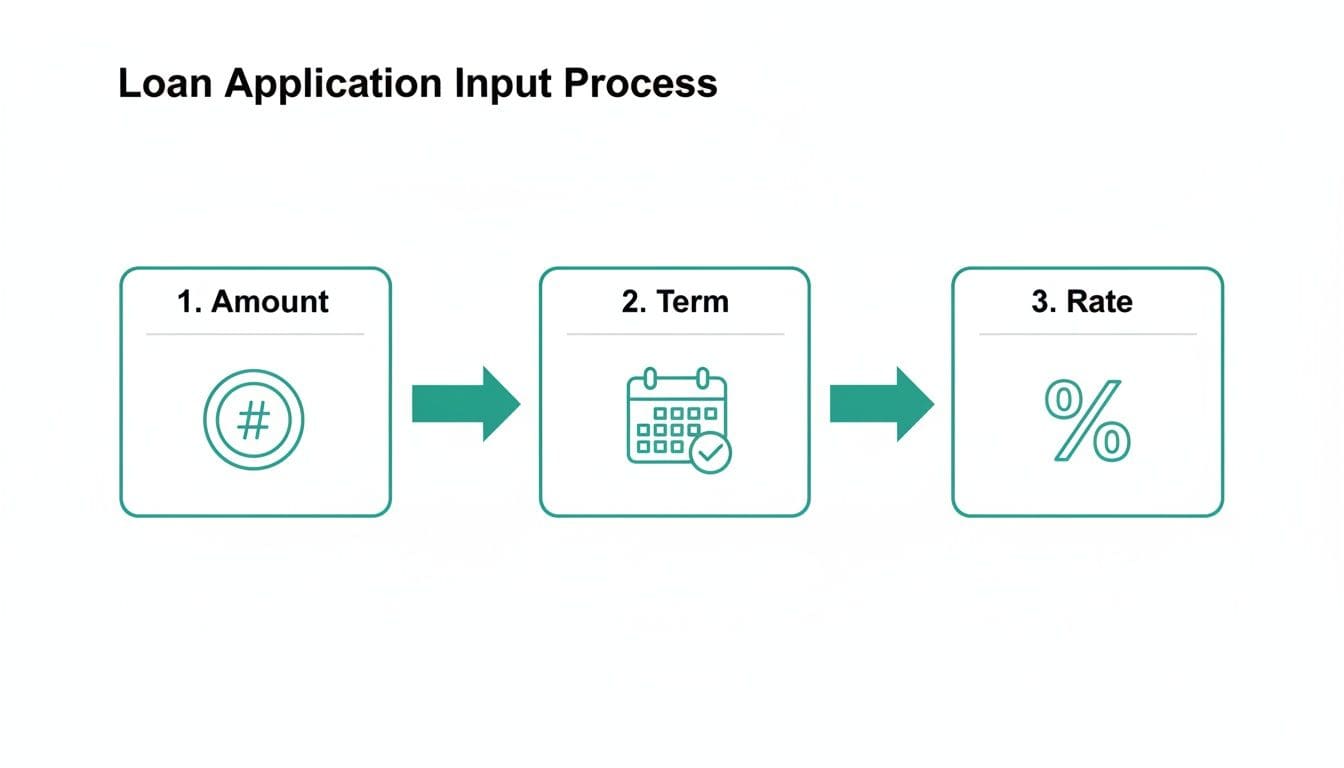
At its core, the calculation always comes down to the same three building blocks.

The amount you need, the term you need it for, and the agreed rate are the fundamentals. How those are combined is what matters.
Rolled-Up vs Retained Interest
If you're tackling a project with zero rental income during the loan term—think heavy refurbs or a classic 'fix and flip'—then rolled-up and retained interest are your go-to options. Both mean you make no monthly interest payments.
With rolled-up interest, the interest simply accrues each month and gets added to the loan balance. When you exit the loan, you pay back the original capital plus all the accumulated interest in one final payment.
Retained interest works a bit differently. Here, the lender calculates the total interest for the entire loan term right at the start and adds it to the loan you draw down. In effect, you borrow the interest on day one.
Key Takeaway: Both rolled-up and retained interest are fantastic for preserving cash flow during a project because you have no monthly outgoings. Just be aware that the total cost can be higher, especially with a rolled-up structure where the interest compounds.
Monthly Serviced Interest
Your third option, monthly serviced interest, is much closer to a traditional mortgage. You simply pay the interest charge each month as it falls due for the entire loan term. This approach almost always results in a lower total cost of borrowing because you aren't paying interest on the interest itself.
- Best for: Investors with reliable cash flow, maybe from a wider property portfolio, who can easily cover the monthly payments.
- Main Benefit: It's usually the cheapest way to structure a bridging loan when you look at the total interest paid.
- Consideration: You'll have to prove to the lender that you have a solid, verifiable source of income to service the monthly payments.
The right choice here depends entirely on your project's strategy and your own financial position. For a deeper look at how these financial moving parts fit together on more complicated projects, our guide on structuring complex property deals is a great resource.
Ultimately, being able to accurately model these different interest types in a bridging loan calculator is the only way to compare lenders' offers like-for-like and make sure your deal stays profitable from start to finish.
Modelling Real-World UK Property Scenarios
This is where the rubber meets the road. Putting a bridging loan calculator to work on actual deals is where you see its true power. Let's move past the theory and model three common UK property scenarios to see how the numbers stack up in the real world.
These examples show you exactly how a calculator helps you analyse deals with speed and accuracy.
Manchester Fix and Flip Project
Picture this: you've found a tired, unloved terraced house in Manchester. It's valued at £150,000 but needs a full cosmetic refurb, which you've scoped at £25,000 and reckon will take about six months. Once the work's done, you're confident of an After Repair Value (ARV) of £220,000.
You need to borrow for the purchase and the works, a total of £175,000. The catch is, lenders will almost always base their loan on the day-one value. At a typical 75% LTV of £150,000, you can borrow £112,500. That means you'll need to find the remaining £62,500 yourself.
Let's plug that into the calculator:
- Gross Loan Amount: £112,500
- Loan Term: 7 months (always add a buffer!)
- Monthly Interest Rate: 0.95%
- Arrangement Fee: 2% (£2,250)
The calculator instantly shows a total interest cost of around £7,481. Add the fees, and your total cost of finance comes to roughly £9,731. This single number is absolutely critical for working out your final profit margin.
Surrey Property Chain Break
Next up, a classic 'chain break' scenario in Surrey. You've agreed to buy your dream home for £600,000, but the sale of your current £450,000 property has been frustratingly delayed. To avoid losing the purchase, you need a bridging loan.
You need to borrow the full £600,000. Lenders will often offer up to 75% LTV secured across both properties. The calculator helps you see the cost of this short-term finance in seconds. For a three-month term at 0.85% monthly interest, the interest alone would be a hefty £15,300, plus fees.
This instant cost assessment is vital. It allows you to decide if the cost of breaking the chain is worth securing your dream home, turning an emotional decision into a calculated one.
Birmingham Auction Purchase
Finally, let's look at an auction purchase in Birmingham. A property is listed with a guide price of £100,000. You get caught up in the moment and win the bid at £115,000. Now the clock is ticking—you have just 28 days to complete, and you need finance, fast.
A bridging loan calculator is your best friend here. You'll likely need a 75% LTV loan (£86,250) for a short term, say four months, giving you enough breathing room to secure a longer-term buy-to-let mortgage. The calculator spits out the finance cost, helping you see on the spot if your winning bid still leaves enough meat on the bone.
If you're running this strategy, our complete guide to analysing UK buy-to-let deals is worth a read.
To bring these scenarios together, let's compare them side-by-side. Seeing the numbers in a table really highlights how different the costs and considerations can be for each use case.
Comparative Analysis of Bridging Scenarios
| Scenario | Loan Amount | Estimated Term | Total Interest Cost | Key Consideration |
|---|---|---|---|---|
| Manchester Fix & Flip | £112,500 | 7 Months | ~£7,481 | Profit margin erosion from finance costs and potential delays. |
| Surrey Chain Break | £600,000 | 3 Months | ~£15,300 | High absolute cost for a short period; balancing emotional vs financial needs. |
| Birmingham Auction | £86,250 | 4 Months | ~£3,500 | Speed is everything. Finance cost must fit within the auction deal's margins. |
This comparison shows that it's not just about the rate; the loan amount and term completely change the financial impact.
These scenarios reflect a major shift in the market. Investment-led borrowing is on the rise, surging from just 13% to 23% of all bridging loans in a single quarter, making it the main driver for this type of finance. With over 75% of borrowers planning a property sale as their exit, mastering these calculations has never been more important for investors.
Avoiding Common and Costly Calculation Mistakes
A bridging loan calculator gives you a powerful sense of clarity, but its output is only as good as the numbers you put in. Get them wrong, and you're flying blind. An inaccurate calculation built on wishful thinking gives you a dangerous level of false confidence, leading to some very expensive surprises down the line.
The most common error I see? Underestimating the loan term. Property projects are notorious for delays. Planning snags, contractor no-shows, or slow solicitors can easily tack weeks or months onto your timeline. Relying on a best-case scenario is a recipe for disaster, because loan extensions come with steep fees that will eat into your profit margin fast.
Don't Forget the "Other" Fees
Another major oversight is forgetting to account for every single associated fee. It's easy to focus on the big two—the arrangement fee and the monthly interest—but a host of other costs are waiting in the wings.
These are the ones people frequently miss:
- Lender's Legal Fees: Yes, you have to pay for their solicitor. This can be a substantial cost.
- Your Own Legal Fees: The costs for your own conveyancing solicitor.
- Valuation Fee: The lender needs an independent valuation, and you're the one who pays for it.
- Exit Fee: Some bridging products include a fee of 1-2% of the loan amount, which you pay when you redeem the loan.
These can easily add thousands of pounds to the true cost of borrowing. A thorough analysis is absolutely crucial, especially for more complex strategies. For a closer look at how these numbers fit together, you might be interested in our guide on how to evaluate HMOs, Serviced Accommodation, and BRRRR deals.
Use Realistic Interest Rates
Finally, stop plugging in unrealistic interest rates. The headline rate you see advertised is almost never the rate you'll actually get.
Your final rate is determined by your credit profile, the property itself, and most importantly, your Loan-to-Value (LTV) ratio. Using a generic rate from a calculator's default settings can give you a dangerously low cost estimate.
Right now, borrower confidence in the bridging market is high, partly thanks to competitive rates which recently fell to a monthly average of 0.81%. That trend was driven by base rate stability and fierce lender competition, but also by borrowers putting in more of their own cash to secure lower LTVs. This just goes to show how critical it is to feed your bridging loan calculator with an accurate LTV and a realistic rate. You can learn more about recent UK bridging market trends to get a better feel for the market.
Actionable Tip: Always add a buffer of one to two months to your estimated loan term to cover unforeseen delays. Before you finalise anything, ask your broker for a detailed breakdown of all fees. Plug those real-world figures into your calculation for a forecast you can actually rely on.
Your Questions Answered
When you're running the numbers on a bridging deal, a few questions always crop up. A good calculator gives you clarity, but the world of bridging finance has its own quirks. Let's tackle the most common queries I hear, so you can approach your next deal with a bit more confidence.
How Accurate Is an Online Bridging Loan Calculator?
Think of an online bridging loan calculator as an essential first-pass reality check. Its accuracy is only as good as the numbers you feed it.
If you plug in realistic figures for the property value, the loan you need, and an interest rate that's in the right ballpark for your circumstances, the output will be a very reliable guide. But it is always just that—a guide. The final, binding offer from a lender will always depend on their formal valuation, the full underwriting process, and the specific terms of their product.
Key Takeaway: Use the calculator as your go-to tool for assessing a deal's viability on day one. But always, always follow up with a qualified broker for a formal illustration before you commit to anything.
Can I Use a Bridging Loan Calculator for a Regulated Loan?
Absolutely. You can use a bridging loan calculator for both regulated and unregulated loans, as the core mechanics for calculating interest and fees are identical. A regulated loan is simply one secured against a property that you or a close family member plan to live in.
The main difference is that regulated bridging finance falls under stricter Financial Conduct Authority (FCA) rules designed to protect consumers. While your calculator inputs won't change, just be aware that lenders might have slightly different rates or fees for their regulated vs. unregulated products.
What's the Most Commonly Forgotten Cost?
Hands down, the most overlooked costs are the third-party fees. I'm talking specifically about legal fees—for both you and the lender—and the valuation fee. So many basic calculators only focus on the lender's arrangement fee and the monthly interest.
In reality, these external costs can easily tack on several thousand pounds to your total bill, taking a real bite out of your net profit. A good calculator will have fields for these, but if yours doesn't, you absolutely must add these estimates manually to see the true cost of the deal.
Does the Calculator Account for an Exit Fee?
Most standard bridging calculators don't automatically include an exit fee, mainly because not all lenders charge one. It's a critical cost to watch out for when you're comparing loans, typically costing 1-2% of the gross loan amount, paid when you redeem the loan.
Don't get caught out. A loan with no exit fee but a slightly higher interest rate might actually be cheaper overall than one with a rock-bottom rate and a painful exit fee. If the calculator you're using has a specific field for 'exit fee', make sure you use it. If not, you'll have to work it out separately and add it to your total cost forecast.

Stop juggling fragile spreadsheets and start making faster, smarter investment decisions. The DealSheet AI app lets you analyse any UK property deal in seconds, right from your iPhone. Get instant clarity on yields, ROI, and cash flow with our robust, UK-specific financial models. Download the app and start your free trial today.