
How to Find Property Investors: A UK Guide for 2026
How to Find Property Investors: A UK Guide for 2026
Finding the right financial partners is the lifeblood of any successful UK property venture. But how do you find property investors who are ready to act? The answer lies in a multi-channel approach that combines modern data analysis with timeless networking, all underpinned by a professional, compelling deal presentation. This guide outlines the exact strategies you need to connect with capital partners in 2026. To get an instant edge, tools like the DealSheet AI app are invaluable for analysing deals accurately and creating the investor-ready materials that build immediate trust.
Your Blueprint for Finding UK Property Investors

Securing funding for your UK property deals in 2026 isn't about luck. It's about a systematic, professional game plan. Before you even think about outreach, your first job is to create a detailed blueprint.
This goes way beyond just having a good deal. It means knowing exactly who you're looking for and what they need to see to feel confident in your ability to deliver.
Defining Investor Profiles
The process kicks off by defining your ideal investor. Are you looking for a high-net-worth individual who prefers a hands-off, passive return? Or do you need a seasoned portfolio landlord to partner with on a joint venture? Each type requires a completely different pitch, level of detail, and approach.
Creating a clear profile helps you focus your search. Without it, you'll just waste time pitching the wrong deals to the wrong people. Think about these common investor archetypes you'll find in the UK market:
- The Passive Investor: Often a busy professional or retiree hunting for better returns than a savings account. They want simple, clear numbers and minimal fuss.
- The Joint Venture Partner: An experienced property person who brings capital, expertise, or both to the table. They will scrutinise every last detail of your plan and challenge your assumptions.
- The Angel Investor: A wealthy individual who might invest in property as part of a diversified portfolio. They are almost always found through personal networks and require a high degree of trust and credibility.
Building a relationship is paramount. Investors are backing you as much as they are backing the property itself. A well-prepared deal pack demonstrates your competence and respect for their time and capital.
Once you know who you're targeting, you can tailor your deal presentation to match. This is where a professional deal pack becomes your most powerful tool. It has to be concise, accurate, and compelling, showing off the opportunity in the best possible light.
As you put your materials together, it's crucial to understand what information matters most and what you can do to stand out. We've gone deep on this in our guide on what property sourcers need to deliver. This playbook will show you how to combine data-driven tactics with powerful networking to build a robust list of potential UK investors.
Preparing Your Investor-Ready Deal Pack
Before you even think about outreach, you need something credible to show. Your "product" is the deal itself, and a professional deal pack is how you sell it. Nothing screams "amateur" louder than approaching investors without a thoroughly analysed and well-presented opportunity. It's the quickest way to burn your reputation before you've even started.
A powerful deal pack doesn't just present a property; it commands attention and separates you from the crowd. It typically has two parts: a sharp one-page summary and a detailed financial model. Together, they give an investor a complete, credible picture of the opportunity.
The One-Page Deal Summary
Think of the one-pager as your hook. It's a clean, visual snapshot designed to grab an investor's interest in under 60 seconds. This isn't the place for a wall of text or dense spreadsheets; it's about presenting the headline figures with clarity and confidence.
Your summary must nail these basics:
- Property Details: Good quality photos, the address, and a brief description of the property and, crucially, its location.
- The Numbers: The purchase price, a realistic refurbishment budget, and the proposed financing structure.
- Key Metrics: The all-important return figures like Gross Yield, Net Yield, and Return on Investment (ROI).
Make sure it's branded, easy to scan, and looks good on a mobile phone. Its only job is to get an investor interested enough to ask for the details.
The Detailed Financial Model
While the summary grabs attention, the financial model builds trust. This is where you prove you've done your homework. A flimsy spreadsheet with a few basic sums just won't cut it with experienced UK investors; they'll see right through it.
Your model has to be robust and account for all the UK-specific costs that can make or break a deal. Forgetting to model Stamp Duty Land Tax (SDLT) correctly or ignoring the impact of Section 24 mortgage interest relief restrictions is a massive red flag. Your operating costs—from voids and maintenance to management fees—need to be grounded in reality, not just optimistic guesses.
A credible financial model proves you understand the true costs of property investment in the UK. It shows you respect the investor's capital by accounting for risks and presenting a realistic forecast, not a sales pitch.
Building these models from scratch for different strategies like Buy-to-Let (BTL) or Houses in Multiple Occupation (HMO) is incredibly time-consuming and riddled with potential for error. This is where modern tools give you a serious edge. The DealSheet AI app, for example, automates this whole process. You can upload an agent's PDF, and it generates a comprehensive, strategy-specific financial model in seconds. This means your numbers are always consistent, credible, and ready for deep scrutiny.
For a deeper dive into the different ways to fund a project, you can learn more in our article about how to finance property development.
Using Data to Uncover Active Investors
The best way to find property investors is to stop guessing and start following the data. Digital prospecting lets you zero in on the exact people and companies actively buying in the UK market right now, making every bit of outreach targeted and relevant.
Forget casting a wide, hopeful net. This is about building a precise list of prospects whose buying habits perfectly match the deals you're sourcing. It's simply about working smarter, not harder, to connect with the right people.
Tapping into Public Records
Your first port of call should be HM Land Registry. It's an absolute goldmine of information, although you'll need a bit of patience to sift through it all. By searching specific postcodes, you can spot individuals and, more importantly, limited companies that have bought multiple properties in your target area over the last 12-24 months.
This screenshot shows the entry point for searching UK property information—the crucial first step in your data-driven investor hunt. Any repeated names or company directors popping up on multiple title deeds are your prime targets. These are the active, serious investors you want to talk to. Cross-reference their company names with Companies House to find the director details for your outreach list.
Following the Yields to Find Investors
Serious investors chase returns, and right now, the data is telling a very clear story. Savvy money is flowing into northern cities in pursuit of higher rental yields.
According to 2025 ONS data, northern markets are boasting yields of 6-8%, a stark contrast to London's sub-3% returns, which is driving significant capital northward. With average UK rents climbing 4.4% to £1,366, this trend is set to continue.
You can use the free tools on portals like Zoopla or Rightmove to analyse gross yields by postcode. Postcodes in cities like Liverpool (averaging 7.2%) and Sunderland (8.1%) are magnets for BTL and HMO investors. When you focus your deal sourcing and investor outreach on these high-performing areas, you're aligning yourself with the market's momentum. You can find out more by exploring the latest insights into UK private rent and house prices from the ONS.
A data-driven approach means every outreach effort is backed by a clear rationale, a critical part of creating a single source of truth for your investment strategy.
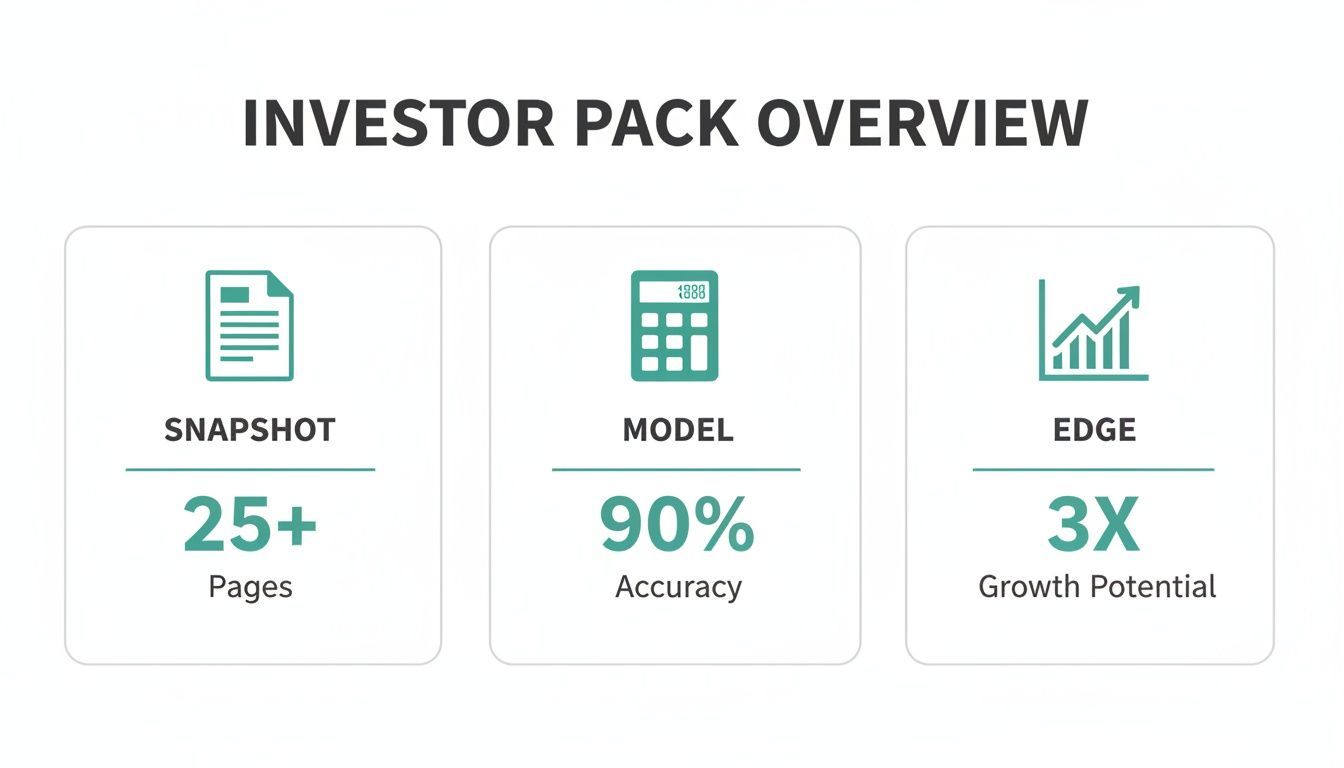
This visual represents the core of your investor pack: a concise snapshot, a robust financial model, and the competitive edge gained from professional analysis. Combining these elements shows you've done the work, making it far more likely an investor will take you seriously. This systematic approach is how to find property investors who are ready to act on good deals.
Mastering In-Person Networking Events

While data tells you who to target, nothing builds trust faster than a face-to-face conversation. Honestly, mastering offline networking is a crucial skill when you're learning how to find property investors. It's how you turn cold data points into warm relationships. Handshakes in these rooms are what become partnerships.
The real key is to move beyond just collecting business cards and start making genuine connections. This means showing up at the right events with a clear strategy, knowing who to talk to, and being ready to showcase your value at a moment's notice.
Attending National Property Events
Big national events like the Property Investor & Homebuyer Show are fantastic for getting a feel for the market and meeting investors from all over the UK. But let's be real, their sheer size can be overwhelming if you go in blind. You need a plan.
Before you even step through the door, study the exhibitor list and speaker schedule. Pinpoint the specialist lenders, solicitors, and high-net-worth accountancy firms. The people gathered around these stands are almost always serious, active investors. Your goal isn't to pitch everyone; it's to have a few meaningful conversations.
Finding Investors at Local Property Auctions
Property auctions are one of the most potent—and surprisingly underused—networking spots in the country. Forget just going to bid; you should be there to meet the people actively deploying capital right now. The room is packed with flippers, developers, and BRRRR (Buy, Refurbish, Refinance, Rent) investors.
My advice? Arrive early and stay late. Watch who is bidding confidently and who is chatting with the auctioneers. These are the active players. A simple opening like, "That was an interesting lot, looks like a great project," can kickstart a valuable conversation. They're there to find deals, and if you can prove you're a source of well-analysed opportunities, you become instantly valuable. It also helps to align your auction attendance with high-yield areas by exploring some of the best cities for investment properties.
Auctions offer raw, unfiltered access to active investors. Unlike a conference, everyone in that room is a qualified lead with capital ready to deploy. Your ability to quickly analyse a deal on the spot gives you a massive advantage.
Independent Investor Network Meetings
For building deeper, long-term relationships, you can't beat local and independent investor networks. Organisations like the Property Investors Network (PIN) host monthly meetings across the country, attracting a solid mix of new and highly experienced landlords.
These smaller, more intimate settings are perfect for establishing credibility over time. The trick is to give value before you ask for anything. Join in on discussions, share insights on the local market, and just become a familiar, trusted face. When you finally do have a great deal, people will already know who you are and will actually want to hear about it.
Building Your Online Presence and Outreach Strategy
In today's market, your online presence isn't just a business card; it's your entire shop window. When you're figuring out how to find property investors in the UK, a professional footprint on a platform like LinkedIn is non-negotiable. It's where credibility is built long before you ever send a connection request.
This isn't just about "being online." It's about a deliberate strategy to pull capital towards you. The goal is to position yourself as a sharp, value-driven deal sourcer, not just another person with their hand out. You achieve this by building genuine relationships and providing value first, turning a cold outreach into a warm conversation.
Cultivating a Professional LinkedIn Profile
LinkedIn is the single most important platform for professional networking in the UK property scene. Start by treating your profile like a landing page for investors. Get a professional headshot, write a sharp headline stating you source specific types of property deals in clear UK locations, and use your summary to showcase your track record and investment focus.
Once the basics are sorted, it's about active contribution, not just passive connections.
- Share Market Insights: Post short, sharp analysis of local market trends in your target cities. A quick update on rental demand in Manchester or regeneration news in Liverpool goes a long way.
- Engage in Discussions: Don't just "like" posts from established investors and developers. Add a thoughtful comment that moves the conversation forward.
- Post Case Studies: Your one-page deal summaries are high-value content. With sensitive details removed, they showcase your ability to find and analyse great opportunities far better than any CV could.
Crafting Outreach Messages That Actually Get a Reply
When you do make a move, your messaging needs to be sharp, personal, and respectful of an investor's time. Generic, spammy templates are the fastest way to get ignored.
Here's a cold outreach message that works:
"Hi [Investor Name], I saw you're active in the Liverpool BTL market and noticed your comments on the recent Northern Powerhouse discussion. I specialise in sourcing high-yield HMO opportunities in the L6 postcode and just analysed a deal with a projected 12% ROI. Would you be open to seeing a one-page summary?"
This works because it's specific, it shows you've done your homework, and it offers immediate, tangible value. The strategy of using data to find your targets is crucial. In Q3 2025 alone, UK commercial real estate investment hit £9.8 billion, with investors flocking to sectors with strong rental growth potential. You can read more about UK real estate investment figures on CBRE.
Your ability to present clean, well-organised deals quickly is what separates you from the noise. Being able to turn rough notes into a professional pitch almost instantly is a huge advantage. If you want to see how this works in practice, you can learn more about how to use AI to clean up messy property notes.
From Lead to Partner: Vetting and Onboarding Investors
Right, so you've got a few nibbles and promising conversations going. That's a great start, but it's only half the battle. The real work begins now: turning those warm leads into actual, signed-up capital partners.
This is where a professional screening and onboarding process comes in. It's not about being difficult; it's about protecting your time, your reputation, and the integrity of the deals you bring to the table. You need to politely but firmly figure out if someone is a serious player or just a tyre-kicker.
Key Vetting Questions to Ask Upfront
Before you even think about sending over your full, beautifully crafted deal pack, you need a quick qualification framework. This isn't an interrogation, just a professional chat to make sure you're both on the same page.
Here are the core areas I always cover:
- Investment Criteria: "Just so I'm only sending you relevant opportunities, what specific property strategies and locations in the UK are you focused on for 2026?" This shows you respect their time and filters out anyone whose goals don't match your deals.
- Funding Capacity: "What's your typical deal size, and are you able to provide proof of funds before we get to the legal stage?" It's a direct question, but a necessary one. Serious investors expect it and will have no problem with it.
- Decision-Making Process: "Are you the sole decision-maker, or are there other partners involved we should be aware of?" There's nothing worse than getting a "yes" only to find out they need to run it by three other people you've never spoken to.
- Past Experience: "Could you share a brief example of a recent property deal you've funded in the UK?" This helps you gauge their experience level and see if they've actually done this before.
These questions are your first line of defence. They help you weed out the dreamers and focus your energy on the investors who are geared up and ready to move.
A systematic screening process builds mutual respect. It tells the investor you're a serious professional who values their time, and it confirms to you that they are a legitimate partner with the capacity to transact.
Once an investor has passed your initial checks and is genuinely keen on a deal, the onboarding can begin. This is all about getting the legal framework in place. Don't cut corners here.
Always get a solicitor to draft clear agreements, whether it's a simple finder's fee agreement or a more complex Joint Venture (JV) contract. This protects everyone involved and lays the groundwork for a solid, long-term relationship built on trust and clarity.
Ultimately, finding and keeping good investors comes down to having a professional, repeatable system. When you combine smart research, targeted networking, and an impeccable presentation—made much faster with tools like DealSheet AI—you build a reliable network of capital partners who will be ready to fund your next UK property deal.
A Few Final Questions
Even with a clear playbook, finding property investors throws up a few common questions. Here are the ones I hear most often from property professionals in the UK.
How Much Detail Should I Share Upfront?
Less is more, at first. Lead with a sharp, professional one-page summary of the deal. It needs to hit the headline figures: purchase price, total cash needed, and the key returns like yield and ROI. Your only job at this stage is to spark enough interest to get a conversation started and show you're not a time-waster.
Once they've replied with genuine interest and you've had a quick chat, that's your cue to send over the full, detailed financial model.
What's the Single Biggest Mistake People Make When Looking for Investors?
Easy. Being unprepared. It's staggering how many people approach potential investors with a half-formed idea and no credible numbers to back it up. It's a fatal error that can burn your reputation for good.
Before you even think about picking up the phone or writing an email, you must have a professionally analysed deal. That means accurate financial projections, a clear breakdown of costs, and a sensible assessment of the risks. Walking into that conversation without an investor-ready pack makes you look like an amateur and wastes everyone's time.
A well-prepared deal pack isn't just about the numbers. It's a signal. It tells an investor you're a serious professional who respects their capital and their time. It's how you start building trust before a penny is on the table.
Is It Better to Have One Big Investor or Lots of Smaller Ones?
Honestly, this comes down to your business model and the kind of projects you're doing. For larger, more complex developments, having a single big-ticket investor or a dedicated Joint Venture partner can make the whole funding process much simpler.
But don't underestimate the power of building a database of several smaller, reliable investors. It gives you incredible flexibility and means you aren't reliant on one person's whims or availability. A smart strategy is to build relationships across the spectrum. That way, when the right opportunity lands on your desk, you can match the deal to the right capital partner, giving you multiple ways to get it funded.
DealSheet AI gives you the tools to create professional, investor-ready deal packs in seconds, ensuring you're always prepared to impress. Start your free trial and get the professional edge you need.