
What Is Rental Yield? A 2026 Guide for UK Property Investors
What Is Rental Yield? A 2026 Guide for UK Property Investors
So, what is rental yield? In simple terms, rental yield is the annual return you get from a property's rent, expressed as a percentage of the property's total cost. Think of it as the interest rate on your property investment; it's the single most important metric for understanding how hard your asset is working for you, even before considering house price growth. Getting your head around this figure is absolutely essential for making smart moves in the UK property market in 2026. Thankfully, modern tools like the DealSheet AI app can now perform these crucial calculations for you in seconds, giving you actionable insights instantly.
Understanding Rental Yield: A Guide for UK Investors

For any investor in the UK, whether you're just starting out or have a portfolio full of properties, the question "what is rental yield?" is the real starting line. It's the primary way to measure how much income a buy-to-let property can actually generate. It cuts through the emotional noise of a purchase and forces you to focus purely on financial performance.
In essence, rental yield is the great equaliser. It lets you compare completely different opportunities on a like-for-like basis. A £150,000 flat in Manchester and a £300,000 house in Bristol might seem worlds apart, but their yields give you a standard yardstick to judge which one is the better income-producing machine.
This relentless focus on income is precisely what makes yield such a powerful tool in your arsenal. While capital appreciation—the property's value going up over time—is a huge part of building wealth, it's never a guarantee. Rental income, on the other hand, provides that consistent cash flow month after month, which is vital for covering the mortgage and all the other running costs.
Why Yield Is a Crucial Metric in 2026
In the 2026 UK economic climate, understanding your yield has never been more critical. With interest rates fluctuating and lenders getting stricter, knowing a property can generate enough income to be profitable is non-negotiable. Lenders themselves will look closely at a property's potential rental income to decide how much they're prepared to lend you in the first place.
A strong rental yield is a sign that you're onto a good thing. It tells you a few key things about an investment:
- Healthy Cash Flow: It suggests the property can comfortably cover its expenses and still leave a profit in your pocket.
- Strong Rental Demand: Properties in areas where tenants are queuing up will naturally command higher rents, which directly boosts the yield.
- Value for Money: A high yield often means you've bought the property at a good price relative to the rent you can realistically achieve.
From a yield perspective, the UK market is particularly compelling. When you look across Europe, UK gross rental yields are notably strong. Data shows that the best-performing areas in the UK can produce gross yields as high as 8.65%, putting the country well ahead of markets like Germany or France. This makes the UK a prime location for buy-to-let investors who are focused on generating a solid income.
If you're wondering what makes a return "strong," be sure to check out our deep dive on what is a good rental yield.
The Critical Difference Between Gross and Net Yield
When you first dive into property investment, you'll see the term 'rental yield' thrown around everywhere. But here's a crucial secret: not all yields are created equal. Getting this wrong can lead to some seriously expensive mistakes down the line.
The two big players are Gross Yield and Net Yield. You have to know the difference.
Think of gross yield as the flashy headline number. It's the quick, back-of-the-envelope calculation that estate agents love to advertise because it looks impressive. It only compares the annual rent to the property price, completely ignoring the mountain of costs that come with being a landlord. While it's a handy starting point for a quick comparison, relying on it alone is like planning a road trip just by looking at the destination, without factoring in the cost of fuel, tolls, or inevitable wear and tear.
Understanding Gross Yield: The Starting Point
The formula for gross yield is dead simple. It gives you an instant, high-level snapshot of a property's potential before any of the real-world costs get in the way.
Gross Yield (%) = (Annual Rental Income / Property Value) x 100
Let's put this into practice. Imagine you've found a two-bedroom flat for sale in a northern UK city for £200,000. The letting agent confidently suggests it could rent out for £1,167 a month.
- Annual Rent: £1,167 x 12 = £14,004
- Gross Yield Calculation: (£14,004 / £200,000) x 100 = 7.0%
A 7.0% gross yield looks fantastic on paper. It's a solid figure that would catch the eye of almost any investor. But this number isn't the money that will actually land in your bank account. Not even close.
Introducing Net Yield: The Real Return
This is where the rubber meets the road. Net Yield is the true measure of profitability because it forces you to account for the real-world costs of owning and running a rental property. It gives you a much more sober, realistic picture of your return.
The net yield is the number that seasoned investors live and die by. It strips away the optimistic headline figure and reveals what your asset is actually generating after all the bills are paid. This is your 'real' return.
The formula for net yield starts the same way but adds a critical step—subtracting your annual operating costs from your income. If you want to dive deeper, you can find more detail in our comprehensive guide to using a UK rental yield calculator.
Net Yield (%) = ((Annual Rental Income - Annual Operating Costs) / Total Property Cost) x 100
These operating costs are unavoidable and can include a whole range of things:
- Mortgage Interest: The interest portion of your monthly payments.
- Insurance: Buildings and landlord insurance are non-negotiable.
- Maintenance and Repairs: A good rule of thumb is to budget 1% of the property's value each year.
- Letting Agent Fees: Typically 8% to 15% of the monthly rent.
- Service Charges & Ground Rent: Almost always a factor with leasehold flats.
- Void Periods: It's sensible to budget for at least one month of no rent per year.
Let's apply these real-world costs to our northern city flat. Say the annual operating costs add up to £5,000.
- Net Annual Income: £14,004 (rent) - £5,000 (costs) = £9,004
- Net Yield Calculation: (£9,004 / £200,000) x 100 = 4.5%
Just like that, the promising 7.0% yield has become a much more realistic 4.5%.
Gross Yield vs Net Yield: A Practical Comparison
This side-by-side table shows just how misleading gross yield can be when you compare it to the net figure for the same property. It's the difference between a paper profit and real cash.
| Metric | Gross Yield Calculation | Net Yield Calculation |
|---|---|---|
| Property Purchase Price | £200,000 | £200,000 |
| Annual Rental Income | £14,004 | £14,004 |
| Annual Operating Costs | £0 (Ignored) | £5,000 |
| Net Annual Income | £14,004 | £9,004 |
| Final Yield Calculation | (£14,004 / £200,000) x 100 | (£9,004 / £200,000) x 100 |
| RESULT | 7.0% | 4.5% |
That dramatic drop from 7.0% to 4.5% shows you everything you need to know. You must always calculate the net yield. It's the difference between an investment that builds wealth and one that could unexpectedly drain your bank account.
How To Calculate Your Rental Yield Step-by-Step
Knowing the difference between gross and net yield is one thing; being able to calculate them confidently is what turns you from a spectator into a player. This is where we get our hands dirty and run the numbers. Forget abstract theory—we'll break the process down into simple, actionable steps that anyone can follow.
To make this practical, we'll use a consistent, real-world UK example throughout: a two-bedroom flat for sale in Birmingham with a purchase price of £225,000.
Step 1: Find Your Total Annual Rent
First things first, you need to establish your top-line income. This is the total amount of rent you expect to collect over a full year, assuming the property is always tenanted. Don't just pluck a number out of thin air.
Get on Rightmove and Zoopla and research what similar properties are actually letting for in the immediate area. For our Birmingham flat, let's say comparable properties are realistically renting for £1,250 per calendar month (pcm).
Your calculation is straightforward: £1,250 (Monthly Rent) x 12 (Months) = £15,000 (Total Annual Rent)
Step 2: Determine Your Total Property Cost
Next up, you need to work out the total amount of money required to actually acquire the property. This isn't just the purchase price. Overlooking the extra costs is a classic rookie mistake that will completely skew your numbers from the start.
For our Birmingham flat, the costs break down as follows:
- Purchase Price: £225,000
- Stamp Duty Land Tax (SDLT): £8,000 (assuming this is an additional property)
- Legal Fees: £1,500
- Mortgage Broker & Arrangement Fees: £1,000
- Initial Refurbishment/Furnishing: £2,500
Adding these together gives us our true initial investment: £225,000 + £8,000 + £1,500 + £1,000 + £2,500 = £238,000 (Total Property Cost)
Step 3: Calculate Your Gross Yield
With your annual rent and total property cost nailed down, you can now calculate your gross yield. This is the simple, headline figure we talked about earlier—a quick benchmark to see if the deal is even in the right ballpark.
The formula is: Gross Yield (%) = (Annual Rental Income / Total Property Cost) x 100
Using our example: (£15,000 / £238,000) x 100 = 6.30%
A gross yield of 6.30% looks promising. It's a solid start. But now we need to dig deeper to find the real return.
This visual flow shows how rental income is the starting point, leading to the simple gross yield and finally the all-important net yield.
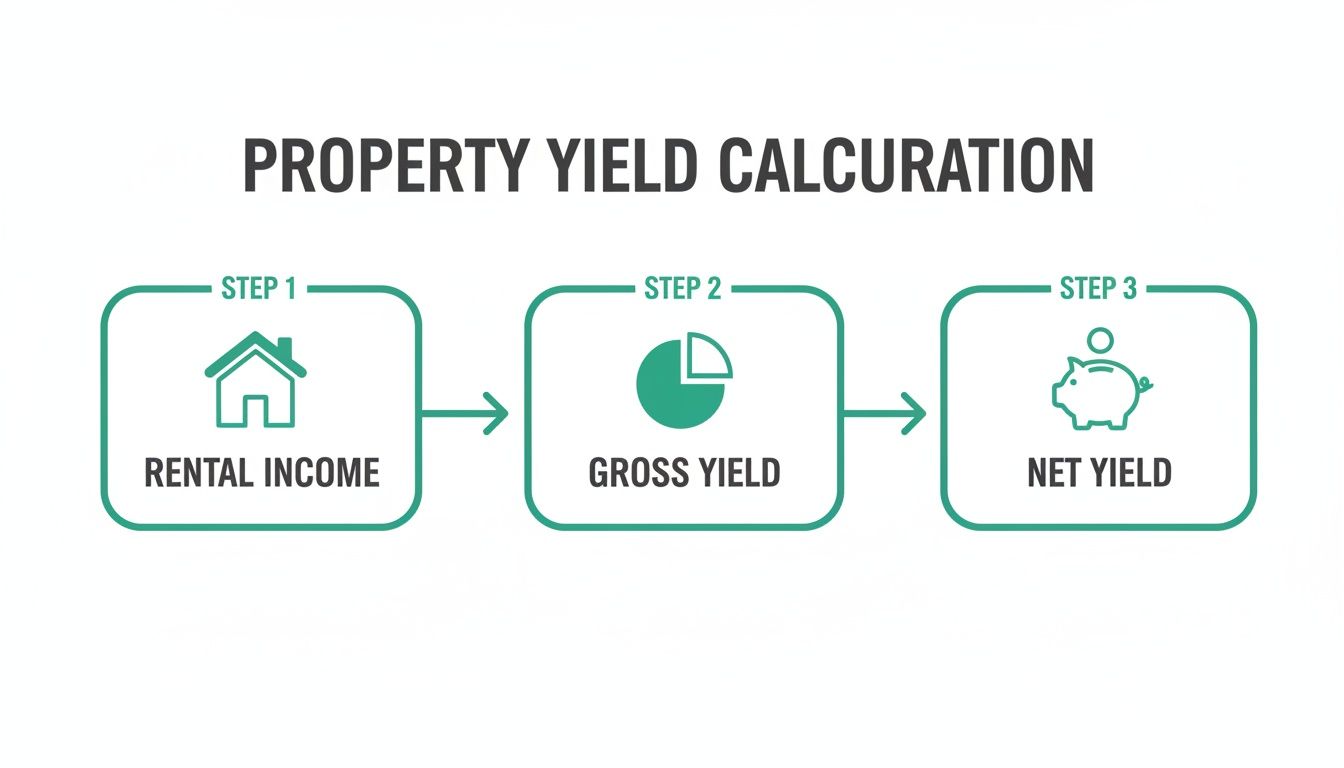
As the flowchart illustrates, the journey doesn't end with gross yield. Accounting for your costs is the essential next step to understanding what the property actually generates.
Step 4: Tally Your Annual Operating Costs
This is the most crucial step for determining your net yield, and it's where most investors get lazy. You need to list every single anticipated expense associated with running the property for a year. Be brutally honest and realistic here.
Here's a typical checklist of annual costs for our Birmingham flat:
- Mortgage Interest: Let's estimate £6,000 for the year.
- Letting Agent Fees: At 10% of rent, this is £1,500.
- Landlord Insurance: Approximately £300.
- Maintenance Fund: A sensible budget of 10% of rent is £1,500. Don't skip this.
- Service Charge & Ground Rent: Common for flats, estimated at £1,200.
- Void Period Provision: Budgeting for one month of vacancy is £1,250.
Your total estimated annual operating costs are: £6,000 + £1,500 + £300 + £1,500 + £1,200 + £1,250 = £11,750
Step 5: Calculate Your True Net Yield
Finally, the moment of truth. You can calculate the net yield—the figure that truly reflects the investment's performance. You simply subtract your annual operating costs from your annual rental income, then divide by the total property cost.
The net yield calculation is your financial reality check. It reveals the actual cash-generating power of the asset after every expense is paid, answering the fundamental question: "Is this deal truly profitable?"
The formula is: Net Yield (%) = ((Annual Rental Income - Annual Operating Costs) / Total Property Cost) x 100
Let's plug in the numbers for our example: ( (£15,000 - £11,750) / £238,000 ) x 100 = 1.37%
Our initially promising gross yield of 6.30% has become a much more sober net yield of 1.37%. This powerful insight shows exactly why you must always complete all five steps. For a more detailed look, learn more about our UK rental yield calculator and how to apply these principles.
What Actually Moves the Needle on Your Rental Yield?
Calculating a yield is a great start, but truly understanding it means getting to grips with the powerful forces that shape this number. It isn't some fixed figure pulled out of thin air; it's a living metric, constantly pushed and pulled by the market, the property itself, and the strategic choices you make as an investor. Mastering these variables is what separates a tidy profit from a costly mistake.
An investor who blindly buys a property based on a single, shiny yield figure without understanding what's under the bonnet is taking a massive gamble. Two properties with the same advertised yield can have wildly different risk profiles and long-term potential. Let's break down the key factors you need to scrutinise in the UK market.
Location, Location, Rental Demand
It's the oldest cliché in the book for a reason. But for a yield-focused investor, it's not just about a 'good' postcode. The magic formula is the relationship between property prices and the strength of local rental demand. This simple dynamic is why many northern UK cities often deliver far juicier yields than London.
- Economic Hubs: Areas with solid job markets, major employers like universities or hospitals, and ongoing business investment are magnets for tenants, keeping rental demand consistently high.
- Transport Links: Being close to a train station, motorway, or reliable bus route is a huge driver of tenant demand and one of the easiest ways to justify charging a premium rent.
- Local Amenities: People pay for convenience. Properties a short walk from good schools, shops, parks, and decent pubs will always be in high demand, which means stronger rents and fewer empty nights.
The Property Itself (and What You Paid for It)
The type of property you buy has a direct and massive impact on its potential yield. A modern two-bed flat is going to perform very differently from a six-bedroom House in Multiple Occupation (HMO). HMOs, for example, typically produce much higher yields because you're renting out individual rooms, effectively creating multiple income streams from a single building.
Just as important is the purchase price. Your yield is fundamentally tied to how much you paid upfront. Every pound you manage to save on the purchase price gives your final return an immediate leg up. Buying below market value—whether through savvy negotiation, at auction, or by finding a motivated seller—is one of the most powerful ways to lock in a high yield before you've even collected the first month's rent. For more on keeping those initial expenses in check, have a look at our guide on UK building costs per square metre.
Operating Costs and the Tax Man
As we saw when comparing gross and net figures, your operating costs are the silent killer of an otherwise fantastic yield. High service charges on a leasehold flat, an unexpected boiler replacement, or an inefficient letting agent can quickly eat away at your profits.
In the UK, you could argue that tax rules are one of the biggest "operating costs" of all. Changes like the Section 24 mortgage interest relief restrictions have completely rewritten the profitability equation for many landlords, making them a non-negotiable part of your net yield calculation.
Under Section 24, individual landlords can no longer deduct their mortgage interest costs from rental income before working out their tax bill. Instead, you get a basic rate tax credit of just 20%. For anyone in the higher-rate (40%) or additional-rate (45%) tax bands, this translates to a much larger tax bill, which directly slashes your net profit and your true net yield. This one legislative change has single-handedly made some previously profitable buy-to-lets unworkable for higher earners.
The wider economic climate also plays a huge role. UK rent inflation has been the engine behind investor returns for decades. For example, rent inflation averaged 3.88% between 1989 and 2025. By early 2026, however, it had cooled to 4.3% year-on-year, its eighth consecutive monthly fall. This softer growth means investors must be even more diligent in their analysis to find deals that still offer a strong return. You can explore more data on UK rent inflation trends to get a feel for these market shifts.
Actionable Strategies to Increase Your Rental Yield
Knowing how to calculate rental yield is just the start. The real skill is knowing how to actively improve it. A calculated yield isn't a fixed destiny; it's a starting point you can build upon with smart, strategic moves. By focusing on either bumping up your rental income or trimming down your costs (or better yet, both), you can turn a decent investment into a genuinely high-performing asset.
Let's move from theory to practice. Here are several proven strategies UK property investors use to squeeze more return out of their properties, each with its own set of trade-offs.
Perform Strategic Refurbishments
Tenants will always pay a premium for a clean, modern, and well-maintained property. A strategic refurbishment isn't about fitting gold-plated taps; it's about making targeted, cost-effective upgrades that directly justify a higher rent.
Focus on the areas that make the biggest difference to a tenant's daily life:
- Kitchens and Bathrooms: A modernised kitchen with updated appliances or a clean, contemporary bathroom can dramatically lift a property's appeal and rental value. These are the rooms that sell a rental.
- Decor and Flooring: A simple repaint and new, hard-wearing flooring can transform a tired-looking space, making it far more attractive to prospective tenants for a relatively small outlay.
- Energy Efficiency: Upgrading to double-glazing or improving insulation doesn't just attract tenants looking to save on bills. It can also improve the property's Energy Performance Certificate (EPC) rating—a critical legal requirement that's only getting stricter.
The trick is to spend money where it adds the most value, ensuring the boost in rent quickly pays back what you spent.
Convert to an HMO or Serviced Accommodation
For investors willing to take on more intensive management, switching up the strategy can unlock significantly higher yields.
A House in Multiple Occupation (HMO) involves renting out individual rooms to separate tenants. While this comes with stricter regulations and licensing headaches, the combined rent from multiple rooms almost always crushes what you could get from a single-family let. It's not uncommon for HMOs to push gross yields above 10%.
Similarly, Serviced Accommodation (SA), or short-term letting, lets you charge a nightly rate much like a hotel. This can generate huge returns, especially in tourist hotspots or areas with high demand from contractors. The catch? The workload is far greater, with constant cleaning, guest communication, and the risk of more frequent empty periods between bookings.
Reduce Your Void Periods and Costs
Every single day a property sits empty, it's costing you money and dragging down your yield. Proactive tenant retention is one of the most underrated strategies for maximising returns. A happy tenant who stays for years is worth their weight in gold, saving you the cost and hassle of finding new ones.
Minimising tenant turnover is a direct boost to your net yield. It eliminates remarketing fees, reduces the risk of costly voids, and provides consistent cash flow—the lifeblood of any successful property investment.
You can also attack your operating costs directly. Consider self-managing the property to eliminate letting agent fees, which typically range from 8% to 15% of your rental income. It requires more of your time, but those savings go straight to your bottom line. It's also worth regularly reviewing your insurance policies and service providers to make sure you're getting the best possible deals.
Finally, remember that the best yields are often secured before you even own the property. Negotiating a better purchase price is the single most effective way to improve your yield from day one. Every pound saved on the purchase price is a pound that doesn't need to be recouped through rent, giving your investment an instant head start.
Why Regional UK Yields Offer a Major Investment Advantage

There's a classic mistake many new investors make: they get fixated on London and the South East. The capital has an undeniable pull, but when you look at the raw numbers, the story for rental yield is completely different. For investors focused on generating powerful, consistent cash flow, the best deals are often found far away from the M25.
It's a simple truth: a high purchase price is the natural enemy of a high rental yield. In London, property values are so astronomical that even strong rents struggle to produce a compelling return on your investment. This creates a huge yield gap between the South and other UK regions, offering a major advantage to savvy investors who know where to look.
The North-South Yield Divide
The difference isn't just a small gap; it's a chasm. In prime London postcodes, it's not uncommon for investors to accept gross yields hovering around 4-5%. They're making a bet, banking heavily on long-term capital appreciation to deliver the bulk of their total return.
But head up north to property hotspots like Manchester, Liverpool, and Glasgow, and the whole dynamic flips. Here, more modest purchase prices are combined with strong and rising rental demand, creating a much healthier environment for income. It's quite normal to find properties in these cities delivering gross yields that comfortably sail past 7%. This highlights a fundamental choice every investor has to make: are you chasing capital growth, or are you chasing immediate cash flow?
Regional variations create massive opportunities. Data from HomeLet's latest rental index shows this clearly. While the UK average rent might be £1,317 pcm, the North East sits at just £715 (with 6.6% year-on-year growth), compared to London's eye-watering £2,129. Similarly, PropertyData's analysis often spotlights postcode districts yielding 8% or more, almost always in these regional cities where lower prices and strong demand create the perfect storm for investors.
Uncovering High-Performing Regional Markets
To find these deals, you need to look beyond the obvious and dive into the data of these high-potential markets. Strong regional cities often have key growth drivers that sustain tenant demand, making them incredibly robust places to invest.
Look out for these factors:
- University Populations: Cities with big student communities provide a constant, reliable stream of tenants year after year.
- Regeneration and Investment: Major infrastructure projects and business investment create jobs, attracting professionals who all need quality places to live.
- Affordability: Tenants are increasingly moving to cities where their money goes further, fuelling demand for rentals outside the expensive South East.
By broadening your search beyond the traditional southern markets, you unlock a completely different tier of investment opportunities. The numbers don't lie—the path to superior cash flow often starts by looking north.
This should encourage you to explore markets you might have previously ignored. The key is having the right tools to compare these varied opportunities quickly and accurately. You need to be able to run the numbers on a property in Glasgow just as easily as one in Guildford, ensuring you don't miss out on a high-performing deal simply because it's outside your usual patch. To dive deeper, check out our detailed guide on the best UK cities for property investment.
Burning Questions About UK Rental Yield
When you're navigating the world of property investment, questions are inevitable. Getting your head around the details of rental yield is crucial, and having clear answers can be the difference between a confident move and a costly mistake. Let's tackle some of the most common questions UK investors ask.
What Is a Good Rental Yield in the UK in 2026?
There's no single magic number for a "good" rental yield. It really depends on your strategy and where you're buying. However, a solid benchmark for a standard buy-to-let in 2026 is a gross yield of 6% or higher.
If you start seeing yields climbing above 8%, you're generally looking at an excellent return. These figures are more common in high-demand northern cities or with more intensive strategies like Houses in Multiple Occupation (HMOs).
On the flip side, in high-value areas like London, a "good" yield might look lower, perhaps around 4-5%. In those markets, investors are often trading a lower rental income for the potential of much stronger long-term capital growth. Ultimately, a good yield is whatever leaves you with positive cash flow after all your costs and taxes are paid.
Does Capital Growth Affect My Rental Yield?
No, and it's vital to keep these two things separate in your head. Rental yield and capital growth are two completely different metrics that measure different parts of your investment's performance.
- Rental Yield: This is all about the income your property generates from rent, shown as a percentage of what it cost you. Think of it as your cash flow.
- Capital Growth (or Appreciation): This is the increase in the property's market value over time. It's a measure of how much your equity has grown.
While a high-yield property might be in an area with slower capital growth (and vice-versa), one doesn't directly influence the calculation of the other. The figure that brings them both together is your Total Return on Investment (ROI), which combines the rental income you've made and the capital gains you bank when you eventually sell.
How Does Section 24 Impact Net Rental Yield?
Section 24 has a huge, direct, and negative impact on the net rental yield for any landlord investing in their personal name, especially if you're a higher or additional-rate taxpayer. It's a game-changer.
Before this rule came in, you could deduct all your mortgage interest from your rental income before working out your tax bill, which seriously reduced your taxable profit.
Under Section 24, you can no longer deduct mortgage interest as a business expense. Instead, you get a tax credit equal to 20% of your interest payments. For a 40% taxpayer, this means you're effectively paying double the tax on that slice of your income.
This shift means you're paying tax on a much bigger chunk of your rental income, which hammers your final net profit. As a result, your effective net yield—the money you actually get to keep—is significantly lower. This is why a precise, forward-looking net yield calculation is absolutely non-negotiable for figuring out if a deal is actually profitable in today's UK market.
Stop getting bogged down in complex spreadsheets and start making faster, smarter investment decisions. DealSheet AI analyses any UK property deal in seconds, giving you the clarity you need on yields, cash flow, and ROI.
Download the DealSheet AI app and start your free trial today.