
UK Building Costs Per Square Metre: A Complete 2024 Guide for Investors
UK Building Costs Per Square Metre: A Complete 2024 Guide for Investors
Understanding UK building costs per square metre is crucial for any property investor, and for a standard residential project in 2024, you can expect a range from £1,750 to over £3,000 per square metre. This guide breaks down exactly what drives this figure, from location to project type, providing the actionable insights you need to budget accurately. To model these variables for your specific deals and get instant, data-driven project estimates, download the DealSheet AI app and see how it transforms your underwriting process.
This article will delve deeper into the factors that influence this critical metric, helping you move from a rough estimate to a confident, investment-grade budget.
Understanding UK Building Costs Per Square Metre
For property investors and developers, getting a grip on building costs per square metre is the difference between a profitable venture and a very expensive mistake. This figure isn't some simple plug-and-play number you can pull off Google. Think of it as a dynamic benchmark—the foundational element of your project's entire financial model, influenced by a huge range of factors we'll explore.
Get this number wrong at the start, and you're setting yourself up for budget overruns, cash flow nightmares, and a deal that spectacularly fails to deliver its projected returns. The goal is to move beyond outdated rules of thumb and learn to analyse your projects with confidence, using realistic, current data.
Why This Metric Matters So Much
The cost per square metre gives you a standardised way to compare the potential construction bill for different projects, long before you have a detailed set of drawings. It's perfect for those quick, back-of-the-envelope feasibility checks that help you sift through opportunities efficiently.
But its real power is in the application. When you understand the components that make up this rate, you can tweak it based on your project's specific quirks. This is absolutely crucial for:
- Initial Deal Analysis: Quickly deciding if a potential project is even financially viable.
- Budget Forecasting: Creating a realistic preliminary budget to get your finance lined up.
- Cost Control: Benchmarking quotes from builders against industry averages to see if you're being taken for a ride.
A savvy investor doesn't just ask, "What are the building costs per square metre?" They ask, "What factors will hammer the building costs for this specific property, in this location, with this finish?"
That shift in perspective is fundamental. It moves you from being a passive price-taker to an active cost manager. Throughout this guide, we'll break down exactly how to develop this skill, making sure your financial assumptions are grounded in reality. From regional price hikes to the quality of the kitchen taps, every detail plays a role. We'll show you what to look for and how to apply it.
Average UK Building Costs Per Square Metre at a Glance
To give you a clearer picture, here's a rough guide to average build costs across different UK regions. Remember, these figures are just a starting point and exclude VAT and professional fees like architects or structural engineers. They represent a typical "medium-spec" finish.
| UK Region | Typical Low-End Cost Per m² | Typical High-End Cost Per m² |
|---|---|---|
| London | £2,250 | £3,500+ |
| South East | £1,900 | £3,000 |
| South West | £1,800 | £2,600 |
| Midlands | £1,750 | £2,400 |
| North of England | £1,700 | £2,200 |
| Wales | £1,700 | £2,100 |
| Scotland | £1,800 | £2,500 |
| Northern Ireland | £1,650 | £2,000 |
As you can see, the variation is significant. A project in Northern Ireland could realistically come in at half the cost of an equivalent build in central London. Use this table to orient yourself, but the real skill lies in understanding why these numbers move so much, which we'll dig into next.
What Really Drives Your Construction Budget?
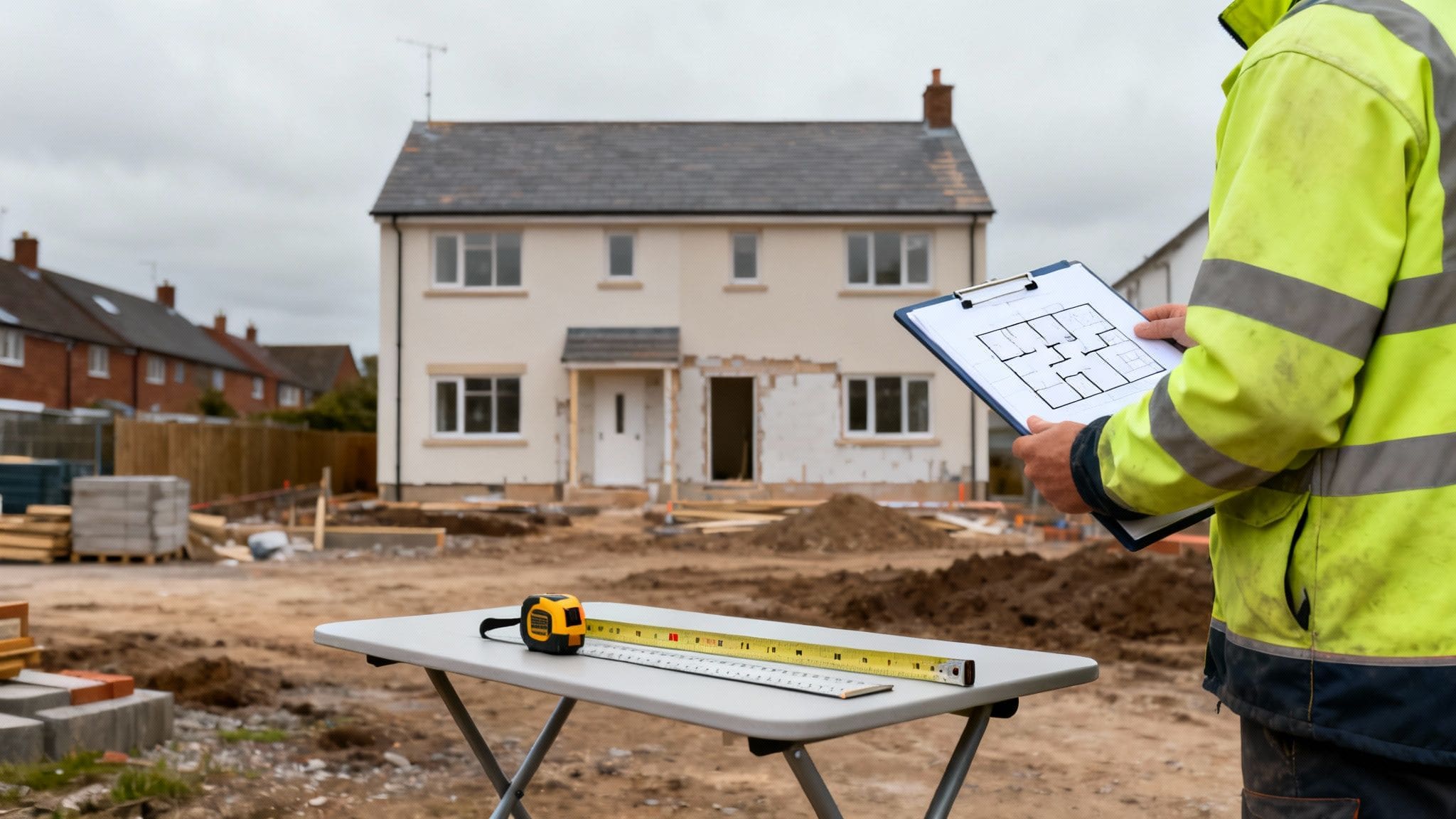
So, why does one new build cost £1,800 per square metre while a similar project down the street demands £2,800? This huge variation in building costs per square metre isn't random. It's driven by a handful of critical factors every investor must get their head around to build a realistic budget and sidestep any nasty financial surprises.
Think of it like buying a car. The base model has a sticker price, but adding the leather seats, panoramic sunroof, and premium sound system sends the final cost soaring. Construction is no different. Your final cost is a unique blend of four main ingredients: location, specification, project type, and site complexity.
The Unavoidable Impact of Location
The old saying "location, location, location" doesn't just apply to property values; it's a massive driver of construction costs, too. The North-South divide is a very real phenomenon in the building trade. Higher labour wages, greater demand for skilled trades, and more expensive material logistics in London and the South East create a significant cost premium.
For instance, recent 2024–25 data shows just how stark this regional difference is. While typical new-build costs might average around £2,200–£2,400 per m² nationally, a project in London could have a mid-range benchmark closer to £2,973 per m². A similar build in the North of England? You could be looking at something nearer £2,477 per m². That's geography alone adding nearly 20% to your budget.
Specification: The Quality of Your Finishes
This is where you have the most direct control. The level of specification refers to the quality of the materials and finishes you choose for the project—it's the difference between a functional, durable finish and a high-end, luxury one.
Let's get specific:
- Kitchens: A standard laminate worktop and basic appliances from a trade supplier are worlds apart from a bespoke kitchen with quartz countertops and integrated Miele appliances.
- Bathrooms: Simple ceramic tiles and basic sanitaryware will cost a fraction of a bathroom fitted out with designer fixtures, porcelain tiles, and a walk-in wet room.
- Flooring: Choosing budget-friendly carpet or laminate is a completely different financial decision from installing engineered oak or polished concrete floors.
- Windows & Doors: Standard uPVC windows are far cheaper than premium aluminium or timber-framed alternatives that might be needed for a high-end look or conservation area.
Every single one of these choices has a direct and immediate impact on the final building cost per square metre. A "basic" spec might keep you at the lower end of the regional average, while a "high-end" spec can easily add £500–£1,000+ per m² to the total bill.
Project Type and Its Inherent Complexity
Not all projects are created equal. A simple, rectangular new-build house on a flat plot is relatively straightforward to construct, benefiting from repeatable processes and economies of scale. It's efficient.
In contrast, other projects come with built-in complexities that ramp up the cost:
- Extensions: These often have higher per-metre costs than new builds. The work is concentrated in a smaller area and involves complex structural tie-ins to an existing building, which is just less efficient than starting from a clean slate.
- HMO Conversions: Turning a standard house into a House in Multiple Occupation (HMO) means adding extra bathrooms, kitchens, and robust fire safety systems (like alarms and fire doors). All of these add significant cost without adding much floor space.
- Listed Buildings: Working on historic or listed properties is a different ball game entirely. It requires specialist trades, expensive heritage-approved materials, and painstaking adherence to conservation rules, pushing costs up dramatically.
Site Complexity: The On-the-Ground Realities
Finally, the site itself can either be your friend or your enemy. The ideal site is flat, with easy access for lorries and machinery, and decent ground conditions. But many sites, especially in dense urban areas, throw a few curveballs that add cost.
Common issues that can blow a hole in your budget include:
- Access: A terraced house with no rear access means every single brick, bag of cement, and window frame has to be carried through the property. That means more labour time, which means more cost.
- Ground Conditions: Poor soil, a high water table, or hitting rock can mean thousands of pounds in extra foundation work before you've even got out of the ground.
- Sloping Sites: Building on a slope requires expensive retaining walls, complex stepped foundations, and extra spoil removal.
- Existing Services: Finding out you need to move drains, gas pipes, or electricity cables can add unexpected delays and significant expense to your project.
Why Old Cost Benchmarks Will Sink Your Project
Relying on construction cost data from just a few years ago is like trying to navigate London with a map from the 1990s. You're not just going to get lost; you're heading straight for a financial dead end. The entire economic landscape of the UK building industry has shifted, and using outdated building costs per square metre is one of the fastest ways to torpedo a project's profitability before you've even laid a brick.
The post-pandemic market has left a kind of 'financial long Covid' on the construction sector. Soaring inflation, completely unpredictable supply chains, and a chronic shortage of skilled trades have shattered the old financial models. The reliable rules of thumb that developers once lived by are now dangerously misleading.
The New Reality of Construction Economics
Forget the stability of the past. Material prices can now swing wildly in just a few months, and the cost of good tradespeople has rocketed due to overwhelming demand. It's not unusual for waiting times for critical components like windows or roof trusses to stretch project timelines by months, piling on extra holding costs and financial pressure.
This volatility means a budget calculated using figures from 2019 or 2020 isn't just a bit off; it's fundamentally broken. Ignoring this new reality will almost certainly lead to a critical funding gap mid-project. That leaves you with three bad options: inject more of your own capital, find expensive secondary financing, or slash the quality of the finish—crippling your end value.
Relying on historical cost data in today's market isn't a calculated risk anymore—it's a guaranteed way to underestimate your budget. Live, dynamic data isn't a luxury; it's an absolute necessity for underwriting deals responsibly.
The Numbers Don't Lie
This isn't just anecdotal grumbling from builders on site; the data paints a crystal-clear picture of a major structural shift in costs. Economic pressures have pushed budgets up across the board, permanently.
For instance, multiple UK sources show that realistic starting points for mainstream, architect-designed homes have climbed sharply. By 2025, the benchmark had risen to around £2,300/m², a jump in the mid-teens on previous benchmarks. For projects on tricky or premium sites, it's now common to see costs blast past £2,900–£3,000/m². You can find more insights on the true cost of building a home in 2025 here.
Adopting a Forward-Looking Approach
To have any chance of success, investors have to throw out their old spreadsheets and adopt a much more dynamic way of estimating costs. This means you need to be:
- Seeking Current Data: Actively hunting for the latest cost reports, indices, and real-world project data.
- Speaking to Professionals: Getting on-the-ground intelligence from quantity surveyors, architects, and builders who are active in your specific area right now.
- Building In Larger Contingencies: Acknowledging the huge risk of price spikes by allocating a much bigger contingency fund. A 15-20% buffer on build costs is the new sensible minimum.
Ultimately, the market punishes those who don't adapt. The investors who will thrive are the ones who recognise that old benchmarks are relics of a bygone era. They use up-to-date, data-driven tools to analyse their deals properly. It's this proactive stance that protects your capital and keeps your projects profitable in a tough new environment.
How Costs Vary Across Investment Strategies
Throwing a generic, one-size-fits-all figure for building costs per square metre at different property deals is a surefire way to get your budget wrong. It's a classic mistake. The truth is, your chosen investment strategy is one of the biggest factors determining your final construction bill. You just can't compare the intense, high-spec work of a House in Multiple Occupation (HMO) conversion with a simple cosmetic update on a buy-to-let.
Let's move from theory to what this looks like on the ground. We'll break down why different investment models have such wildly different cost profiles, showing you why a tailored approach is absolutely critical for underwriting deals accurately. Getting this wrong at the start is one of the most common—and most expensive—errors an investor can make.
Buy-To-Let Refurbishment Costs
A standard buy-to-let (BTL) refurb usually sits at the lower end of the cost spectrum. The goal here isn't luxury; it's durability and function. You're creating a clean, safe, and appealing space for tenants without splashing cash on high-end finishes that won't actually get you a higher rent.
The work typically involves:
- Cosmetic Updates: A fresh coat of paint, new carpets, and modernising the light fittings. Simple but effective.
- Kitchen & Bathroom: This is often a straightforward refresh with budget-friendly but hard-wearing units, laminate worktops, and standard white sanitaryware.
- Systems Check: You'll make sure the electrics and plumbing are safe and compliant, but you'd rarely do a full rewire or re-plumb unless it's absolutely essential.
For a BTL, you're aiming for a robust finish that cuts down on future maintenance calls, not one designed to hit a top-tier sales price. This pragmatic approach keeps the building cost per square metre relatively low.
High-End Flip Project Costs
Flipping a high-end property is a completely different game. Here, every pound spent is geared towards maximising the final sale value—the Gross Development Value (GDV). The entire budget is an investment in creating a "wow" factor that justifies a premium price tag.
For a flip, the question isn't "what's the cheapest way to do this?" It's "what level of finish will generate the highest return on my investment?" This mindset shift sends the per-metre cost soaring.
This strategy means a much heavier investment in premium finishes:
- Designer Kitchens: Think stone worktops, integrated high-end appliances, and feature lighting.
- Luxury Bathrooms: Often including sleek walk-in showers, designer tiles, and premium fixtures.
- Enhanced Kerb Appeal: Serious money goes into landscaping, new windows, and an impressive front door to create that crucial first impression.
The building costs per square metre for a premium flip can easily be 50-75% higher than for a standard BTL refurb of the exact same property. The specification is your primary tool for creating value. For a deeper look at the different models, check out our guide on different UK property investment strategies.
HMO Conversion Costs
On a per-square-metre basis, HMO conversions are arguably the most complex and expensive projects. This isn't about luxury finishes; it's about density, compliance, and pure functionality. You are essentially squeezing more facilities—like kitchens and bathrooms—into the same footprint, which has a massive knock-on effect on the budget.
The key drivers that push the per-metre rate sky-high are:
- Multiple Bathrooms: Adding en-suites or shared bathrooms requires extensive plumbing and tiling, which adds up fast.
- Enhanced Fire Safety: Strict regulations mean fitting interconnected smoke alarms, fire doors, and sometimes emergency lighting. These are non-negotiable and costly.
- Acoustic & Structural Work: Soundproofing between rooms is often needed, and layouts are frequently changed to maximise the number of rentable rooms.
- Increased Durability: HMOs get a lot of wear and tear, so you need to invest in more robust, commercial-grade finishes that can take a beating.
This difference in cost based on use is backed up by industry data. For example, figures from CostModelling show a clear cost separation between a 'one-off' detached house (typically £2,390–£2,650/m²) and more complex apartment projects, which can start from £3,000–£3,320/m² and climb much higher. It's a perfect illustration of why applying a simple new-build rate to a dense HMO conversion would lead to a catastrophic budgeting error.
Cost Per m² Benchmarks by Investment Strategy
To pull this all together, it's helpful to see the typical cost ranges side-by-side. The table below gives a snapshot of how different strategies stack up, highlighting what's really driving the cost in each case.
| Investment Strategy | Typical Cost Per m² Range | Key Cost Drivers |
|---|---|---|
| Standard Buy-to-Let | £600 - £1,100 | Cosmetic updates, basic kitchen/bathroom refresh, durability over luxury. |
| High-End Flip | £1,500 - £2,500+ | Premium finishes, designer kitchens/bathrooms, landscaping, kerb appeal. |
| HMO Conversion | £1,800 - £3,000+ | Multiple bathrooms, fire safety compliance, structural changes, robust finishes. |
Remember, these are benchmarks. Your final figure will always depend on the specifics of your project—its location, complexity, and the standard you're aiming for. But this gives you a much more realistic starting point than a single, generic number ever could.
Budgeting Beyond the Build Cost
Focusing only on the building costs per square metre is like looking at just the tip of an iceberg. It's a vital number for your initial sums, but the real dangers—the extra, often forgotten expenses lurking beneath the surface—are what can truly sink your project's finances.
So many inexperienced investors get caught out here. They'll meticulously calculate the construction bill but completely forget the whole ecosystem of costs that supports it. This is the critical difference between the raw build cost and the Total Project Cost. Getting your head around this is fundamental to building a realistic financial model and protecting your profit margin from day one.
The Essential Checklist of Additional Costs
To go from a rough, back-of-an-envelope estimate to an investment-grade budget, you have to layer on several other unavoidable expenses. Think of the build cost as the engine of your car; it's the biggest, most obvious part, but you still need to pay for the chassis, wheels, and electronics to get a vehicle that actually works.
A proper project budget must always include:
- Professional Fees: The cost of hiring the experts you need to design, engineer, and manage the project legally and safely.
- Statutory Fees: The non-negotiable charges from local authorities to approve and inspect your work.
- VAT (Value Added Tax): A complex and often misunderstood tax that can add a massive chunk to your final bill.
- Contingency Fund: Your project's financial safety net for when the unexpected—and it's always unexpected—happens.
Deconstructing Professional Fees
Unless you're a qualified professional yourself, you're going to need to hire a team to get your project off the ground. These fees are not optional extras; they are critical investments in getting the project designed correctly and approved for construction.
Your team will usually include:
- Architect / Architectural Technologist: To draw up everything from initial concepts to the detailed technical drawings needed for planning permission and building regulations. Their fees can range from 5-12% of the build cost, depending on how involved they are.
- Structural Engineer: To calculate and design all the structural bits, like steel beams (RSJs), foundations, and roof structures. This is a legal must-have for most projects.
- Quantity Surveyor (QS): On bigger or more complex projects, a QS is invaluable. They provide detailed costings, manage the tender process with builders, and help keep the budget under control as the build progresses.
Trying to save money by skimping on professional advice is a false economy. A well-designed project saves you a fortune during the construction phase through sheer efficiency and by avoiding costly on-site mistakes.
Navigating Statutory Fees and Taxes
Before you can even think about putting a spade in the ground, you need the council's permission. These statutory fees are fixed, non-negotiable, and part of the process.
You absolutely must budget for:
- Planning Application Fees: The cost to submit your plans to the local authority for approval.
- Building Control Fees: The charge for having your project inspected at key stages to make sure it complies with UK Building Regulations. You can use the local council's service or a private approved inspector.
On top of this, VAT is a huge budget item that needs your full attention. While new-build properties are typically zero-rated, most refurbishment and conversion projects are subject to the standard 20% rate. Getting this wrong can instantly wipe out a deal's profitability.
Finally, don't forget property acquisition costs like Stamp Duty Land Tax (SDLT), which can be a massive upfront hit. It's vital to factor this into your initial purchase calculations; you can get a clearer picture by using a Stamp Duty Land Tax calculator for property investors to see exactly how it impacts your total outlay.
The Non-Negotiable Contingency Fund
No construction project in history has ever gone perfectly to plan. Unforeseen issues will always pop up, whether it's discovering awful ground conditions when you start digging foundations or finding out your chosen materials are suddenly unavailable. A contingency fund is the money you set aside specifically to deal with these problems.
It's not a "nice-to-have"; it is an absolutely essential part of responsible project budgeting.
For most standard residential projects, a contingency of 10-15% of the total build cost is a sensible minimum. If you're tackling something more complex, like working with a listed building or on a site with tricky access, pushing that up to 20% is just plain smart. This fund is your financial buffer, making sure that unexpected costs don't derail the entire project or force you to cut corners on the final finish.
A Practical Guide to Underwriting a Deal
Right, let's put the theory to one side and see how these numbers actually behave in the real world. This is where the spreadsheets come out and we move from a simple area measurement to a solid, investment-grade financial model.
We're going to walk through a hypothetical 75m² terrace house in the Midlands, which we plan to convert into a 4-bedroom House in Multiple Occupation (HMO). This is the exact logic that powerful tools like DealSheet AI automate, but understanding it manually is crucial.
Step 1: Start with the Base Build Cost
First things first, we need our core construction budget. To do that, we need to pick an appropriate building costs per square metre rate. As we've already covered, an HMO conversion is a complex job, so it's going to sit at the higher end of the cost spectrum.
Given the Midlands location and the sheer density of the work involved (adding en-suites, fire safety, beefed-up electrics), a rate of £1,950 per square metre feels realistic.
- Gross Internal Area (GIA): 75 m²
- Selected Build Rate: £1,950 / m²
- Initial Build Cost = 75 m² x £1,950/m² = £146,250
This £146,250 is our starting block. It covers the direct labour and materials for the physical conversion—our single biggest expense. But it's a long way from being the total project cost. You have to layer on the other costs methodically to get an accurate picture.
This infographic shows the typical flow from that basic build cost to the final project budget you can actually work with.

As you can see, the build cost is just the foundation. Professional fees and a robust contingency are non-negotiable additions for a realistic budget.
Step 2: Layer on Professional and Statutory Fees
Next up are the experts. We need to pay for the brains behind the project—the people who design and approve the work—along with the council fees. A common rule of thumb is to allow 10-15% of the build cost for professional fees. Let's be prudent and use 12%.
- Professional Fees (12% of £146,250) = £17,550
This pot of money covers our architect for drawings, a structural engineer for any beam calculations, and potentially a project manager to keep everything on track. We also need to add statutory fees for planning and building control, which we'll estimate at a flat £1,500.
Total Fees = £17,550 + £1,500 = £19,050
Our running total is now £146,250 (Build) + £19,050 (Fees) = £165,300. If you're using short-term finance, it's vital to understand how these costs interact with your loan. Our guide on using a bridging loan calculator gives some useful context here.
Step 3: Add the Non-Negotiable Contingency Fund
Here's a hard-earned lesson: no project ever goes exactly to plan. A contingency fund is your financial safety net for when things go wrong. For a complex HMO conversion inside an older terraced house, a 15% contingency on the build cost is a sensible, prudent choice.
- Contingency Fund (15% of £146,250) = £21,938
This buffer is what protects you from the unknowns—hidden structural problems, damp that appears when you strip the walls back, or a sudden spike in plasterboard prices. It ensures you have the cash reserves to finish the project without cutting corners or stalling the work.
Step 4: Calculate the Total Project Cost
Finally, we pull all the components together. This gives us our Total Project Cost—the number we can confidently take to a lender and use for our final investment analysis.
- Initial Build Cost: £146,250
- Total Fees: £19,050
- Contingency Fund: £21,938
- Total Project Cost = £187,238
By following these steps, we've gone from a simple £1,950 per square metre estimate to a detailed, realistic, and defensible budget of over £187,000. This methodical approach is the hallmark of a professional investor and is absolutely vital for making sure your deals are genuinely profitable.
Frequently Asked Questions About Building Costs

To wrap things up, let's tackle some of the common questions that pop up time and again when investors and developers are getting to grips with building costs per square metre. These are the practical queries that can make or break a budget.
Are Extension Costs Higher Per Square Metre?
Yes, almost always. The cost per square metre for an extension is typically higher than for a complete new build, which can feel a bit counterintuitive at first.
It all comes down to complexity and a lack of scale. A new build benefits from repeatable processes and economies of scale. Extensions, on the other hand, involve fiddly, labour-intensive work in a very concentrated space—things like tying into the existing structure, navigating tricky site access, and making good on the original property. You're packing a lot of complex tasks into a small footprint, and that pushes the unit cost up.
Is VAT Always Charged on Construction Work?
Getting the VAT assumption right is absolutely critical; getting it wrong can instantly wipe out your profit margin. It's a complex area, so you need to tread carefully.
As a rule of thumb, new-build residential properties are typically zero-rated for VAT, which is a massive cost advantage.
However, most refurbishment, conversion, and extension projects will be subject to VAT at the standard rate of 20%. There are some helpful exceptions, like a reduced 5% rate for converting certain commercial buildings into residential use. Always, always get professional advice from an accountant on this. It's especially vital when your returns depend on the final rental income, a topic we cover in our guide on how to calculate property rental yield.
What Is the Best Way to Get an Accurate Quote?
While per-square-metre rates are fantastic for initial deal analysis and checking feasibility, they are still just a well-informed estimate. The only way to get a truly accurate cost is through a formal tender process. This is the gold standard for setting a firm budget.
A per-square-metre rate gets you in the ballpark; a formal tender gives you your exact seat number. It moves your budget from a well-informed estimate to a contractual price.
To do this properly, you'll need a full set of detailed architectural and structural drawings. These plans are then sent out to several reputable contractors who price the job competitively. Their itemised quotes, based on your exact specifications, give you a firm, market-tested price that will form the basis of your building contract.
Ready to move beyond estimates and analyse your deals with precision? DealSheet AI lets you model total project costs, including build rates, fees, and contingencies, in seconds. Stop wrestling with spreadsheets and start making smarter investment decisions. Download DealSheet AI on the App Store and start your free trial today.