
Unlock Your Profits with a Rental Yield Calculator UK: A 2026 Guide for Investors
Unlock Your Profits with a Rental Yield Calculator UK: A 2026 Guide for Investors
Understanding rental yield is the bedrock of any successful UK property investment. To calculate your true profit, you need to know the crucial difference between a flashy 'gross' yield and the 'net' yield that actually hits your bank account. This guide provides the formula and actionable insights you need to analyse deals effectively in 2026. For investors who want to analyse deals in seconds, not hours, you can download the DealSheet AI app from the App Store to get instant, UK-specific numbers and find genuinely profitable opportunities.
Why Calculating Rental Yield Is Non-Negotiable
For any serious property investor in the UK, rental yield isn't just a useful metric; it's the core indicator of an asset's performance. Think of it as the pulse of your investment—a quick check tells you exactly how healthy its cash flow is relative to its value.
Without this calculation, you're essentially investing blind. You have no real way to compare different opportunities or forecast your actual returns. A precise calculation moves you from guesswork to a data-driven strategy, letting you objectively assess whether a property in Manchester offers a better income return than one in Bristol, even if their purchase prices are worlds apart.
The UK Rental Market Context for 2026
The UK rental market has seen significant shifts, with prices climbing steadily. Projections for 2026 indicate that the Index of Private Housing Rental Prices will continue its upward trend, with recent data showing a significant year-on-year rise. For context, average monthly rents in many UK cities are expected to set new records, making accurate financial analysis more important than ever. You can discover more about the residential rental market in the UK on Statista.
This rising rental income makes accurate yield calculation more critical than ever. Higher rents can signal better returns, but they are often paired with higher property prices and operating costs, making a detailed analysis essential to find truly profitable deals.
For those just starting out, our guide on property investment for beginners in the UK provides a great foundation.
Streamlining Your Analysis with Modern Tools
Manually calculating the yield for every single property you see is slow, repetitive, and riddled with potential for error. This is where a modern rental yield calculator uk tool becomes completely indispensable.

An app like DealSheet AI can instantly pull the key financial metrics from a single property listing. This lets you bypass all the tedious data entry and get an immediate, clear picture of a deal's viability. You see the gross yield, net yield, and potential cash flow in seconds, all tailored to UK tax rules and costs.
Gross Yield vs Net Yield: The Critical Difference Between Paper Profit and Real Cash
When you're running the numbers on a potential buy-to-let, you'll constantly hear two terms: gross yield and net yield. They sound similar, but understanding the gap between them is the single most important step in telling a genuinely profitable deal from a dud.
Get this wrong, and you could end up with a property that looks great on paper but drains your bank account every single month.
Gross Yield: The Quick and Dirty Snapshot
Think of gross yield as the sticker price on a car. It's a fast, top-level number that's useful for quickly comparing different properties without getting lost in the weeds. It gives you a starting point, but it tells you absolutely nothing about the actual running costs.
The formula is dead simple:
Gross Yield = (Annual Rental Income / Total Property Cost) x 100
This figure is perfect for that initial filter. If you're looking at ten properties, it helps you spot the one or two worth a closer look. But relying on it to make a final decision is a classic rookie mistake. It completely ignores all the real-world costs that chip away at your returns.
Net Yield: This Is Where the Truth Lies
Net yield is the number that actually matters. This is your true profitability, showing what's left after every single property-related expense has been paid. It's the equivalent of knowing the car's fuel efficiency, insurance, tax, and maintenance costs before you decide to buy it.
The formula is more involved, but it's non-negotiable for serious investors:
Net Yield = ((Annual Rental Income - Annual Operating Costs) / Total Property Cost) x 100
Calculating this figure forces you to be honest about the costs. It's the only way to forecast your actual return on investment and get a clear picture of your future cash flow.
A juicy gross yield can easily hide a painfully low (or even negative) net yield. This happens all the time with properties that come with hefty service charges, constant maintenance issues, or high letting agent fees. Never, ever make an investment decision based on gross yield alone.
Gross Yield vs Net Yield At a Glance
Here's a quick table to break down the key differences every UK property investor needs to know.
| Metric | Gross Rental Yield | Net Rental Yield |
|---|---|---|
| Purpose | Quick, high-level comparison to filter deals. | Detailed, realistic profitability assessment. |
| Costs Included | None. It only considers rental income and property price. | All of them! Mortgage interest, insurance, voids, fees, etc. |
| Accuracy | Low. Can be highly misleading. | High. Reflects the true cash-in-hand return. |
| Best For | Initial screening of multiple properties. | Making the final investment decision. |
Ultimately, gross yield is for shortlisting candidates, while net yield is for making the final decision. One is for speed, the other is for certainty.
A Checklist of Real-World UK Property Expenses
To get your net yield right, you have to be meticulous about subtracting all the relevant annual costs. For a much deeper dive, our complete guide on the buy-to-let yield calculator covers these in more detail, but here's a solid checklist to get you started:
- Mortgage Interest: The interest-only part of your mortgage payments. Remember that Section 24 rules change how you can claim tax relief on this.
- Landlord Insurance: This is essential. It covers buildings, contents, and public liability.
- Letting Agent Fees: If you're not self-managing, this will typically be 8-15% of the monthly rent.
- Maintenance & Repairs: A crucial buffer. A good rule of thumb is to budget 1% of the property's value annually or set aside 10% of the rent.
- Void Periods: You need a provision for when the property is empty. Budgeting for one month's rent per year is a safe bet.
- Service Charges & Ground Rent: These are mandatory fees for leasehold properties like flats and some new-build houses.
- Safety Certificates: The annual costs for Gas Safety (CP12), Electrical Installation Condition Reports (EICR), and Energy Performance Certificates (EPC).
- Council Tax & Utilities: During any void periods between tenancies, you're the one liable for these bills.
Let's put this into a real-world example. Imagine two flats for sale at £200,000, both renting for £1,000 a month. On paper, they have the exact same gross yield of 6%. Easy choice, right?
Not so fast. Flat A is a modern freehold house with low running costs. Flat B is an older leasehold flat burdened with high service charges and ground rent.
Once you dig into the details and account for those very different operating expenses, Flat A might have a healthy net yield of 4.5%. Meanwhile, Flat B's net yield could plummet to just 2.8%. That stark difference is precisely why net yield is the only number that gives you the true picture of an investment's potential.
How to Calculate Your Rental Yield Step by Step
Right, let's move from theory to the practical side of things. It's one thing to understand the formulas, but it's applying them to a real UK property that truly makes it click. This guide will walk you through calculating both gross and net yield using a realistic example.
We'll take a look at a typical three-bedroom terraced house in a regional city like Liverpool or Manchester. By breaking it down into simple stages, you'll see exactly how the numbers build up, turning abstract concepts into a concrete investment analysis.
Step 1: Gather Your Key Figures
Before you can punch any numbers into a calculator, you need to get your foundational figures straight. Accuracy here is absolutely critical—any mistake will throw off your entire yield calculation.
For our example property, let's lay out the numbers:
- Purchase Price: £200,000
- Purchase Costs: £8,500 (This covers Stamp Duty, legal fees, and survey costs)
- Total Initial Investment: £208,500
- Achievable Monthly Rent: £1,000
- Annual Rental Income: £12,000 (£1,000 x 12)
These figures are the bedrock of our analysis. Don't forget those purchase costs; they're a crucial part of your total investment that investors often overlook.
Step 2: Calculate the Gross Yield
With our initial figures ready, the first calculation is for the gross yield. This gives us that quick, top-level snapshot of the property's potential before we start chipping away at it with running costs.
The formula is nice and simple:
Gross Yield = (Annual Rental Income / Total Initial Investment) x 100
Plugging in our example numbers: (£12,000 / £208,500) x 100 = 5.75% Gross Yield
This is a pretty respectable starting point, and not uncommon for many regional UK cities. It tells us the property is worth a closer look, but it definitely doesn't confirm it's a profitable deal. For that, we need to get into the weeds of the operational expenses.
Step 3: Itemise and Annualise All Operating Costs
This is where the real work begins, and it's the most important step in finding your actual return. To calculate the net yield, we need to be meticulous and list every single ongoing cost tied to owning and letting out the property.
Let's break down the annual expenses for our example house:
- Mortgage Interest: £5,000 (Assuming an interest-only mortgage on 75% of the purchase price)
- Landlord Insurance: £300
- Letting Agent Fees: £1,440 (Based on 12% of annual rent)
- Maintenance Budget: £1,200 (A common rule of thumb is 10% of annual rent)
- Void Period Provision: £500 (Sensible to budget for half a month's rent)
- Safety Certificates: £160 (The annualised cost for gas, electric, and EPC renewals)
Total Annual Operating Costs = £8,600
This list captures the true financial reality of running a buy-to-let. For a more detailed breakdown of everything you should include, check out our guide on using an investment property calculator in the UK. Forgetting even one of these can paint a dangerously misleading picture of profitability.
This visual flow shows the simple journey from gross income to the final net yield figure after all costs are deducted.
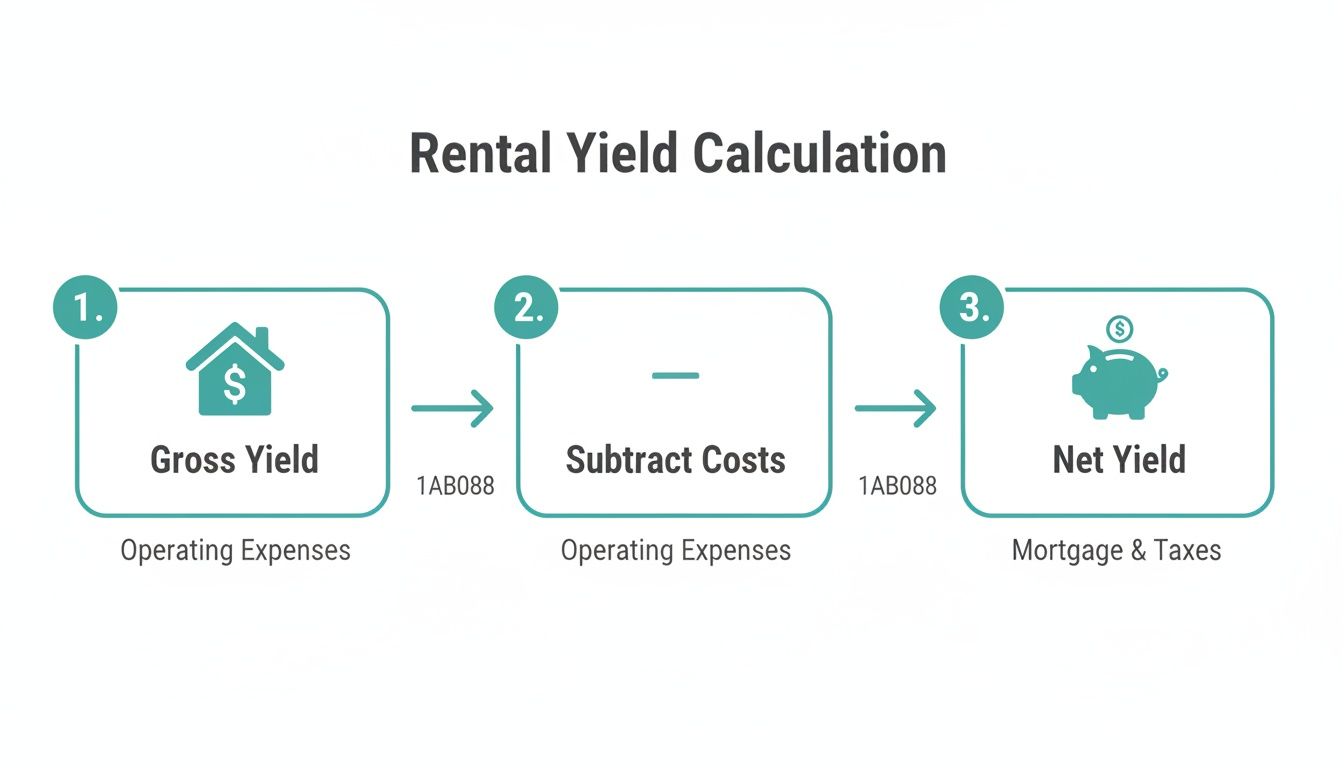 This process highlights that the initial gross yield is just a starting point, with the true return only revealed after accounting for all operational expenses.
Step 4: Arrive at the Final Net Yield
Now we have all the pieces of the puzzle. We can calculate the net yield, which reflects the property's genuine performance and the actual return on your invested cash.
The formula for net yield is:
Net Yield = ((Annual Rental Income - Annual Operating Costs) / Total Initial Investment) x 100
Let's plug in our numbers: ((£12,000 - £8,600) / £208,500) x 100 = 1.63% Net Yield
The difference is stark. Our promising 5.75% gross yield has been hammered down to a far more realistic 1.63% net yield. This is the figure that actually matters for assessing your cash flow and comparing this deal against other investment opportunities.
Running these numbers manually in a spreadsheet is doable, but it's slow and dangerously prone to error. An app like DealSheet AI automates this entire process. It extracts the data, applies UK-specific costs and tax rules like Section 24, and spits out an accurate net yield in seconds. This speed allows you to analyse far more deals and make faster, more confident decisions.
What Is a Good Rental Yield in the UK?
Trying to define a 'good' rental yield in the UK is like trying to nail jelly to a wall. There's no single magic number. A yield that looks incredible in one city might be painfully average in another. The right benchmark comes down to your location, the type of property, and most importantly, your personal investment strategy.
As a general rule of thumb, many investors aim for a net rental yield somewhere between 5% and 8%. But treat this as a starting point, not a universal truth. What really matters is understanding the story behind the numbers and what they signal about an investment.
Regional Variations and Realistic Benchmarks
The UK property market isn't one single entity; it's a patchwork of fiercely local markets, each with its own personality and yield profile. What counts as a strong return in one postcode can be completely different just a few miles down the road. A lower yield isn't always a red flag, just as a high one doesn't automatically mean you've struck gold.
For example, a 4% net yield on a flat in Central London could be a fantastic result. Why? Because you're also making a bet on powerful, long-term capital growth—the increase in the property's value over time. In prime locations, investors often accept lower monthly income for the potential of a much bigger payday when they eventually sell.
Head north to cities like Liverpool, Manchester, or Glasgow, and the game changes completely. Here, investors are often chasing higher yields of 7% or more. In these markets, the immediate cash flow from rent is the main prize, with capital growth being a welcome bonus rather than the primary goal.
The core principle is the trade-off between yield and growth. High-yield areas often offer lower capital growth potential, while high-growth areas tend to produce lower rental yields. Your strategy must decide which of these you want to prioritise.
This regional spread is where the real opportunities lie for savvy investors. While London might show average yields around 2.8% with eye-watering rents, other regions offer far more attractive income. The North East, for example, consistently shows some of the highest yields in the country. For more data on this topic, you can explore the full breakdown of UK rental yields on Global Property Guide.
How Investment Strategy Shapes Your Target Yield
The yield you should be aiming for will also shift dramatically depending on the type of investment you're making. Different strategies carry different levels of risk and management headaches, and your target return needs to reflect that. Our guide on what is a good rental yield digs into this further, but here's a quick overview.
-
Standard Buy-to-Lets: This is the bread and butter of property investing. For a standard, single-tenancy property in a solid area, a net yield of 4-6% is often considered a respectable return.
-
Houses in Multiple Occupation (HMOs): Renting a property out room-by-room to multiple tenants cranks up the rental income significantly. But it also brings a ton more management complexity and regulatory hoops to jump through. To make that extra work worthwhile, investors rightly expect a much higher return, often targeting net yields of 8-12% or more.
-
Serviced Accommodation: Properties let out on a short-term basis, like holiday lets, can produce seriously high income streams. The catch? They demand intense management, and you have to deal with fluctuating occupancy rates. Investors look for net yields well into the double digits—often 10-15% and above—to justify the effort.
Ultimately, a "good" rental yield is simply one that hits your financial targets and properly compensates you for the risk and effort you're putting in. Don't get fixated on a single number. Instead, use a rental yield calculator uk tool to analyse each deal in the context of its specific location and your wider strategy. It's this informed approach that helps you build a portfolio that truly works for you, balancing immediate cash flow with long-term wealth creation.
Common Mistakes That'll Wreck Your Rental Yield Calculations
An inaccurate yield calculation isn't just a maths problem; it's a decision that can turn what looks like a great investment into a financial black hole. Even seasoned investors can fall into common traps, painting a dangerously rosy picture of a property's real performance.
Getting your numbers right from the very start is the single best way to protect your capital and make sure your portfolio actually grows. Think of this as your due diligence checklist, designed to pressure-test your analysis and validate every assumption you make with a reliable rental yield calculator uk. Let's walk through the most frequent mistakes UK investors make and how you can sidestep them.
Underestimating Voids and Maintenance
This is, without a doubt, the most common and costly mistake. It's incredibly tempting to assume your property will be tenanted 12 months a year and that nothing will ever break. This is pure fantasy.
Real-world properties have void periods between tenancies, and boilers have a nasty habit of failing at the most inconvenient (and expensive) times. Forgetting to budget for these certainties will absolutely destroy your net yield.
Rule of Thumb: A conservative approach is to budget for one month's rent per year for voids. For maintenance, a widely accepted benchmark is to set aside 1% of the property's value annually. Another solid method is to budget 10% of the gross rental income.
Forgetting One-Off Purchase Costs
Your total investment isn't just the purchase price on the tin. Many investors, especially those new to the game, forget to factor in the significant upfront costs of simply buying the property when they calculate their yield.
This oversight artificially inflates your return on investment figure because it understates the total capital you've actually put on the line.
- Stamp Duty Land Tax (SDLT): This is a huge one, especially with the 3% surcharge on second homes.
- Legal Fees: Conveyancing costs can easily run into thousands of pounds.
- Survey and Valuation Fees: Essential for your due diligence and for getting the mortgage approved.
- Mortgage Arrangement Fees: Lenders often charge hefty fees to set up a buy-to-let mortgage.
You must add these to the purchase price to get your true total investment cost. This is the correct denominator for an accurate yield calculation.
Using Overly Optimistic Rental Figures
Another classic error. It's easy to just plug in the rental figure quoted in the agent's sales particulars without a second thought. But remember, estate agents are in the business of selling properties, and their rental estimates can sometimes be on the optimistic side to make the numbers look more attractive.
Basing your entire financial model on an unverified rental figure is a recipe for disappointment. If the property only achieves £100 less per month than you banked on, that's a £1,200 annual shortfall that comes directly out of your bottom line.
To avoid this, do your own homework. Check what similar properties in the immediate area have recently let for on portals like Rightmove and Zoopla. Better yet, pick up the phone and speak to a couple of local letting agents. Ask for a realistic, achievable rental figure for that specific property in its current condition.
Beyond Spreadsheets: The Power of Modern Analysis Tools
While a trusty spreadsheet has its place, serious UK property investors have moved on. To gain a competitive edge and make faster, more accurate decisions, they're using specialised tools. The traditional spreadsheet, once the go-to for deal analysis, is increasingly being replaced by more powerful, reliable, and efficient alternatives.

This isn't just about fancy tech; it's a necessary shift driven by the need for speed and precision in a market that moves incredibly fast. Let's break down the three main approaches investors use today and see where they fall short.
The Limits of DIY Spreadsheets
Spreadsheets are flexible, but they're also fragile. A single incorrect formula, a typo in one cell, or a forgotten expense can completely derail your analysis. That projected profit can quickly turn into a real-world loss. We've all been there.
The time commitment is another huge drawback. Manually punching in every single piece of data for every potential deal is a slow, repetitive chore. This inefficiency means you end up analysing fewer properties, and you risk missing out on great opportunities simply because you can't process them quickly enough.
Web Calculators: Quick but Superficial
Free online web calculators are definitely a step up from a manual spreadsheet. They're convenient for a rapid, back-of-the-envelope check of a property's gross yield and can be useful for a quick first filter.
But for serious due diligence? They're just too basic. These tools rarely account for the full spectrum of UK-specific costs, like Stamp Duty Land Tax (SDLT) or the punishing impact of Section 24 on mortgage interest for higher-rate taxpayers. They give you a glimpse, but not the full, detailed picture you need before committing serious capital. For a deeper dive into what a proper tool needs, our guide on the buy-to-let calculator UK investors actually need is a valuable read.
The Advantage of Dedicated Analysis Apps
This is where dedicated mobile apps like DealSheet AI create a clear and undeniable advantage. These platforms are built from the ground up specifically for property investment analysis, transforming it from a time-consuming headache into a genuine strategic strength.
Instead of wrestling with manual data entry, you can simply feed it a property listing URL. The AI instantly extracts all the key information—price, rent, address—and builds a complete financial model for you.
This modern approach offers several game-changing benefits:
- Speed: Analyse a deal in seconds, not hours. This lets you vet dozens of opportunities in the time it would have taken you to build a single, clunky spreadsheet.
- Accuracy: By using standardised, proven templates, you eliminate the risk of formula errors. The calculations are consistent and reliable, every single time.
- UK-Specific Intelligence: The app automatically applies the correct SDLT rates and models the impact of Section 24, ensuring your analysis actually reflects the current UK tax and legal environment.
To make the choice clearer, let's compare these tools side-by-side.
Property Analysis Tool Comparison
| Feature | Spreadsheet | Web Calculator | DealSheet AI App |
|---|---|---|---|
| UK Tax Logic (SDLT, S24) | Manual setup, high error risk | Often missing or simplified | Built-in, automated, and accurate |
| Speed | Very slow, manual data entry | Fast for basic calculations | Instant, from URL or photo |
| Accuracy | Prone to user error | Reliable for simple metrics | Deterministic and consistent |
| Complexity | Can be highly complex | Very basic, superficial | Handles complex scenarios easily |
| Accessibility | Desktop-bound, clunky on mobile | Good, web-based | Mobile-first, designed for on-the-go |
| Cost | "Free" but high time cost | Usually free | Subscription-based |
As the table shows, while spreadsheets and web calculators have their uses for hobbyists or one-off calculations, they don't provide the robust, repeatable framework that serious portfolio building requires.
Ultimately, using a purpose-built rental yield calculator UK app moves you beyond simple arithmetic. It provides the speed and, most importantly, the confidence needed to spot genuinely profitable deals and build your portfolio far more effectively.
Common Questions (and Clear Answers)
Even with the best calculator, a few key questions always pop up when you're analysing property deals. Here are the most common ones UK investors ask about rental yield, with practical answers to keep you on track.
How Often Should I Recalculate My Rental Yield?
It's good practice to recalculate the net yield for your properties at least once a year. A perfect time to do this is when you're reviewing your annual expenses anyway, like when your insurance renewal comes through or you get the updated service charge statement from your managing agent.
You should also definitely run the numbers again after any major financial change. This could be a rent increase, remortgaging onto a new interest rate, or even appointing a new letting agent with a different fee structure. Keeping your figures fresh means you always have an honest, up-to-date picture of how your portfolio is really performing.
Does a Rental Yield Calculator Account for Capital Gains Tax?
No, and it's not supposed to. A standard rental yield calculator uk is laser-focused on one thing: the income your property generates from rent. Think of it as a tool for measuring your property's operational health right now.
Capital Gains Tax (CGT) is a completely different beast. It only comes into play when you sell the property and is calculated on the profit you make from the increase in the property's value, not its rental income.
While CGT isn't part of a yield calculation, your potential liability is a huge factor in your overall investment return. It's a critical piece of your long-term exit strategy, but it's separate from your day-to-day yield.
Can I Include Property Price Growth in My Yield Calculation?
You really shouldn't. Mixing anticipated capital growth into a rental yield calculation muddies the waters completely. Rental yield is a specific metric designed to measure the return from rental income against your total investment cost. It's a measure of cash flow.
When you add predicted price growth into the mix, you're no longer calculating yield. You're forecasting your Total Return on Investment (ROI). While analysing potential capital appreciation is a vital part of assessing any deal, it's crucial to keep it separate from the rental yield figure to maintain clarity and avoid kidding yourself.
A strong yield puts immediate cash in your pocket today. Capital growth is just an unrealised, on-paper gain until you actually sell the property in the future. The most effective investors analyse both of these powerful metrics independently to build a balanced and resilient portfolio.
Stop wrestling with spreadsheets and start making faster, smarter investment decisions. With DealSheet AI, you can analyse any UK property deal in seconds and get the clear, accurate numbers you need to build your portfolio with confidence. Download DealSheet AI from the App Store and start your free trial today.