
A UK Beginner Property Investment Guide for 2026
A UK Beginner Property Investment Guide for 2026
Stepping into the world of UK property investment is one of the most reliable paths to building long-term wealth, but for a beginner, knowing where to start is key. The secret to a successful beginner property investment lies in mastering a solid, repeatable process for finding and analysing deals, with a standard buy-to-let in a high-demand area being a classic and effective first step. This guide breaks down that process, giving you the actionable insights needed for 2026. To sidestep costly mistakes, modern investors use technology to analyse opportunities quickly; a great first move is to download the DealSheet AI app, which lets you analyse any UK property deal in seconds.
Your First Steps into UK Property Investment
Getting started on your property investment journey is an exciting prospect. At its heart, the strategy is beautifully simple: buy assets that generate a steady rental income while, hopefully, growing in value over time. Success isn't about a secret formula but about building a disciplined, informed approach from day one.

This guide is designed to strip away the jargon and break down the essential concepts, strategies, and number-crunching you'll need to turn that ambition into a real, profitable portfolio. The goal is to get you from theory to action with confidence.
Laying the Groundwork for Success
Before you even think about scrolling through property portals, your first job is to get educated. Truly understanding the core numbers, your legal responsibilities, and how the market ticks will be your best defence against expensive errors. This foundational knowledge is what separates investors who are still in the game a decade later from those who quit after one bad experience.
A huge part of this is defining what "success" actually looks like for you. Your personal goals will shape every single decision you make, from the type of house you buy to how you finance it.
Think of it this way: you wouldn't set off on a long road trip without a map. In property, your goals are your map. They guide you towards your destination, whether that's early retirement, a bit of extra income, or building wealth for the next generation.
Building Your Investment Plan
Once your goals are clear, you can start putting together a practical plan. This comes down to a few key questions that will form the backbone of your entire strategy:
- Financial Readiness: How much cash can you actually put to work? This isn't just your deposit. You need to account for solicitor fees, Stamp Duty Land Tax (SDLT), and a rainy-day fund for unexpected repairs. A typical buy-to-let mortgage in the UK requires a 25% deposit.
- Strategy Selection: Are you playing the long game for rental income with a simple buy-to-let? Or are you more interested in forcing appreciation through renovation, like a property flip? Your answer will narrow down your property search dramatically.
- Market Research: Which towns or cities fit your budget and have strong rental demand? You're looking for places with solid local employment, good transport links, and the kind of amenities that tenants want.
- Sourcing Deals: How are you going to find potential investments? Portals like Rightmove are a good start, but many of the best deals are found "off-market" through networking or professional sourcers. To get a feel for what to expect, check out our deep dive into property deal sourcing in the UK.
Nailing these points gives you a clear framework, making the whole process feel much less overwhelming and a lot more achievable.
Understanding the Numbers That Drive Property Deals
Before you can spot a genuinely good deal, you have to speak the language of property finance. Getting a handle on a few key numbers is non-negotiable for any serious investor, especially if you're just starting out. These metrics cut through the sales pitch and tell you the real story of a property's potential.

Think of it like learning the rules before you play the game; without them, you're just guessing. We'll break down the essential figures that drive every investment, from the headline rent right down to the actual cash that lands in your bank account each month.
Gross Yield and Net Yield: The Starting Point
The first metric you'll hear thrown around is Gross Yield. It's a quick, back-of-an-envelope calculation that gives you a rough baseline for comparing different properties. It simply measures the total annual rent against the property's purchase price.
- Formula: (Annual Rental Income / Property Purchase Price) x 100 = Gross Yield %
But here's the thing: Gross Yield is a vanity metric. It's useful for a fast first look, but it completely ignores all the costs of actually running the property. This is where Net Yield steps in, giving you a much more realistic picture by factoring in all your operational expenses.
Net Yield is the metric that actually matters. It's the difference between a deal that looks good on a listing and one that truly performs in the real world. It accounts for everything from insurance and maintenance to letting agent fees.
Return on Investment: The True Measure of Performance
Return on Investment (ROI), often called 'Cash on Cash Return', is arguably the most important number for any property investor to master. While yield measures a property's performance against its price tag, ROI tells you how well the actual cash you personally invested is working.
This is a crucial difference. Your invested cash isn't just the deposit. It's every penny you paid out of your own pocket—the deposit, Stamp Duty, solicitor fees, and any money spent on refurbishment. ROI shows you how hard your money is working for you.
- Formula: (Annual Net Profit / Total Cash Invested) x 100 = ROI %
A deal with a 7% Net Yield might sound great, but if it required a massive cash investment from you, the ROI could be disappointingly low. On the flip side, a property with a lower yield but financed cleverly with less of your own cash could deliver a fantastic ROI. For a deeper look, check out our guide on using an investment property calculator for UK deals.
Cash Flow: The Monthly Reality
Finally, we get to the lifeblood of any rental portfolio: Cash Flow. This is the tangible, spendable profit left in your bank account each month after the mortgage and all other running costs have been paid.
Positive cash flow means the property pays for itself and leaves you with extra income. Negative cash flow means you're topping it up from your own salary every month—an unsustainable position for most investors. As we look towards 2026, forecasts suggest continued rental growth in key UK regions, which should help support healthier cash flows for landlords who buy in the right areas.
UK Tax Rules You Cannot Ignore
Understanding the deal's numbers is only half the battle. You absolutely have to factor in the UK-specific tax rules that directly hit your bottom line.
- Stamp Duty Land Tax (SDLT): This is the tax you pay when buying a property. For investment properties, you're hit with a higher rate, which includes a 3% surcharge on top of the standard residential bands. It's a huge upfront cost that must be included in your ROI calculations.
- Section 24 (The Landlord Tax): A real game-changer in recent years, this rule stops individual landlords from deducting their mortgage interest costs from rental income before calculating their tax bill. Instead, you get a tax credit equal to 20% of your interest payments. For higher-rate taxpayers, this has massively increased the tax burden and squeezed profitability.
These tax rules are complex, but they have a direct and significant impact on your net profit and cash flow. Ignoring them can turn a deal that looks profitable on paper into a serious financial drain.
Choosing Your Beginner Investment Strategy
Picking the right strategy is one of the most important first steps you'll take. There's no single "perfect" approach here; the best path for you comes down to your available cash, what you want to achieve long-term, and how much risk you're comfortable with. Your choice dictates everything that follows, from the type of property you'll be looking for to how much time you'll spend managing it.
This section offers a practical look at the most common routes for new investors in the UK. We'll break down four popular strategies: the classic Buy-to-Let (BTL), Houses in Multiple Occupation (HMOs), property 'Flipping', and the powerful BRRRR method. Each offers a completely different balance of income, capital growth, and hands-on effort.
The Classic Buy-to-Let (BTL)
The standard Buy-to-Let is the most common entry point for a reason. It's straightforward, can be relatively passive, and is laser-focused on generating a steady, reliable monthly income.
The idea couldn't be simpler: you buy a property—usually a flat or a small house—and rent it out to a single tenant or family. It's the ideal starting point for investors who want long-term, stable returns without the day-to-day intensity of other strategies. Your main goal is to have money left in the bank each month after the mortgage and all other costs have been paid. While it won't give you the huge, quick profits of a successful flip, it's a brilliant way to build a solid foundation for your portfolio.
Houses in Multiple Occupation (HMOs)
An HMO is simply a property rented out by at least three people who aren't from the same family but share facilities like the kitchen and bathroom. Think of it as renting out a property one room at a time. The big appeal? The potential for significantly higher cash flow compared to a standard BTL.
But that extra return comes with extra responsibility. HMOs are a much more active form of investment, demanding more hands-on management to deal with multiple tenancies, higher tenant turnover, and often, more maintenance. They're also covered by stricter regulations, including mandatory licensing from the local council and specific fire safety standards. This strategy is a great fit for investors who are ready to be more involved in exchange for those beefier yields.
Key Insight: The UK rental market is changing, and understanding this shift is vital for finding your edge. A huge trend for new investors to watch is the rise of big, institutional landlords. By 2026, the UK is projected to have over 150,000 completed build-to-rent (BtR) homes. While these giants focus on shiny new-build blocks, they create opportunities for individual investors to target older, slightly tired properties that the big players ignore. These are the properties with fantastic potential for refurbishment and much higher yields. You can discover more insights into this trend and what it means for private landlords.
Flipping for Capital Growth
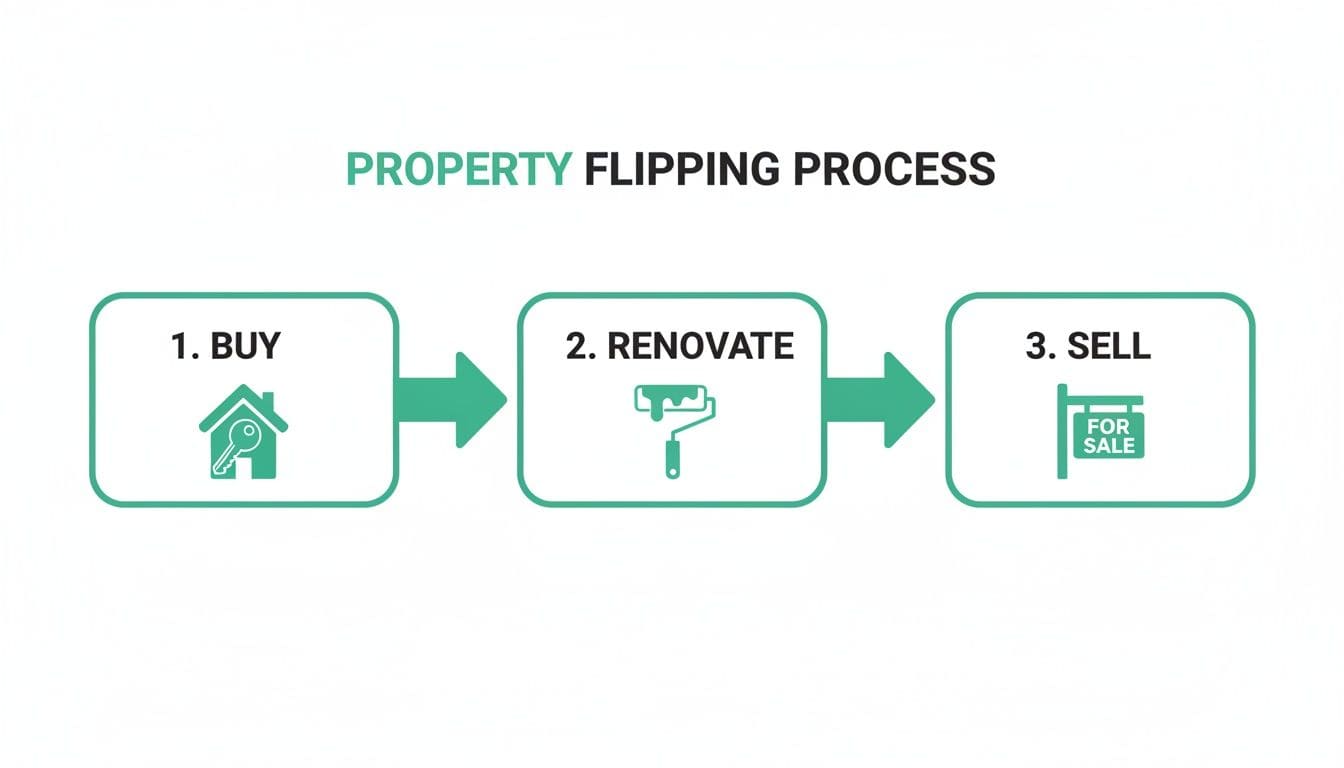
'Flipping'—or the Buy, Renovate, Sell strategy—is all about chasing capital growth, not rental income. The game here is to buy a property that's undervalued, add value through a well-executed refurbishment, and then sell it on for a tidy profit in a short space of time, typically within six to twelve months.
This approach requires a good eye for a property's hidden potential, the ability to budget a renovation accurately, and a solid grasp of the local sales market. It can be incredibly profitable, but it also carries higher risk. If the market suddenly dips or your renovation costs spiral out of control, that healthy profit margin can vanish overnight. Flipping is best suited for those with project management skills and access to short-term finance like bridging loans.
The BRRRR Method for Scaling
The BRRRR method—which stands for Buy, Refurbish, Rent, Refinance, Repeat—is a powerful cyclical strategy designed to help you build a portfolio quickly by recycling the same pot of cash over and over again. It cleverly combines the value-add of flipping with the cash flow of buy-to-let.
Here's the process in a nutshell:
- Buy: You find and purchase a property that needs work, securing it below its true market value.
- Refurbish: You renovate the property to a high standard, forcing its value to increase significantly.
- Rent: You find tenants and let the property out, establishing a consistent rental income.
- Refinance: You then go to a lender and remortgage the property based on its new, higher valuation. This allows you to pull out your initial investment cash (and sometimes even more).
- Repeat: You take that pot of cash you just pulled out and use it as the deposit for your next deal.
BRRRR is a fantastic engine for growth, but it demands careful planning, a solid understanding of property values, and a good mortgage broker. To dig deeper into this and other approaches, check out our comprehensive guide on UK property investment strategies to see which one truly aligns with your goals.
To help you see how these strategies stack up side-by-side, we've put together a simple comparison table. This should make it easier to see which path might be the right starting point for you.
Comparing Beginner Property Investment Strategies
| Strategy | Primary Goal | Typical ROI | Capital Required | Management Intensity |
|---|---|---|---|---|
| Buy-to-Let (BTL) | Consistent cash flow & long-term growth | 4-8% | Medium | Low |
| HMO | High cash flow | 10-20%+ | Medium-High | High |
| Flipping | Quick capital profit | 20%+ per project | High (often short-term finance) | High (project-based) |
| BRRRR | Portfolio growth & capital recycling | 15%+ (highly variable) | Medium (recyclable) | High |
Each strategy has its own unique profile. A classic BTL is a slow-and-steady builder, whereas flipping is a high-stakes sprint. HMOs are for those who want to maximise income, and BRRRR is for those who want to build a portfolio fast. Your job is to pick the one that best fits your financial situation and the amount of time and effort you're willing to put in.
How to Analyse a Property Deal Like a Pro
Finding a potential property is the easy bit. The real skill—the one that separates successful investors from those who make expensive mistakes—is knowing if it's actually a good deal.
Mastering deal analysis is everything. It all starts with what's known as 'desktop analysis', a quick screening process you can do from your computer to filter out the duds. This first step saves you a mountain of time and energy, letting you focus only on the deals with genuine potential.
Starting with Desktop Analysis
Before you even dream of booking a viewing, you need to get good at spotting red flags in online listings. Your main tools here are the big property portals like Rightmove and Zoopla. Your job is to look past the professionally shot photos and dig into the details.
A listing with no floor plan? Blurry photos of the kitchen or bathroom? Vague descriptions? These can be early warning signs. It's also worth checking the property's history. Has it been languishing on the market for months, or has the price been slashed several times? That could point to underlying problems.
Next, get a quick feel for the potential rent. Search for similar properties—same number of bedrooms, similar condition—that are currently up for rent in the immediate area. This gives you a realistic monthly rental figure, the 'market rent', which is the foundation for all your future calculations.
Building Your Financial Model
Once a property passes your initial desktop sniff test, it's time to build a simple financial model. Don't worry, this isn't as scary as it sounds. You're just creating a forecast of all the money coming in and all the money going out.
Your model absolutely must include:
- Purchase Costs: This is much more than just the offer price. You have to account for Stamp Duty Land Tax (SDLT), solicitor fees, survey costs, and any mortgage arrangement fees.
- Refurbishment Budget: Does the property need work? Be brutally honest about the costs. A new kitchen, bathroom, or boiler isn't cheap. Always add a 10-15% contingency on top for the nasty surprises that always crop up.
- Ongoing Expenses: These are the regular costs of being a landlord. Factor in mortgage payments, landlord insurance, letting agent fees (typically 10-12% of rent), a pot for repairs, and annual safety checks like the gas safety certificate.
For a much deeper dive into the numbers, our complete guide to analysing UK buy-to-let deals for 2026 breaks this down even further.
A Real-World Example
Let's put this into practice. Imagine a typical two-bedroom terrace, a classic choice for a first investment.
- Purchase Price: £150,000
- Total Purchase Costs (including SDLT & fees): £9,000
- Refurbishment Budget: £6,000
- Total Cash Invested (25% deposit + costs): £37,500 + £9,000 + £6,000 = £52,500
Now, let's look at the income and running costs:
- Monthly Rent: £850 (£10,200 per year)
- Monthly Mortgage (interest-only): £470
- Monthly Expenses (insurance, agent, maintenance): £170
- Total Monthly Outgoings: £640
With these figures, we can finally calculate the metrics that matter:
Gross Yield: (£10,200 / £150,000) x 100 = 6.8% Monthly Cash Flow: £850 - £640 = £210 (£2,520 per year) Return on Investment (ROI): (£2,520 / £52,500) x 100 = 4.8%
This process reveals the true performance of the investment, not just a headline figure. While you can do this manually, tools exist to make it much faster. An app like DealSheet AI automates this entire underwriting process. You just paste in a property link and it generates a complete financial breakdown in seconds, applying all the correct UK tax rules automatically.
This is a different strategy, but the principle of understanding your numbers is the same for property 'flipping'.

The flow from buying an undervalued property to renovating and selling it is all about actively creating value, rather than passively earning it through rent. Even with recent tax changes, the UK market offers plenty of opportunities for those who do their homework. While gross buy-to-let yields averaged 7.5% nationally in 2025, they often climb to 9-12% in high-demand northern cities like Manchester and Liverpool. This resilience is notable, as UK real estate still delivered 8.1% total returns up to February 2025, despite investment volumes falling 33% to £8bn in Q1 2025, which can create buyer-friendly pricing for those ready to act. You can learn more about 2025 UK property market trends and how they impact new investors.
Financing Your First UK Investment Property
Sorting out the finance is often the biggest hurdle when you're starting out in property. Unlike buying your own home, getting a loan for an investment property plays by a completely different set of rules. Getting your head around these differences is the first step to structuring a deal that actually makes money.
The whole process can feel a bit overwhelming, but what it really boils down to is proving to a lender that your plan makes solid financial sense. They'll look at you, the property itself, and the income it's likely to bring in. Nail this part, and you've got the key to your first purchase.
Buy-to-Let Mortgages vs Residential Mortgages
First things first: you can't use a standard residential mortgage to buy a rental property. It's just not allowed. You need a specific product called a Buy-to-Let (BTL) mortgage, and while the name is similar, the way lenders assess them is worlds apart.
The most noticeable difference is the deposit. For a BTL mortgage, you'll almost always need to find a minimum deposit of 25% of the property's value. That's a fair bit higher than what you might need for a home you're going to live in.
Another key feature is that most BTL mortgages are set up on an interest-only basis. This means your monthly payments only cover the interest on the loan, not the capital you borrowed. The big advantage here is lower monthly outgoings, which helps maximise your cash flow — and that's the name of the game for most investors. The full loan is then paid back at the end of the term, usually by selling the property or refinancing onto a new deal.
How Lenders Assess Your Application
When you apply for a BTL mortgage, lenders really only care about two things: can the property pay for itself, and are you a reliable borrower? They figure this out using a couple of key calculations.
- Interest Coverage Ratio (ICR): This is the big one. Lenders need to be confident that the rent you'll receive will cover the mortgage payment by a healthy margin. Typically, they'll want to see the rent covering at least 125% of the monthly mortgage payment, calculated at a "stress-tested" interest rate that's often around 5.5% or even higher.
- Personal Income: While the property's rent does the heavy lifting, many lenders still want you to have a minimum personal income, often around £25,000 per year. This just proves you have a financial cushion to fall back on if things go wrong.
- Credit Profile: A clean credit history is non-negotiable. Lenders need to see you're good at managing your finances before they'll trust you with theirs.
Alternative Financing Options
Standard BTL mortgages aren't the only route. Depending on your strategy and the state of the property, you might need to look at other ways to fund your purchase.
Expert Tip: Don't get stuck thinking there's only one way to fund a deal. The most successful investors are creative with their financing, carefully matching the right product to the right project to boost their returns and protect their cash.
Limited Company (SPV) Purchases Because of the Section 24 tax changes, a lot of investors now buy properties through a Limited Company, often called a Special Purpose Vehicle (SPV). This can give you some serious tax benefits, mainly because you can deduct the full mortgage interest as a business expense. The trade-off is that mortgage rates for companies can be a touch higher, and you'll have the extra admin that comes with running a business.
Bridging Loans For certain deals, a bridging loan is an essential tool. Think buying at auction where you need funds fast, or buying a wreck of a property that's currently unmortgageable. A bridging loan is a short-term loan, usually for up to 12 months, designed to 'bridge' the gap until you can get long-term finance or sell the property on. They are much quicker to arrange but come with higher interest rates and fees. To get a feel for the costs, you can learn more about how a bridging loan calculator works.
Refinancing for Growth Refinancing isn't just about finding a better interest rate; it's a powerful engine for growing your portfolio. This is the absolute cornerstone of the BRRRR (Buy, Refurbish, Rent, Refinance, Repeat) strategy. Once you've added value to a property through a refurbishment, you can refinance it based on its new, higher valuation. This lets you pull your initial investment back out, ready to be used as the deposit for your next deal.
Building Your Property Investment Toolkit
Let's be honest, success in property isn't about working harder; it's about working smarter. To get a real edge in today's market, you need efficient systems, not just sheer effort. That means assembling a toolkit of essential resources and, just as importantly, a reliable team to back you up. This is how you move from guesswork to speed and accuracy.
Your toolkit starts with how you find opportunities. Of course, property portals like Rightmove and OnTheMarket are your main hunting grounds, but don't just browse aimlessly. Get specific. Set up targeted alerts for certain postcodes, property types, and even keywords like "requires modernisation" or "no chain" to have the most promising deals sent straight to you.
Assembling Your Power Team
No investor is an island. A huge part of your toolkit is your professional network—what many of us call a 'power team'. These are the experts who'll guide you through the minefield of legal and financial complexities that come with every single deal.
Your power team must include:
- A Specialist Mortgage Broker: Don't just go to any high street broker. You need someone who lives and breathes buy-to-let finance and truly gets the nuances of lender criteria for investors.
- An Experienced Solicitor: A good property solicitor who actually communicates and works efficiently can be the difference between a deal sailing through smoothly or collapsing under the pressure.
- A Local Letting Agent: Their on-the-ground knowledge is gold dust. They can give you realistic rental valuations and confirm local demand, making sure your financial forecasts are based on reality, not optimism.
Embracing Technology for a Competitive Edge
A great team is vital, but technology is what will really set you apart from the competition. Fragile, error-prone spreadsheets just don't cut it anymore for serious deal analysis. The modern investor needs a tool that guarantees both accuracy and speed, allowing you to sift through more opportunities and get offers in faster than anyone else.
This is where technology stops being a 'nice-to-have' and becomes a non-negotiable part of your strategy. Instead of wasting hours manually calculating Stamp Duty Land Tax or trying to model the impact of Section 24, a dedicated tool can do it in seconds. That frees you up to do what really matters: finding the next deal.
A purpose-built analysis app like DealSheet AI is designed to do exactly this. It completely removes the risk of manual error by automatically applying complex UK rules, ensuring every deal you look at is judged against the same tough standards. This is how you start making data-driven decisions with real confidence, turning a messy process into a simple, repeatable system for building your portfolio.
Your Top Questions Answered
When you're just starting out in property, it feels like there are a million questions and a mountain of jargon to climb. Getting simple, straight answers is the first step to feeling confident enough to actually do something.
Let's tackle some of the most common questions I hear from new investors across the UK, breaking them down into practical, no-nonsense advice.
How Much Money Do I Really Need to Start Investing in UK Property?
This is the big one, and the honest answer is: it depends where you're buying. But as a solid rule of thumb, you'll need a 25% deposit for a standard buy-to-let mortgage.
So, for a £150,000 property, that's a £37,500 deposit. But that's not the whole story. You absolutely must budget for the other costs that catch people out: Stamp Duty (SDLT), solicitor fees, and survey costs. These can easily add another 5-7% on top.
For that same £150,000 house, a realistic starting budget is closer to £45,000-£50,000. That gives you the cash you need to actually complete the purchase without any nasty surprises.
Is Buying Property Through a Limited Company a Good Idea?
This comes down to your personal tax situation, and it's a game-changer for many. If you're a higher-rate taxpayer, buying through a limited company (often called a Special Purpose Vehicle or SPV) is often far more tax-efficient. This is mainly because of the infamous Section 24 rules, which hammered individual landlords by restricting how much mortgage interest they could claim against tax.
With a company, profits are hit with corporation tax, and you get more options for how you take money out. The trade-off? Mortgage rates for companies are usually a bit higher, and there's more paperwork involved.
This is not a decision to make lightly. You must get proper advice from a qualified property accountant who can run the numbers for your specific circumstances. Don't skip this step.
What's the Best UK Area for a Beginner to Invest in?
There's no magic "best" area, but there are definitely smarter places for a first-timer to look. You want to find cities with a healthy mix of strong rental demand, a growing population, and good transport links.
For beginners, the numbers often stack up better in the North of England and the Midlands. Cities like Liverpool, Manchester, Leeds, and Birmingham tend to offer a sweet spot of lower purchase prices and much healthier rental yields (7-9%+) compared to the overheated markets in London and the South East.
My advice is to focus your search on areas with solid local economies, a university presence, and visible regeneration projects. That's a great recipe for a solid first beginner property investment.
Stop guessing and start analysing. With DealSheet AI, you can analyse any UK property deal in seconds, get accurate financial forecasts, and make offers with confidence. Download the DealSheet AI app and start your free trial today.