
Investing in UK Student Accommodation: Your 2026 Guide
Investing in UK Student Accommodation: Your 2026 Guide
Investing in UK student accommodation is a proven strategy for property investors seeking high rental yields and consistent demand, making it one of the most resilient sectors in the market. The key to success lies in understanding the unique dynamics of this asset class, from selecting the right university city to accurately forecasting your net returns. This guide provides the actionable insights you need for investing student accommodation in 2026 and beyond. To run the numbers on potential deals with speed and precision, the DealSheet AI app is an indispensable tool for modelling cash flow and ROI directly from your phone.
Why Student Accommodation Is a Smart Investment in 2026

The UK student property market isn't a niche anymore; it's a mature, mainstream asset class pulling in serious capital. For private investors, it offers a rare blend of predictable tenant demand and the potential for returns that often outpace traditional buy-to-lets. The logic is hard to argue with: UK universities keep attracting students, and those students always need a place to live.
This creates a wonderfully defensive investment. It's far less vulnerable to wider economic wobbles. A young professional might move back home during a recession, but a student is tied to their university town for the entire length of their degree.
The Numbers Driving the Demand
The case for investing student accommodation is backed by some compelling data. Industry revenue is on track to hit £7.2 billion in 2025-26, a figure fuelled by record student numbers clashing with a chronic undersupply of suitable housing.
In fact, by 2026, experts are forecasting a staggering shortfall of over 620,000 student beds across the UK. This fundamental imbalance between supply and demand is what keeps pushing rents up and occupancy rates high, creating a perfect storm for landlords. You can read more about these property market trends to see the detailed analysis.
This structural deficit presents a clear opportunity for investors, bringing several key benefits:
- Higher Yields: Student properties, especially HMOs (Houses in Multiple Occupation), consistently generate higher rental yields than their single-let counterparts.
- Minimal Void Periods: Tenancies are typically fixed for a 10-12 month term. In strong university cities, demand is so fierce that rooms for the next academic year are often snapped up months in advance.
- Parental Guarantors: Securing a parental guarantor for each tenant is standard practice. This acts as a powerful safety net, dramatically reducing the risk of rent arrears.
Here's a quick look at the key drivers that make this sector so compelling for investors.
UK Student Accommodation Investment at a Glance
| Metric | Key Data Point | Implication for Investors |
|---|---|---|
| Projected Market Revenue | £7.2 billion in 2025-26 | A large, stable, and growing market with strong financial fundamentals. |
| Supply Shortfall | 620,000+ beds by 2026 | Chronic undersupply creates upward pressure on rents and high occupancy rates. |
| Typical Tenancy | Fixed 10-12 month terms | Predictable income stream with minimal void periods compared to other rental types. |
| Risk Mitigation | Parental guarantors are standard | Significantly reduces the risk of rent arrears, providing greater financial security. |
| Yield Potential | Often higher than traditional BTL | HMOs in particular offer the chance for enhanced rental yields and cash flow. |
These figures paint a clear picture: the fundamentals are solid, and the demand isn't going anywhere.
For newcomers, it's worth remembering that many principles of student lets overlap with other property strategies. Nailing the basics is essential. Our beginner's guide to property investment covers foundational knowledge that applies right across the board.
Choosing Your Investment Path: PBSA vs. HMOs
When you're serious about investing student accommodation, your first big decision is about the kind of asset you'll be chasing. The UK market really splits into two main camps: the corporate-scale world of Purpose-Built Student Accommodation (PBSA) and the more traditional, boots-on-the-ground route of Houses in Multiple Occupation (HMOs).
Each path comes with a completely different risk and reward profile, and they line up with very different investor goals and bank balances.
PBSA developments are the modern, shiny face of student living. Think large blocks, packed with self-contained studios or cluster flats, often boasting shared gyms, cinemas, and study lounges. For an investor, this can be a relatively hands-off game, as they're usually run by huge, specialist operators. The whole model is built for scale, appealing to institutional funds and high-net-worth individuals who can write seriously big cheques.
On the other hand, a student HMO is your classic Victorian terrace or semi-detached house, converted to be let room-by-room to a group of three, four, five, or more students. This is the traditional entry point for private landlords. It's definitely more hands-on, but it can generate much punchier yields on a single-asset basis and needs a fraction of the upfront capital compared to a PBSA scheme.
The Appeal of Institutional-Grade PBSA
The PBSA sector has grown up. It's now a multibillion-pound marketplace that pulls in significant global capital, and its appeal is all about scalability and the professional management that holds it all together. Investors aren't just buying a residential let; they're buying into a commercial property asset class.
This part of the market is a beast. To give you an idea, a staggering £830 million was ploughed into UK PBSA in Q2 2025 alone, showing just how hungry the big players are. With prime yields in London sitting around 4.25% and in top regional cities at 5.25%, the returns are still compelling next to other asset classes. You can explore the full report on UK student homes investment to dig into the numbers.
This institutional backing gives the sector a stability and liquidity you just don't find in the fragmented HMO market.
The bottom line with PBSA is you're buying into a professionally managed, purpose-designed product. The operational headaches are someone else's problem, but that convenience comes at the cost of a much higher entry price and potentially lower net yields than a well-run, self-managed HMO.
The High-Yield Potential of Student HMOs
For most private UK investors, the HMO is the more realistic—and often more profitable—way into investing student accommodation. The upfront cash needed is a tiny fraction of what a PBSA development demands, making it far more accessible.
The real magic of an HMO is in its rental arithmetic.
By letting a property on a per-room basis, you can generate a much higher gross income than you could by letting the same house to a single family. For instance, a four-bedroom house that might fetch £1,600 a month as a family home could easily achieve £550 per room as a student HMO. That's a total of £2,200 a month, a huge uplift.
Here's a simplified breakdown to show the difference in scale:
| Feature | Purpose-Built Student Accommodation (PBSA) | House in Multiple Occupation (HMO) |
|---|---|---|
| Typical Investor | Institutional funds, property companies | Private landlords, small investors |
| Capital Outlay | £5M - £100M+ | £150,000 - £750,000+ |
| Management | Specialist third-party operators | Often self-managed or by a local agent |
| Yield Profile | Lower but stable (4-6% Net) | Higher but more variable (6-10%+ Net) |
| Scalability | High (buying entire blocks) | Lower (building a portfolio house by house) |
While HMOs offer seriously compelling returns, they do come with more management intensity. You're on the hook for everything—finding tenants, collecting rent, and making sure the property meets strict licensing and safety rules.
Getting the numbers right from the start is critical. That's why understanding how to evaluate HMOs properly is a non-negotiable skill for any aspiring student landlord. Your choice between these two routes ultimately boils down to your available capital, your appetite for hands-on work, and what you want your portfolio to look like in the long run.
How to Analyse Student Accommodation Deals
Running the numbers properly is what separates a calculated investment from a hopeful gamble. A glossy brochure showing a high gross yield is tempting, but it's the net figures—after all the messy, real-world costs are factored in—that actually matter. This is where you make your money.
Getting your underwriting right means forecasting your operational expenses with an almost pessimistic level of detail. Student properties, especially HMOs, have a unique cost profile that can easily catch out new investors. We'll break down how to account for everything from higher maintenance demands to the inevitable summer void periods, ensuring your financial model is built for reality, not just for paper.
Moving Beyond Gross Yield
The first mistake I see investors make is getting fixated on the gross yield. It's a simple metric—annual rent divided by the purchase price—and it's a decent starting point for filtering deals. But it tells you absolutely nothing about the property's real performance.
To get a true picture, you have to dig down to the Net Operating Income (NOI).
NOI is your gross rental income minus all your operational running costs, but crucially, it's calculated before you account for mortgage payments. This figure shows you how profitable the asset is on its own, regardless of how you've financed it.
The operational costs for student lets are non-negotiable and need to be itemised properly. Key things to factor in are:
- Letting Agent Fees: For a fully managed student let, you're typically looking at 10-15% of gross rent. Don't underestimate this; managing students can be intensive.
- Utilities: Most student lets are advertised with 'bills included'. You absolutely must forecast costs for gas, electricity, water, and high-speed broadband. Get recent bills if you can.
- Council Tax: While students are exempt during term time, you, the landlord, are liable for council tax during any void periods. That summer gap can sting if you haven't budgeted for it.
- Insurance: You'll need specialist landlord and HMO insurance, which is more expensive than a standard buy-to-let policy.
- Licensing Fees: Mandatory HMO licensing costs vary by council. Find out the exact fee and amortise it over the licence period (usually five years) in your model.
- Maintenance: This is a big one. Student properties get a lot of wear and tear. A good rule of thumb is to budget at least 10% of your gross rent for ongoing maintenance and repairs.
Here's a simple flowchart that shows how financial modelling is the final, critical checkpoint before you ever commit to a deal.
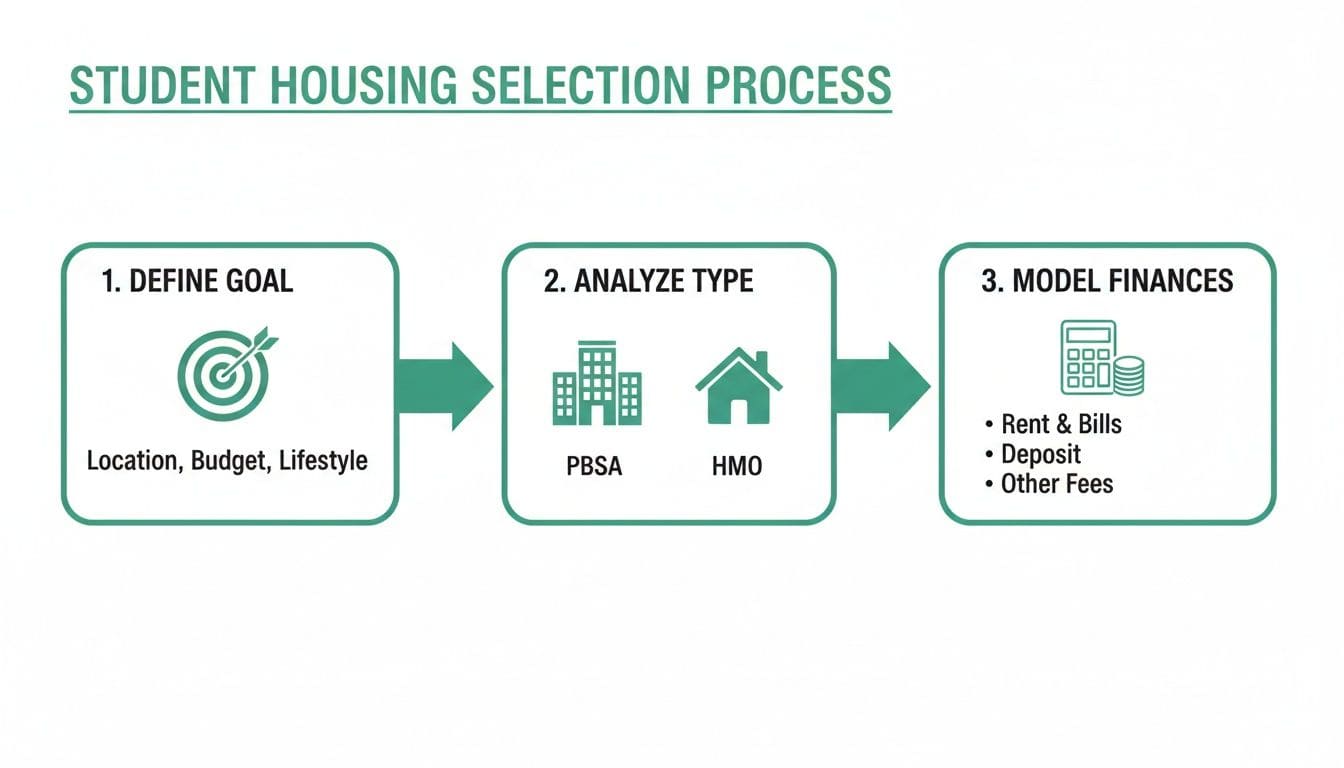
This visual really drives home the point: your financial model is the last gate you pass through before putting your capital at risk.
Factoring in Voids and Capital Expenditure
Two of the biggest profit-killers in student property are voids and Capital Expenditure (CapEx). They are predictable, so you need to plan for them.
Unlike a standard buy-to-let, you should realistically expect a two-to-three-month void period over the summer. Some landlords get lucky with 12-month tenancies or find short-term summer lets, but you shouldn't rely on it. Always analyse your deal based on a 10-month academic year to be safe. Any extra income is a bonus.
Then there's CapEx. This isn't your day-to-day maintenance budget; this is for the big-ticket items that need replacing over time. For a student HMO, this is non-negotiable.
A smart way to handle this is to set aside a separate "sinking fund," contributing at least 5% of your gross annual rent. This fund is there to cover future costs like a new boiler, a kitchen refresh, or replacing all the bedroom furniture every five to seven years.
Without a CapEx budget, your monthly "cash flow" is an illusion. A single boiler failure could wipe out an entire year's profit if you haven't planned for it.
To help you structure this, here's a sample checklist of the kind of items you should be including in your financial analysis for a student property.
Sample Underwriting Checklist for a 6-Bed Student HMO
| Category | Item/Consideration | Example Annual Estimate (£) |
|---|---|---|
| Revenue | Gross Annual Rent (based on 10 months) | 36,000 |
| Operating Costs | Letting Agent Fees (12% of Gross Rent) | 4,320 |
| Landlord Insurance | 600 | |
| Utilities (Gas, Electric, Water) | 3,600 | |
| High-Speed Broadband | 480 | |
| Council Tax (Summer Void Period) | 500 | |
| HMO Licence Fee (Amortised over 5 years) | 200 | |
| Annual Gas Safety & PAT Testing | 150 | |
| Reserves | Maintenance Sinking Fund (10% of Gross Rent) | 3,600 |
| Capital Expenditure (CapEx) Fund (5% of Gross Rent) | 1,800 |
This table isn't exhaustive, but it gives you a solid framework. Your numbers will vary, but the categories won't. Being methodical here prevents nasty surprises down the line.
Stress-Testing Your Deal
A solid underwriting model doesn't just work on today's numbers; it has to withstand pressure. What happens to your cash flow if mortgage interest rates rise by 2%? What if a major repair bill lands unexpectedly? What if rental growth stalls for a year?
This is where you need to look at the market critically. While UK student accommodation has seen strong rental growth, affordability is becoming a real issue. Operators are increasingly using incentives like cashback offers or rent-free weeks to keep rooms full. One report on student rent trends highlighted that while university-owned rents grew by 4.44%, the value of incentives grew much faster at 15% annually.
This trend is a huge red flag if you're not paying attention. It means you need to model scenarios where your headline rent is achieved, but your net income is chipped away by incentives or slightly longer voids. Building these sensitivities into your analysis gives you a much clearer picture of a deal's true resilience.
For a deeper dive into the mechanics of deal analysis, our complete guide to analysing UK buy-to-let deals for 2026 gives you the foundational knowledge to build financial models that stand up to scrutiny.
Navigating Finance and Tax for Student Properties
Getting the finance and tax structure right is where many student property investments either fly or fail. Get it wrong, and you can see your profits disappear before the first rent cheque even clears. The world of student lets is a different beast to standard buy-to-let, and that means your approach to borrowing and tax planning needs to be sharper.
Your financing options really hinge on the scale of your project. For a smaller student HMO, maybe up to six rooms, you'll find plenty of lenders offering specialist buy-to-let mortgages. These products are pretty familiar, but be prepared for extra scrutiny. Lenders will dig into the deal's rental coverage and want to see some evidence of your experience as a landlord.
Once you step up to larger HMOs (think seven beds or more) or a full-blown PBSA block, you're squarely in commercial finance territory. This is a completely different conversation. Lenders here act less like a mortgage provider and more like a business partner. They'll expect a detailed business plan, proper cash flow forecasts, and solid proof that you know how to run a more complex asset.
Understanding What Lenders Are Looking For
Lenders see student properties for what they are: higher-yielding but also carrying higher risk. They need to know you've done your sums.
- Deposit Size: You'll need more skin in the game. Expect to put down a larger deposit than for a standard BTL, typically 25-30% of the property's value.
- Rental Coverage Ratios: The stress tests are tougher. Lenders will want to see that the rent covers the mortgage payment by a healthy margin, often 145% or more, calculated at a higher "notional" interest rate.
- Landlord Experience: It's not always a deal-breaker, but a proven track record opens doors to better mortgage deals. Some lenders simply won't touch an HMO for a first-time landlord.
The bottom line is this: lenders need to see a profitable, well-researched business proposal. They're not just funding a house purchase; they're backing your ability to run a successful property business. Your application has to reflect that level of professionalism.
Tackling the UK Tax Landscape
With finance in place, your next battle is tax efficiency. The UK property landscape has been reshaped by two key pieces of legislation: Stamp Duty Land Tax (SDLT) and the Section 24 mortgage interest relief rules.
SDLT is the tax you pay when you buy property in England and Northern Ireland. If this isn't your first property, you'll be hit with a 3% surcharge on top of the standard rates. This can be a hefty upfront cost, so it absolutely must be baked into your initial deal analysis. If you want to get into the nuts and bolts, our team has put together a simple guide on what Stamp Duty Land Tax is and how it works.
But the real game-changer, especially for higher-rate taxpayers, has been Section 24. Phased in between 2017 and 2020, this change stopped landlords from deducting their mortgage interest costs from rental income before working out their tax bill. Now, you only get a basic-rate tax credit of 20% on those finance costs.
If you pay tax at 40% or 45%, this legislation is punishing. It can artificially inflate your taxable income, sometimes pushing people into a higher tax bracket and carving a huge slice out of the net profit for others.
Personal vs Limited Company Ownership
The arrival of Section 24 has made holding property inside a limited company—usually a Special Purpose Vehicle (SPV)—the go-to strategy for most serious investors.
It's simple: when a company owns the property, Section 24 doesn't apply. The company can still deduct 100% of its mortgage interest and other finance costs as a standard business expense before it calculates its Corporation Tax liability.
Let's run through a quick example to see just how big the difference is.
Scenario: A 6-Bed Student HMO
- Annual Rental Income: £42,000
- Annual Mortgage Interest: £15,000
- Investor's Tax Rate: 40% (Higher Rate)
| Metric | Held Personally | Held in a Limited Company (SPV) |
|---|---|---|
| Taxable Profit Calculation | £42,000 (Full Rental Income) | £27,000 (£42k Rent - £15k Interest) |
| Tax Bill | £13,800 (£42k x 40% - £3k Tax Credit) | £6,750 (£27k x 25% Corporation Tax) |
| Net Profit (Before Other Costs) | £13,200 | £20,250 |
The numbers don't lie. In this scenario, owning the property in a limited company leaves you with an extra £7,050 in profit every single year.
Of course, a corporate structure comes with its own admin and costs—like accountancy fees and slightly different mortgage products—but for most higher-rate taxpayers, the tax saving is simply too big to ignore.
Managing Compliance and Mitigating Risk
Once the deal is done and you've got the keys, your focus has to shift. This is where the real work of student property investing begins. This isn't a hands-off, passive investment; staying on top of UK regulations and actively managing risk is what protects your profits and keeps your tenants safe.
It might be the less glamorous side of property, but this is where long-term success is truly forged.

For anyone running Houses in Multiple Occupation (HMOs), compliance isn't just part of the business—it is the business. The legal framework is strict, designed to protect tenants in shared housing, and ignorance is no defence. Get this wrong, and you're looking at huge fines, or even a criminal record.
The Essentials of HMO Licensing and Safety
The maze of HMO regulations can feel overwhelming, and it varies significantly between local councils. But at its core, compliance boils down to three key areas you absolutely have to nail from day one.
- HMO Licensing: First, you need to figure out which licence your property needs. Mandatory Licensing is the national standard, applying to any HMO with five or more tenants from two or more households. But don't stop there. Many councils have brought in Additional Licensing schemes covering smaller HMOs (e.g., three or four tenants) and even Selective Licensing which can apply to all rental properties in a specific area. Check your local council's website. Always.
- Fire Safety: This is non-negotiable. You are legally required to have a professional fire risk assessment carried out. This document will dictate the safety measures you need, which almost always includes mains-powered, interlinked smoke alarms, heat detectors in kitchens, proper fire doors, and fire extinguishers or blankets.
- Gas and Electrical Safety: You must have an annual Gas Safety Certificate (CP12) from a Gas Safe registered engineer. For electrics, an Electrical Installation Condition Report (EICR) is needed at least every five years, alongside annual Portable Appliance Testing (PAT) for any electrical items you've provided.
Managing compliance isn't just about ticking boxes. It's about creating a safe, professional, and therefore more desirable product. A fully compliant, well-run HMO attracts better tenants, justifies higher rents, and suffers fewer headaches over time.
Proactive Tenant Management Strategies
Student tenants operate on a unique cycle tied to the academic year, and your management strategy has to reflect that reality. Getting this right is what minimises voids and protects your asset.
A non-negotiable first step is securing a guarantor—usually a parent or guardian—for every single tenant. This provides a vital safety net, making them financially liable if the student fails to pay rent or causes damage. It's standard practice in the student market for a reason: it dramatically cuts your financial risk.
Then there's the end-of-tenancy changeover. This is an intense, often chaotic period over a few weeks in the summer. You need a slick process for inspecting the property, handling deposit deductions fairly, and blitzing any maintenance and cleaning before the new group arrives. Being ruthlessly organised here is the key to a smooth transition and avoiding costly void periods.
Identifying and Mitigating Key Investment Risks
Beyond the day-to-day, the best student landlords are always looking ahead, anticipating threats to their investment. Acknowledging these risks is the first step; building a plan to mitigate them is what sets you apart.
Some experienced investors use complex ownership structures to shield their assets from certain risks. If that's something you're considering, our guide on structuring complex property deals dives into the strategies the pros use.
Here's a practical checklist of common risks and how to get ahead of them.
Risk Mitigation Checklist for Student Property
| Risk Category | Specific Threat | Mitigation Strategy |
|---|---|---|
| Legislative Change | A council introduces a new licensing scheme or the government brings in new regulations. | Join landlord associations like the NRLA to stay informed. Build a healthy contingency fund to cover potential upgrade costs without panic. |
| Rising Costs | Utility prices shoot up for your 'bills included' lets, or your mortgage rate jumps. | Review and adjust your rents annually to keep pace with inflation. Lock in longer-term fixed-rate mortgages to give you cost certainty. |
| Increased Competition | A shiny new PBSA block opens down the road, or the market becomes saturated with HMOs. | Focus on being the best in your class. Offer a superior product: faster broadband, modern furnishings, and hyper-responsive management. |
| University Policy Shift | A university decides to cap student numbers or relocates an entire faculty to another campus. | If you can, diversify your portfolio across different university towns. At a minimum, favour locations that serve multiple universities to spread the risk. |
By proactively spotting these challenges and building robust systems for compliance and management, you can insulate your investment from the worst shocks. This is how you turn a simple student property into a resilient, profitable, long-term business.
Your Questions Answered: Student Accommodation Investing
Even with a solid plan, stepping into a new property niche always throws up questions. When it comes to investing in student accommodation, a few key queries pop up time and time again, whether you're a first-timer or a seasoned landlord. Getting straight, practical answers is the only way to build confidence and sidestep the common traps in the UK market.
This section tackles the most frequent questions we hear. From finding the right city to navigating council red tape, these are the real-world answers you need to move forward.
What Are the Best UK Cities for Student Property Investment?
The most profitable UK cities are almost always the ones with a high student-to-resident ratio, at least one Russell Group university, and a clear, structural undersupply of good quality housing. This is the holy trinity that creates intense, reliable demand year after year.
Cities like Nottingham, Manchester, Bristol, and Sheffield consistently top the list. They have enormous student populations and a housing stock that simply can't keep up. That dynamic gives landlords serious pricing power and keeps void periods to an absolute minimum.
But don't write off the strong 'second-tier' university towns. Places like Loughborough or Exeter can be fantastic alternatives. You'll often find lower property prices and less competition from other investors, while still benefiting from rock-solid rental demand from a dedicated student body.
The real key is local due diligence. Before you even think about offering, you have to dig into:
- Local Supply vs Demand: How many students are actively looking for rooms versus how many beds are actually available? Get granular on this.
- Average Rents: What's the real-world going rate per room for a well-finished HMO on the right street? Not what agents are advertising, but what's actually being achieved.
- Council Rules: Is there an Article 4 Direction in place that slams the brakes on creating new HMOs? This is a non-negotiable check.
How Does an Article 4 Direction Affect My Investment?
An Article 4 Direction is a planning tool used by local councils to control the spread of HMOs, and it has a massive impact on your strategy. It essentially removes your 'permitted development rights'.
In simple terms, without an Article 4, you can convert a standard family home (C3 use class) into a small HMO for up to six people (C4 use class) without needing full planning permission. Where an Article 4 is in force, that automatic right is gone. You have to submit a full planning application, and getting it approved can be a long, expensive, and often fruitless battle.
This is a classic double-edged sword for investors. It makes creating new HMOs much harder, which effectively chokes off new supply. This can massively inflate the value and rental demand for existing, legally compliant HMOs, turning them into sought-after, premium assets.
If you're buying in an Article 4 area, you're usually buying an existing, operational HMO with a track record. But it also means any grand plan to buy a cheap family home and convert it into a student let will hit a major planning wall.
Should I Self-Manage or Use a Letting Agent?
This decision really boils down to three things: your proximity to the property, your level of experience, and how much time you can honestly commit.
Self-management looks great on a spreadsheet. You can save 10-15% of your gross rent in agent fees, which is tempting. But it's a demanding, hands-on job. You are the one marketing rooms, running viewings, referencing tenants and their guarantors, chasing rent, and being on call for every blocked drain and lost key at 10 PM on a Tuesday.
A specialist student letting agent, on the other hand, does all of this for a living. They have streamlined processes perfectly tuned to the annual student cycle. They know the local market inside out and have a roster of reliable tradespeople who will actually turn up. For investors who live miles away or have a demanding career, using a good local agent is nearly always the smarter—and more profitable—choice in the long run.
What Is a Realistic Net Yield for a Student HMO?
Gross yields get thrown around in property marketing all the time and can look incredible—sometimes 8-12% or even higher. But the net yield is the only number that actually matters. It's what's left in your pocket after everyone else has been paid.
A realistic net yield for a well-run student HMO in a strong UK university city typically lands somewhere between 5% and 8%.
That figure is what remains after you've paid for everything. We're talking mortgage interest, landlord insurance, council tax during the summer void, all-inclusive utility bills, HMO licensing fees, ongoing maintenance, and letting agent fees. Properties in prime spots right next to campus might show slightly lower net yields because their purchase prices are so high. Those a bit further out might offer higher yields but could be a tougher sell to tenants. You have to model every single cost before you commit.
Analysing these variables for every potential deal is crucial. With the DealSheet AI app, you can model different scenarios in seconds, from testing the impact of an Article 4 premium to comparing the net profit of self-management versus using an agent. Stop guessing and start making data-backed decisions by downloading the app today.