
How to manage property portfolio in the UK for maximum returns in 2026
How to manage property portfolio in the UK for maximum returns in 2026
To effectively manage a property portfolio in the UK, the core principle is to operate like a strategic business, not a mere collector of properties. This guide outlines the essential pillars for success in 2026: building a robust strategy, streamlining acquisitions, mastering management systems, ensuring tax and legal compliance, and analysing performance for growth. A crystal-clear investment strategy is the bedrock, governing every decision to ensure each asset actively contributes to your long-term financial goals, turning chaotic buying into a focused, scalable operation. For instant clarity on the go, tools like the DealSheet AI app can vet potential deals against your personal criteria in seconds, keeping your acquisitions perfectly on track.
Building Your Foundation for Portfolio Success
Successfully managing a UK property portfolio starts long before you book your first viewing. It begins with laying a solid foundation: your investment strategy.
Think of it as a detailed blueprint, not just a fuzzy idea of "making money from property." Without one, you're flying blind, making emotional decisions, overpaying for unsuitable assets, and ending up with a random collection of properties that don't work together.
Your strategy is your filter. It lets you sift through dozens of opportunities and instantly discard the ones that don't fit, saving you immense time and energy. It is the single most important document for anyone looking to manage a property portfolio for serious growth.
Defining Your Core Investment Criteria
To build a strategy that actually works, you need to get specific. This means sitting down and answering some fundamental questions about your goals, your finances, and your tolerance for risk.
Get granular on these key areas:
- Primary Financial Goal: What's the main objective here? Are you chasing consistent monthly income (cash flow) to supplement or replace your salary? Or is your focus on long-term capital growth, where the property's value does the heavy lifting over time?
- Target Property Types: Which models actually suit your goals and, just as importantly, your capacity to manage them? UK options are broad, from standard single-let (Buy-to-Let) properties and Houses in Multiple Occupation (HMOs) to more hands-on strategies like serviced accommodation or flips.
- Geographical Focus: Are you investing locally where you can be hands-on, or are you targeting high-yield cities further afield? Nailing down a specific region or even a few postcodes allows you to become a genuine market expert.
- Key Financial Metrics: What are your non-negotiable numbers? You need to set hard targets for metrics like rental yield, Return on Investment (ROI), and the minimum monthly cash flow you'll accept per property.
A well-defined strategy is your portfolio's North Star. It gives you the confidence to make swift, decisive calls because you're not just buying a property; you're acquiring an asset that fits a pre-approved, profitable plan.
Getting this groundwork right is non-negotiable. For investors ready to scale, you can dive deeper into the fundamentals in our guide on how to build a property portfolio from scratch.
Establishing these rules from day one ensures every single acquisition adds real value to your bigger picture, creating a robust and high-performing portfolio for 2026 and beyond.
Before moving on, it's useful to see how different strategies align with specific goals and metrics. Each path demands a different focus, and knowing which numbers matter most for your chosen strategy is critical for success.
Key UK Investment Strategy Metrics
| Strategy | Primary Goal | Key Metric Focus |
|---|---|---|
| Buy-to-Let (BTL) | Stable income, long-term growth | Net Yield, Monthly Cash Flow, ROI |
| House in Multiple Occupation (HMO) | Maximised cash flow | Gross/Net Yield, Cash Flow per Room, ROI |
| BRRRR (Buy, Refurbish, Refinance, Rent) | Capital recycling, rapid growth | ROI, Cash Left In, Refinance Valuation |
| Serviced Accommodation (SA) | High cash flow, active management | Nightly Rate, Occupancy, RevPAR, ROI |
| Flipping (Buy-to-Sell) | Short-term capital profit | Profit Margin, ROI, Speed of Turnaround |
This table isn't exhaustive, but it highlights a crucial point: the metrics that define a "good" deal for a BTL investor are fundamentally different from those that matter to someone flipping a property. Your strategy dictates your focus.
Your Workflow for Acquisition and Financing
Once you've nailed down your strategy, the real work begins: building a repeatable system for finding, analysing, and financing properties. Let's be blunt: a disorganised acquisition process is the fastest way to miss out on the best opportunities, especially in a competitive market. To seriously manage a property portfolio that grows, you need a workflow that lets you move with speed and confidence.
This isn't just about scrolling through Rightmove. It's about cultivating relationships, understanding your finance options inside-out, and having your professional team ready to pounce the moment a deal lands. The goal is to create a seamless pipeline from spotting an opportunity to getting the keys, cutting out the friction and delays that kill good deals.
Here's a simple way to visualise how your high-level strategy translates into the concrete steps of your acquisition workflow.
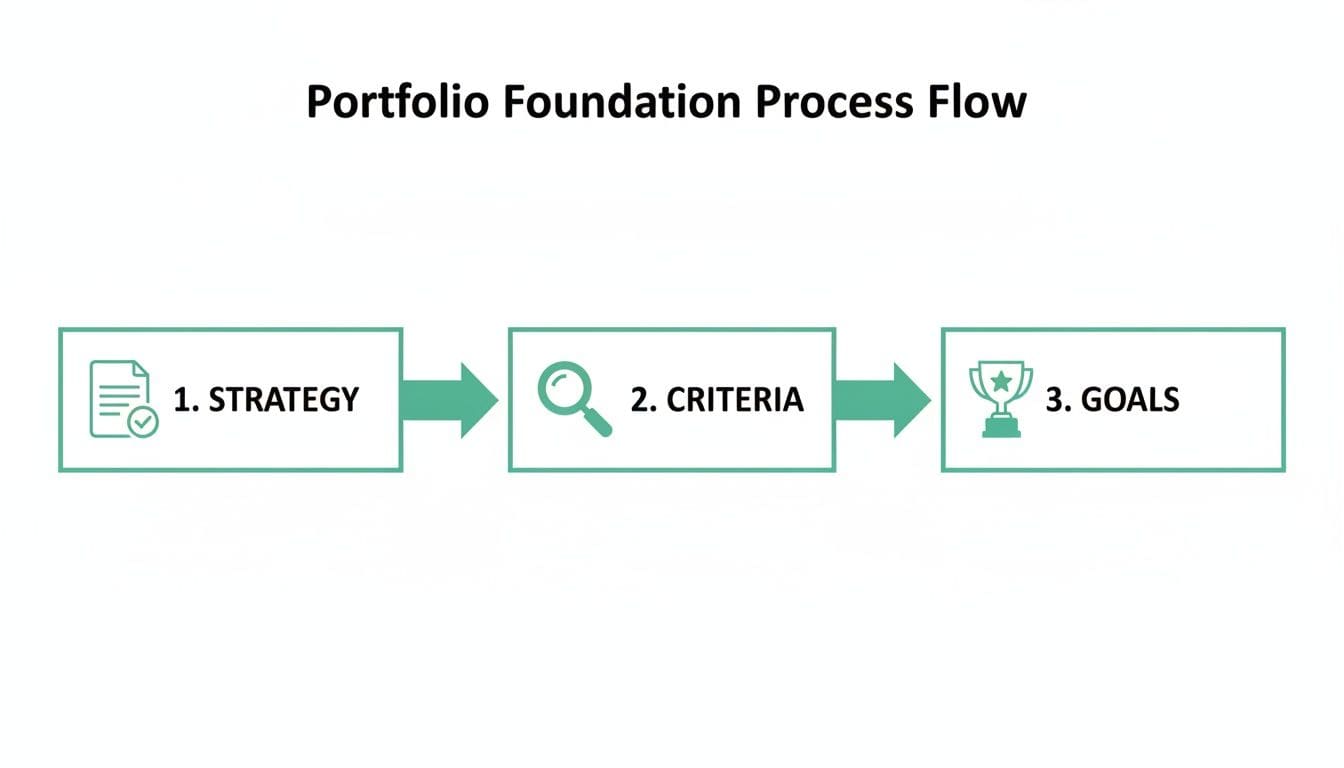
This diagram highlights a crucial point: your strategy and criteria aren't just abstract ideas. They directly shape your goals and create a clear path for every single purchase.
Cultivating Your Deal Flow
The best deals rarely sit on the open market waiting for you. If your only source is property portals, you're fighting for scraps with everyone else. Building a strong, proactive network is the only way to get a look-in at genuine off-market opportunities.
Your network should include:
- Estate Agents: Don't just be a name on a mailing list. Meet local agents in person. Clearly explain your criteria and, most importantly, prove you're a serious buyer who can complete. When a suitable property comes up that needs a quick, quiet sale, you'll be the first person they call.
- Property Sourcers: A good sourcer can be worth their weight in gold, particularly if you're investing in an area you don't live in. They do the legwork, finding and vetting deals that fit your strategy, all for a fee.
- Other Investors: Networking with other landlords is often overlooked. They might be selling a property that no longer fits their portfolio but is a perfect match for yours.
Building these relationships takes time, but the payoff is enormous. It shifts your deal-finding from a reactive, frustrating search into a proactive pipeline. This is a critical step if you want to properly manage a property portfolio at scale.
Structuring Your Financing Options
In the UK property market, hesitation costs deals. Having your financing lined up—or at the very least, fully understood—is non-negotiable for moving quickly. You need to know exactly which financial product fits the deal you're chasing before you even make an offer.
Common financing routes for portfolio landlords include:
- Buy-to-Let (BTL) Mortgages: This is the bread and butter for most long-term holds. Be aware that lenders will assess the health of your entire portfolio, not just the single property. Keeping your finances impeccably organised is vital.
- Bridging Loans: This is fast, short-term finance, perfect for auction buys or properties that are currently unmortgageable. Bridging is an essential tool for any investor using the BRRRR (Buy, Refurbish, Refinance, Rent) strategy.
- Commercial Finance: For larger portfolios, multi-unit blocks, or more complex deals, commercial loans offer greater flexibility than standard BTL products, though often at a higher cost.
Having a brilliant mortgage broker who specialises in portfolio finance isn't a luxury; it's a necessity. They have access to lenders and products you'll never find on your own, and their expertise can be the difference between a smooth purchase and a failed application.
Your broker and solicitor should be on speed dial, ready to act the moment you find a viable opportunity. This preparedness doesn't just help you; it signals to agents that you are a serious, professional buyer who can get the transaction over the line efficiently. Understanding how to find property investors and securing their backing can also open up alternative financing routes, as we cover in our detailed guide.
Mastering Tenant and Property Management Systems
A portfolio's true value isn't just its paper valuation; it's the consistent cash flow it generates. That cash flow relies entirely on having robust tenant and property management systems. Without them, you're not an investor; you're a full-time firefighter, constantly battling void periods, maintenance dramas, and compliance headaches.
To truly manage a property portfolio effectively, you have to shift from a reactive, firefighting approach to a proactive, systemised operation. This is the only way to protect your assets, slash your stress levels, and lock in profitability, whether you have one property or fifty. It's how you make the leap from being just another landlord to a professional portfolio manager.

Self-Management vs Letting Agent: The Core Decision
The first big call you need to make is whether to manage your properties yourself or hand them over to a letting agent. There's no single right answer here. It all comes down to your available time, your expertise, your location, and the scale of your portfolio.
Going it alone gives you direct control and saves you on fees, which typically chew up 10-15% of your monthly rent. But make no mistake, it demands a serious time commitment and a solid grasp of UK property law, which seems to change every other Tuesday.
On the other hand, a good letting agent frees you up to focus on what really grows your portfolio—finding the next deal. They handle the day-to-day grind, from finding tenants to fixing leaky taps. The obvious downside is the cost, which hits your net cash flow directly, and the risk of picking a dud agent who creates more problems than they solve.
A hybrid model can work wonders. You could self-manage the properties on your doorstep while using an agent for those further afield. It's a smart way to get a balance of control and freedom.
This isn't just a simple fee calculation. It's about adopting a wider perspective on your entire operation, a concept we dig into in our guide on developing portfolio-level thinking for landlords.
Essential Processes for Self-Managing Landlords
If you choose to self-manage, systemising your processes isn't just a good idea—it's non-negotiable. This isn't about creating pointless bureaucracy; it's about building efficiency and, crucially, protecting yourself legally.
Your essential toolkit must include:
- Comprehensive Tenant Vetting: This is your first line of defence against future problems. Your process should always include credit checks, affordability calculations, references from previous landlords, and employment verification. Never, ever skip a step.
- Compliant Tenancy Agreements: Use up-to-date Assured Shorthold Tenancy (AST) agreement templates that reflect current UK legislation. Make sure all prescribed information, like the 'How to Rent' guide, is provided at the start of every single tenancy.
- Regular Property Inspections: Don't wait for tenants to report problems. Schedule inspections—quarterly is a good rhythm—to check the property's condition and spot maintenance issues early. Document everything with photos and signed reports.
These systems aren't optional extras. They are fundamental to managing your risk.
Leveraging Technology for Efficient Management
Trying to manually track rent payments, maintenance requests, and compliance deadlines across multiple properties is a recipe for disaster. It's inefficient and riddled with opportunities for human error. Modern property management software is a complete game-changer for landlords who want to manage a property portfolio professionally.
Platforms like Landlord Vision or PayProp can automate the core, time-sucking tasks that bog you down.
Key Software Features to Look For
- Rent Collection and Tracking: Automated reminders to tenants and a clean dashboard showing who has paid and who is falling behind.
- Maintenance Management: A simple system for tenants to log issues and for you to track jobs assigned to contractors right through to completion.
- Compliance Reminders: Automated alerts for critical deadlines, such as Gas Safety Certificate renewals, Electrical Installation Condition Reports (EICRs), and Energy Performance Certificate (EPC) expirations.
It's also worth noting the shifts in the wider UK property landscape. While this guide focuses on residential, managing a UK property portfolio means staying aware of major market currents. For instance, the traditional dominance of UK institutional investors—like insurance firms and pension funds—in commercial property has weakened significantly. Their holdings dropped from £95 billion in 2006 to just £84 billion by 2022, now making up only 16% of the total. This creates a gap in the market that savvy private investors are well-placed to fill.
Getting your head around the UK's maze of property tax isn't just a box-ticking exercise; it's a massive part of a smart investment strategy. To really manage a property portfolio well, you need to go beyond just paying the taxman and start thinking about sharp tax planning and solid compliance.
Get this bit wrong, and you can see years of hard work unravel thanks to fines or just a horribly inefficient tax structure. This section will break down the must-know tax and compliance duties for UK landlords, making sure you protect your returns and keep your portfolio healthy for the long run.
The Core Taxes Every UK Landlord Must Master
Three main taxes shape the financial world for UK property investors. Each one pops up at a different point in the investment journey, and if you don't grasp their impact, your deal analysis and portfolio planning will be built on shaky ground.
- Stamp Duty Land Tax (SDLT): This is the tax you pay right at the start when buying a property in England and Northern Ireland. For buy-to-let investors, there's a 3% surcharge slapped on top of the standard rates, which can seriously inflate your upfront costs. You absolutely have to factor this in properly to figure out your true Return on Investment.
- Capital Gains Tax (CGT): When you sell a property that isn't your main home and make a profit, CGT is waiting for you. The rate you pay is tied to your income tax band, but it's a hefty cost that can take a big bite out of your gains if you haven't planned for it.
- Income Tax: The rental profit you make each year is hit with Income Tax. The exact amount depends on your personal tax bracket, making it a critical variable in your ongoing cash flow calculations.
Failing to budget for these can lead to some very nasty surprises down the line. For a deeper dive, check out our guide that answers the question, what is Stamp Duty Land Tax, and how it really affects your purchases.
To keep things clear, here's a quick summary of the main taxes you'll be dealing with as a UK landlord.
| Tax Type | Trigger Point | Key Impact for Landlords |
|---|---|---|
| Stamp Duty Land Tax (SDLT) | Property Purchase | Increases upfront acquisition costs, especially with the 3% buy-to-let surcharge. |
| Capital Gains Tax (CGT) | Property Sale (at a profit) | Reduces the net profit you walk away with when you sell an investment property. |
| Income Tax | Receiving Rental Profit (Annually) | Directly affects your monthly and annual cash flow, with rates depending on your tax band. |
| Corporation Tax | Company Profits (if using an SPV) | Paid on profits within a limited company before you can extract dividends or a salary. |
Understanding when each tax applies is the first step towards building a tax-efficient portfolio.
Ownership Structures: Personal Name vs. Limited Company
One of the biggest strategic calls you'll make is how you legally own your properties. The two main paths in the UK are holding them in your personal name or setting up a limited company, usually a Special Purpose Vehicle (SPV).
Holding property in your own name is simple to get going but can be really tax-inefficient if you're a higher-rate taxpayer. This is all down to the infamous Section 24 mortgage interest relief rules. This rule stops individual landlords from deducting their full mortgage interest costs as a business expense, offering a much less generous 20% tax credit instead.
Owning properties within a limited company allows you to deduct 100% of your mortgage interest as a legitimate business expense before paying Corporation Tax on the profits. This can result in a significant tax saving, especially for those in the 40% or 45% income tax brackets.
But it's not a magic bullet. Running a limited company brings more admin, like filing annual accounts and confirmation statements, and getting profits out can be more complicated. You absolutely need to get professional advice from a property-specialist accountant to figure out the best structure for your own situation.
Critical Compliance You Cannot Ignore
Beyond tax, keeping up with UK rental regulations is non-negotiable. The rules are always changing, and pleading ignorance won't save you from the massive fines they hand out for non-compliance. Keeping your portfolio legally watertight is just part of being a professional landlord.
Here are a few essential areas you have to get right:
- HMO Licensing: If you're running a House in Multiple Occupation (HMO), you'll almost certainly need a licence from your local council. The rules for mandatory licensing are UK-wide, but a lot of councils have their own additional or selective licensing schemes with very specific requirements.
- Right to Rent Checks: You are legally required to check that all adult tenants have the legal right to rent in the UK before their tenancy starts. Getting this wrong can lead to unlimited fines or even prison time.
- Safety Certificates: You must have valid certificates for Gas Safety (checked every year), Electrical Installation Condition Reports (every five years), and Energy Performance (every ten years).
Managing a UK property portfolio also means keeping an eye on wider market trends. For portfolio managers, thinking strategically about which sectors to be in is vital. For instance, Healthcare led with £12.9 billion in investments in 2026, followed by the Living sector at £12.0 billion—which includes the buy-to-let and HMO properties we focus on. This data shows just how important it is to analyse trends quickly to catch opportunities in growing sectors. You can discover more insights about UK real estate investment figures to see how different sectors are performing.
Analysing Performance and Stress-Testing Your Portfolio
To properly manage a property portfolio, you have to get past gut feelings and start measuring what actually matters. It's not enough to know the gross yield; you need to dig into the real-world performance of your assets. This means tracking the key performance indicators (KPIs) that reveal the true financial health of your investments, showing you which properties are star performers and which ones are dragging the whole portfolio down.
This kind of proactive analysis is what separates a professional investor from someone who just happens to own a few properties. It's all about building a simple, repeatable system for monitoring your assets so you can make strategic, numbers-led decisions.

Key Performance Indicators You Must Track
Forget about vanity metrics. A successful portfolio is built on numbers that reflect genuine profitability. While gross yield is a decent starting point, it completely ignores the costs that eat away at your returns.
Here are the essential KPIs you should be monitoring:
- Net Yield: This is your annual rental income minus all operating costs (mortgage interest, insurance, voids, maintenance, fees), shown as a percentage of the property's value. It's the true measure of a property's income-generating power.
- Return on Capital Employed (ROCE): This metric is absolutely crucial. It calculates the annual profit generated by a property as a percentage of the actual cash you have invested. In short, it tells you how hard your own money is working for you.
- Net Cash Flow Per Unit: This is the pure profit left in your bank account each month from a specific property after every single bill is paid. Positive cash flow is the lifeblood of a sustainable portfolio.
- Portfolio Loan-to-Value (LTV): This is simply the total value of your outstanding mortgages divided by the total current value of your properties. Tracking this is vital for understanding your overall leverage and your ability to refinance or expand.
By focusing on these core metrics, you get an honest, unfiltered view of your portfolio's health. This data empowers you to spot underperforming assets and make informed decisions, whether that's adjusting rents, refinancing, or selling a property that no longer fits your strategy.
For a more detailed breakdown, our guide on using a property ROI calculator for UK investments provides the formulas and context you need.
The Critical Practice of Stress-Testing
Knowing your current numbers is only half the battle. To truly manage a property portfolio with any degree of resilience, you must stress-test it against future uncertainties. This just means running a few "what-if" scenarios to see how your cash flow and profitability would hold up under pressure.
Stress-testing isn't about trying to predict the future; it's about spotting vulnerabilities before they become full-blown crises. It prepares you for market shifts and protects your financial stability.
Here are some common scenarios you should be modelling:
- Interest Rate Rises: What happens to your portfolio's net cash flow if your mortgage rates jump by 1%, 2%, or even 3%? For any leveraged investor in the UK today, this is probably the single most important test to run.
- Extended Void Periods: How would a two or three-month void in one of your larger properties hammer your overall profit for the year? Would it push the entire portfolio into a negative cash flow position?
- Major Capital Expenditure: What if a boiler fails in one house and the roof needs replacing on another, all in the same financial year? Does your contingency fund actually cover it without derailing everything else?
- Rent Reductions: How would a 10% drop in market rents across your area impact your ability to meet your mortgage payments and other costs?
Running these simulations exposes the weak links in your portfolio. It might reveal that a particular property with a tight cash flow becomes unprofitable after just a small rate rise, signalling that it might be time to sell or restructure its financing. This proactive approach turns potential disasters into manageable business challenges.
Scaling Your Portfolio and Planning Your Exit
Growth is the goal for most investors, but taking a portfolio from a few properties to a serious, scalable business isn't an accident. It's a deliberate shift in mindset and strategy.
This is the point where you stop being a hands-on landlord and start acting like the CEO of your own property company. Your focus moves from leaky taps and individual tenants to the performance of the portfolio as a whole. It's about building a machine that can grow without you being the bottleneck.
Leveraging Equity for Smart Growth
One of the most powerful engines for scaling is recycling your deposit. This simply means using the equity you've built in existing properties to fund new purchases. As your properties appreciate and you chip away at the mortgages, you create a reservoir of capital that can be unlocked through refinancing.
The process lets you pull out tax-free cash to use as a deposit on your next deal. In effect, you're using the same pot of initial investment money over and over again. For many UK investors, this is the core engine of rapid portfolio growth, but it comes with a major health warning: you must manage your overall Loan-to-Value (LTV) carefully to avoid becoming over-leveraged.
Your exit strategy isn't something you bolt on at the end; it's the filter you use for every decision you make today. Knowing whether you're building a legacy for your kids or a pension pot to cash in will fundamentally change your buying criteria, financing choices, and how long you hold each asset.
Thinking about your exit from day one is a non-negotiable part of how you manage a property portfolio like a professional.
Knowing When to Delegate
You can't scale if you're still the one taking calls about a broken boiler or doing viewings on a Saturday. Growth is impossible without delegation. The trick is to let go of the tasks that don't align with your highest-value activities—which, for a portfolio owner, should be strategy, financing, and acquisitions.
Delegation can happen in stages:
- Hiring a Virtual Assistant (VA): A good VA can take over the admin grind—bookkeeping, chasing late rent, or managing compliance paperwork—for a fraction of the cost of a full-time employee.
- Engaging a Full-Service Managing Agent: For a truly hands-off approach, a solid agent handles everything from finding tenants to 24/7 maintenance calls. While this will cost 10-15% of your monthly rent, it frees up 100% of your time to focus on finding the next deal.
The decision to delegate is purely financial. Work out the value of your time. If an hour spent finding your next property is worth more than it costs an agent to manage a property for a month, it's time to hand over the keys.
Defining Your Exit Strategy
Successful investors don't just accumulate properties; they plan for the endgame. Your exit strategy defines the ultimate purpose of your portfolio and should shape every decision you make. Without one, you're just collecting assets with no clear goal.
What's your primary endgame?
- Building a Legacy: Are you planning to pass the portfolio on to the next generation? This demands a focus on long-term, stable assets and influences your ownership structure from the start (think trusts and limited companies).
- Funding Retirement: Is the goal to sell the entire portfolio for a lump sum? This strategy means you need to maximise capital appreciation and keep the portfolio in a clean, attractive state, ready for a sale to another investor or institution.
- Generating Passive Income: Maybe you never plan to sell. The goal is to pay down all the mortgages and live off the unencumbered rental income. This requires a laser focus on high-cash-flowing properties and a disciplined approach to debt reduction.
Preparing for your exit means keeping meticulous records, ensuring every property is compliant, and optimising the portfolio's financial performance. You want it to be as attractive as possible for a future sale, transfer, or for generating that hassle-free income you've worked so hard for.
Frequently Asked Questions
How Many Properties Make a 'Portfolio' in the UK?
You'll find there isn't a single, official number, but in the eyes of most UK lenders, the magic number is four. Once you own four or more buy-to-let properties, you're generally classed as a "portfolio landlord".
This isn't just a label. It triggers a different approach from lenders, who will subject you to more stringent affordability checks. They stop looking at just the deal in front of them and start assessing the financial health of your entire portfolio. They need to see that you can manage a property portfolio as a whole, not just one asset in isolation.
Should I Manage My Properties Myself or Hire an Agent?
This is the classic trade-off between time and money, and the answer really depends on your expertise and how close you live to your investments.
Going it alone saves you the 10-15% management fee that most agents charge, which goes straight to your bottom line. You also get direct control and a closer relationship with your tenants. But don't underestimate the work involved—it demands a serious time commitment and a solid understanding of UK landlord regulations, which are constantly changing.
On the other hand, handing over to a good letting agent frees you up to focus on growing your portfolio, not fixing leaky taps. The catch? That fee eats into your net cash flow, and choosing a poor agent can create more headaches than it solves.
What's the Best Way to Structure a UK Property Portfolio for Tax?
The "best" structure—holding property in your personal name versus a limited company (often called an SPV)—comes down entirely to your personal tax situation. There's no one-size-fits-all answer.
Since the introduction of Section 24, which dramatically cut the mortgage interest relief available to individual landlords, using a limited company has become the go-to for many higher-rate taxpayers. It's often far more tax-efficient.
However, running a company brings its own baggage, like extra admin, accountancy costs, and different mortgage products.
This is one area where you absolutely should not guess. Get professional advice from a property-specialist accountant. They can run the numbers for your specific circumstances and help you build a structure that actually supports your long-term goals.
Ready to analyse your next deal with speed and precision? Download the DealSheet AI app today and turn property listings into actionable insights in seconds. Get started with a free trial on the App Store.