
Your Guide to Using a Property ROI Calculator UK in 2026
Your Guide to Using a Property ROI Calculator UK in 2026
For any serious property investor in the UK, a property ROI calculator UK is the single most critical tool in your arsenal, designed to cut through the noise and measure a deal's true profitability. The answer to a successful investment lies in calculating your Return on Investment (ROI)—the ultimate scorecard that weighs rental income and capital growth against every cost. To ditch unreliable spreadsheets for good and make this essential process seamless, download the DealSheet AI app from the Apple App Store and start analysing deals with professional accuracy today.
Your Essential Guide to UK Property ROI
For UK property investors, success in 2026 will hinge on your ability to analyse a deal accurately before you commit a single pound. A generic online tool simply won't cut it. You need a property ROI calculator UK investors can trust—one that understands the unique financial landscape of British real estate. This is about moving beyond simplistic yield figures and embracing a much more robust measure of performance.

Unlike a basic spreadsheet, a specialised calculator is built to handle the complexities that can make or break an investment in the UK market. These are the critical factors that often get overlooked but are absolutely vital for a true profitability forecast.
Why a UK-Specific Calculator Matters
A dedicated tool offers far more than simple arithmetic. It provides a solid framework for consistent and reliable deal analysis by factoring in all those region-specific nuances that catch people out.
Here's why it's a game-changer:
- Accurate Tax Modelling: It correctly calculates Stamp Duty Land Tax (SDLT), including the crucial second property surcharge that trips up so many investors.
- Regulatory Awareness: It understands the real-world impact of legislation like the Section 24 mortgage interest relief rules, which can dramatically change the net profit for individual landlords.
- Localised Cost Assumptions: It can account for the significant variations in maintenance costs, council tax, and agent fees you'll find from London to Liverpool.
In essence, a UK-focused calculator translates a property listing into a clear financial story. It tells you not just what you might earn, but what you will actually keep after every tax, fee, and expense is paid.
This level of detail is what prevents costly surprises down the line. By using a sophisticated property ROI calculator UK, you replace hopeful guesswork with data-driven confidence. It allows you to compare potential deals on a true like-for-like basis, helping you build a more resilient and profitable portfolio.
Getting to Grips with the Numbers That Drive Your Investment
To properly use any property ROI calculator UK investors swear by, you first have to speak the language of property finance. It's never about one big number; it's about a handful of key metrics that each tell a different part of your investment's story. Nailing these is the foundation of every sound deal.
Think of these metrics as different lenses. Each one gives you a unique perspective on a deal's financial health, and only when you look through all of them do you get the full picture. They're all related, but confusing them is a classic rookie error that leads straight to bad investments.
The Four Pillars of Property Analysis
At the heart of any solid deal analysis are four core figures. Understanding the difference between them is what separates amateur landlords from professional investors—it's the gap between seeing a flashy headline number and knowing the actual profit.
These are the metrics you absolutely must master:
-
Gross Yield: This is the simplest metric and, honestly, the most misleading. It's just the total annual rent divided by the property's purchase price. Think of it as the property's 'headline' performance before a single real-world cost has been considered.
-
Net Yield: This gives you a much more realistic view. It takes the annual rent and subtracts all your predictable running costs—like management fees, insurance, and service charges—before dividing by the purchase price. For a deeper dive on this crucial metric, check out our guide on how to calculate rental yield in the UK.
-
Cash Flow: This is the big one. It's the actual money left in your pocket each year after every single expense, including your mortgage payments, has been settled. Positive cash flow means the property pays for itself and then some.
-
Return on Investment (ROI): This is the ultimate measure of performance. It calculates your annual profit (your cash flow) as a percentage of the total cash you personally put into the deal—your deposit, stamp duty, legal fees, and any refurb costs.
To make this crystal clear, let's break down how each metric works and why it matters in a simple table.
Key UK Property Investment Metrics Explained
This table is a side-by-side look at the essential financial metrics. It clarifies what each one measures, how it's calculated, and why it's a critical part of your analysis toolkit.
| Metric | What It Measures | Simple Formula | Why It Matters |
|---|---|---|---|
| Gross Yield | The raw return on the property's value, ignoring all costs. | (Annual Rent / Purchase Price) x 100 | A quick, high-level comparison tool, but often misleading on its own. |
| Net Yield | The return after accounting for operating expenses (excluding mortgage). | ((Annual Rent - Operating Costs) / Purchase Price) x 100 | A more realistic indicator of a property's profitability before financing. |
| Cash Flow | The actual profit you receive after all bills, including mortgage, are paid. | Annual Rent - (Operating Costs + Mortgage Payments) | Determines if the property generates a monthly income or costs you money. |
| ROI | The efficiency of your invested capital in generating profit. | (Annual Profit / Total Cash Invested) x 100 | The most important metric for assessing how hard your own money is working for you. |
Looking at the table, you can see why chasing yield alone is a mistake. A high yield might catch your eye, but it's the ROI that truly tells you if it's a good investment.
That figure reveals how effectively your capital is being put to work. A property could have a fairly average yield but deliver an incredible ROI if you managed to secure it with a small amount of your own cash. That's what makes it a far superior deal.
Gathering the Data for an Accurate ROI Calculation
The output from any property ROI calculator UK investors use is only as trustworthy as the data you feed it. Garbage in, garbage out is the golden rule here. A precise calculation demands a comprehensive and realistic list of figures, and underestimating costs is the single biggest reason property investments fail to live up to their spreadsheets.
To avoid this trap, it helps to organise your numbers into three clear buckets. This forces you to think through every stage and makes it much harder to miss a crucial expense.
Upfront Purchase Costs
This group covers every single pound you'll spend just to get the keys. It's always far more than the headline property price, a hard lesson many first-time investors learn when they find their budget doesn't stretch.
- Purchase Price: The price you've agreed to pay for the property.
- Stamp Duty Land Tax (SDLT): A critical UK-specific tax. You absolutely must factor in the correct tiered rate and the 3% surcharge if you already own another property. Getting this wrong can blow a hole in your budget.
- Legal & Conveyancing Fees: The bill for your solicitor to handle all the legal paperwork and transfer of ownership.
- Survey Costs: Fees for a homebuyer's report or a full structural survey. Don't skip this.
- Initial Refurbishment Budget: The immediate cash needed for repairs, upgrades, or just a lick of paint to make the property rentable. For a deeper dive into budgeting for works, you can find more on current UK building costs per square metre.
Ongoing Operational Costs
Once you own the property, the spending doesn't stop. These are the recurring costs that eat into your monthly cash flow, and they must be estimated with brutal honesty. Using vague percentages is a recipe for disaster; always get local quotes for a more accurate forecast.
These costs include:
- Mortgage Payments: For ROI purposes, this is usually calculated on an interest-only basis.
- Landlord Insurance: Essential cover for the building, any contents you provide, and your liability.
- Letting Agent Fees: Typically a percentage of the monthly rent, with 8-15% being a common range.
- Maintenance & Repairs: A vital contingency fund for when the boiler inevitably gives up. A common rule of thumb is to set aside 1% of the property's value each year.
- Void Periods: You must budget for times when the property is empty between tenants. Assuming one month's rent per year is a sensible starting point.
- Service Charges & Ground Rent: Non-negotiable costs for leasehold properties like flats.
The secret to a reliable analysis is using realistic, localised numbers, not generic industry averages. A letting agent in Manchester will charge differently to one in Bristol. Underestimating these operational costs will systematically destroy your real-world ROI.
Financing Details
Finally, you need the specific figures that relate to how you're actually funding the purchase. This is vital because ROI is ultimately a measure of how hard your invested cash is working for you.
- Deposit Amount: The total cash you are personally putting into the deal.
- Loan Amount: The total sum you're borrowing from a lender.
- Mortgage Interest Rate: The rate that dictates your single biggest monthly cost.
Gathering these details meticulously isn't just good practice; it's non-negotiable for a professional investor. Modern tools are designed to make this less painful. The DealSheet AI app, for instance, pre-populates many of these fields with current UK data, saving you time and preventing the kind of costly miscalculations that can sink a deal.
Putting It All Together: A Step-by-Step ROI Calculation
Theory is one thing, but the real lightbulb moment comes when you see a calculation in action. Let's walk through a proper ROI analysis for a typical UK buy-to-let property, using realistic figures for a two-bedroom flat in a popular part of Birmingham in 2026. This will bring all the concepts we've discussed together.
We'll use a property ROI calculator UK framework to make sure nothing gets missed. For this example, let's assume the investor already owns their own home, which means the 3% Stamp Duty surcharge will apply.
Step 1: Calculate Your Total Cash Invested
First things first, we need to nail down the total amount of cash needed to actually get the keys. This is always much more than just the deposit.
- Purchase Price: £200,000
- Deposit (25%): £50,000
- Stamp Duty Land Tax (SDLT): £7,500 (this includes that 3% surcharge)
- Legal & Survey Fees: £2,000
- Initial Refurbishment (new carpets, a lick of paint): £3,000
Add it all up, and the Total Cash Invested is £62,500. This is the number that matters. Our return is measured against this figure, not the £200,000 purchase price. That's a distinction that trips up a lot of new investors.
Step 2: Determine Your Annual Operating Profit
Next up, let's figure out the annual profit before we even think about the mortgage.
- Monthly Rent: £1,100
- Annual Gross Rent: £13,200
From that headline figure, we need to subtract the real-world costs of running the property:
- Letting Agent Fees (10%): -£1,320
- Landlord Insurance: -£300
- Maintenance Fund (10% of rent): -£1,320
- Annual Service Charge: -£1,200
That leaves us with an Annual Operating Profit of £9,060.
This diagram shows how all the key costs flow together, from the initial outlay to the ongoing operational expenses and financing.
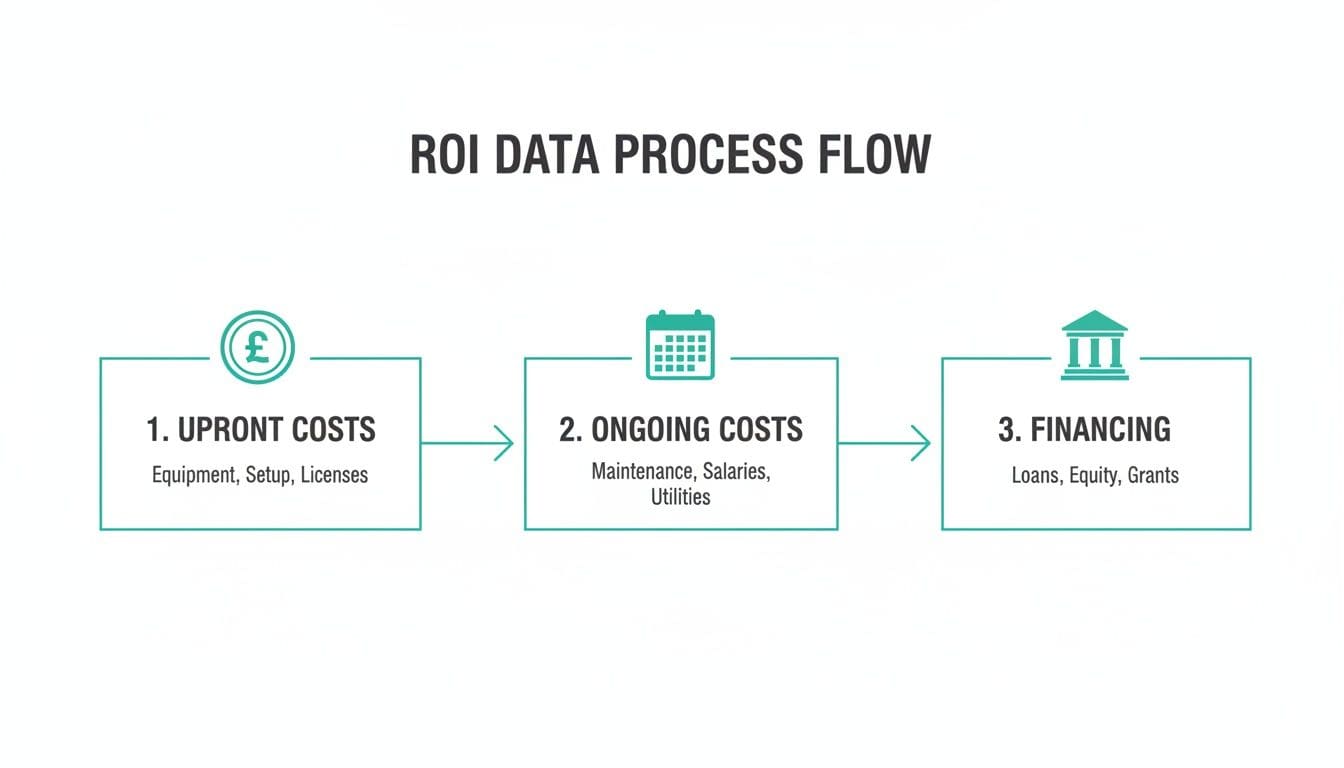
You can see how each stage systematically chips away at the gross income to reveal the true profit underneath. It's a process of elimination.
Step 3: Calculate Net Annual Cash Flow
Now it's time to factor in the biggest expense of them all: the mortgage.
- Loan Amount: £150,000
- Interest Rate: 5.0%
- Annual Interest-Only Mortgage Cost: £7,500
We simply subtract this from our operating profit:
£9,060 (Annual Operating Profit) - £7,500 (Annual Mortgage Cost) = £1,560 Net Annual Cash Flow
This £1,560 is what you're left with. It's the actual cash profit the property puts in your pocket each year. For investors using different types of finance, like short-term bridging, getting the costs right is crucial; our guide on using a bridging loan calculator goes into more detail on that.
Step 4: Find the Final ROI Percentage
We're at the final hurdle. With all our figures in place, we can calculate the true Return on Investment. This is the ultimate stress test of the deal's performance.
The formula is beautifully simple: (Net Annual Cash Flow / Total Cash Invested) x 100
- (£1,560 / £62,500) x 100 = 2.5% ROI
This 2.5% represents the cash-on-cash return for this investment in its first year. This single figure is powerful. It allows you to compare this Birmingham flat directly against any other opportunity—another property, stocks, or even a savings account—giving you a clear, numbers-led foundation for your decision.
Why Generic ROI Calculators Miss the Mark for UK Investors
Using a generic ROI calculator for a UK property deal is a recipe for disaster. It's like trying to navigate London with a map of New York—the core principles might seem similar, but you're going to end up in the wrong place, fast.
These one-size-fits-all tools, usually designed for the US market, are completely blind to the financial and tax landscape that defines British property investment. Relying on them leads to dangerously misleading projections that can turn a deal that looks great on paper into a real-world financial headache.
An accurate property roi calculator UK investors can trust has to be built from the ground up with our local rules baked in.
The Stamp Duty Land Tax Trap
The most glaring omission in generic tools is Stamp Duty Land Tax (SDLT). This isn't just a minor detail; it's a massive upfront cost that can cripple a deal before it even starts.
The UK's system isn't a simple flat tax. It's a tiered structure where the rate climbs with the property's value. More importantly, it includes a 3% surcharge on the entire purchase price for anyone buying an additional property—which is nearly every buy-to-let investor. A generic calculator will miss this completely, instantly wiping out your first year's profit and leaving you with a nasty surprise.
You can learn more about how this critical tax works in our detailed guide on what is Stamp Duty Land Tax.
Ignoring Section 24 and Regional Costs
Another uniquely British curveball is Section 24, a tax rule that fundamentally changed how individual landlords can claim mortgage interest relief. Instead of deducting interest as a business expense, you now get a flat 20% tax credit.
This sounds like a subtle change, but its impact on your net profit is enormous, especially for higher-rate taxpayers. Yet generic tools have never even heard of it.
Generic calculators operate in a financial vacuum, ignoring the specific tax laws and regional cost variations that determine true profitability in the UK. This isn't just an inconvenience; it's a critical flaw that renders their outputs useless.
On top of that, the UK market is anything but uniform. Maintenance costs, letting agent fees, and rental demand vary hugely between London, Manchester, and Edinburgh. A calculator that slaps on a generic "10% for maintenance" rule without considering local realities will never give you a reliable forecast.
The UK's property market has its own distinct rhythm. While long-term appreciation has been substantial—with average house prices rising by nearly £100,000 over the last 10 years alone—this growth is highly regional. For instance, in the year to September 2025, Scotland saw 5.3% annual growth, while England saw just 2.0%.
This is why a specialised property roi calculator UK investors can rely on is non-negotiable. You need a tool that speaks our language and understands our rules.
How to Stress-Test Your Investment Against Market Changes
A profitable deal on paper means nothing if it crumbles at the first sign of market trouble. This is where stress-testing comes in. It's the process of asking the tough "what if" questions before you put your capital on the line, revealing the true resilience of an investment.

The single biggest factor to test against? Interest rates. A jump in your mortgage rate can gut your cash flow almost overnight, turning a healthy asset into a monthly financial drain. This isn't just theory; it's the painful reality many investors faced during the sharp rate hikes of recent years.
Modelling Different Scenarios
A solid property ROI calculator UK investors use is perfect for this job. Instead of running your numbers just once, you need to model a few different outcomes to see how the property holds up under pressure.
Here's a simple framework to get you started:
- Best Case: Your initial calculation, using today's optimistic figures.
- Moderate Case: Model a 1% increase in your mortgage interest rate. What does cash flow look like now?
- Worst Case: Model a 2% rate rise and factor in a longer-than-expected void period.
By comparing the ROI and cash flow across each scenario, you can quickly identify the property's financial breaking point. This is fundamental to understanding what actually makes a good return. For a deeper dive, check out our guide on what is a good ROI on a rental property.
This process isn't about predicting the future with perfect accuracy. It's about building a robust, future-proof portfolio by understanding how much of a financial buffer your investment truly has before it gets into trouble.
Interest rates are the dominant force affecting UK house prices and landlord returns. In fact, some research has shown that the huge rise in property values over the last few decades was largely fuelled by falling interest rates. A sharp reversal, like we saw in 2022 when some mortgage rates doubled, directly cools the market and squeezes investor profits. This just hammers home why stress-testing your rate sensitivity is absolutely essential. You can read the full research about the impact of interest rates on UK property.
Your Questions, Answered
When you're deep in property deal analysis, a few questions always seem to pop up. Let's tackle the most common ones so you can use a property ROI calculator UK with more confidence and make sharper decisions.
What Is a Good ROI for a UK Buy-to-Let Property?
There's no single magic number, and anyone who tells you otherwise is probably selling something. A 'good' ROI really depends on your strategy, how much risk you're comfortable with, and where the property is.
That said, most UK investors in 2026 are hunting for a cash-on-cash ROI of 8-12% or higher. It's a solid benchmark. Just remember the trade-offs: a property in a high-growth city might have lower initial cash flow but serious potential for capital appreciation, which boosts your total return down the line. The real key is to set your own target and use a calculator to check if a deal hits your mark, every single time.
How Does a Property ROI Calculator Handle UK Taxes?
A generic calculator you find online will get this badly wrong, but a tool built for the UK market like DealSheet AI handles it correctly. For starters, it calculates the right Stamp Duty Land Tax (SDLT) based on the purchase price and whether it's your first or an additional property—that second-property surcharge is a deal-killer if you forget it.
More importantly, it understands Section 24. Instead of wrongly deducting mortgage interest as an expense (the old way), it correctly models the 20% tax credit. This is a crucial difference that gives you a far more accurate picture of your actual net profit. Get this wrong, and you could be facing an unexpected tax bill.
Can I Use an ROI Calculator for HMO or Flip Strategies?
Yes, but you absolutely need a calculator designed for different strategies, because the numbers work in completely different ways.
For a property flip, the ROI is all about the net profit you walk away with after the sale, once every single cost is stripped out. An HMO analysis, on the other hand, is an operational model—it needs inputs for multiple tenancies and has much higher running costs. Good, advanced tools will have specific modes or templates for these strategies so you're not trying to jam a square peg into a round hole.
Stop second-guessing your numbers and start analysing deals with professional-grade accuracy. Download DealSheet AI from the Apple App Store to replace your fragile spreadsheets with a powerful, UK-focused underwriting tool.