
Your Ultimate Guide to the UK Rent to Value Calculator in 2026
Your Ultimate Guide to the UK Rent to Value Calculator in 2026
When sizing up a UK property deal, the rent to value ratio—also known as gross rental yield—is the first, most crucial metric you need. A rent to value calculator is the tool that gives you this number instantly, showing a property's raw income potential relative to its price. The core formula is simple: (Annual Rent / Property Value) x 100. This guide will walk you through how to use it, what a good ratio looks like in the UK for 2026, and why it's only the first step in a proper deal analysis. To start making data-backed decisions and analyse deals in seconds, download the DealSheet AI app from the App Store.
Understanding the Rent to Value Ratio

At its heart, the rent to value ratio (or gross yield) is a foundational metric. It tells you how much rental income a property generates relative to its market value, boiled down to a simple percentage. Think of it as a property's raw earning power.
This calculation is your first filter. It helps you sift through dozens of listings to spot the potential winners and immediately discard the non-starters. It's the essential first step in your due diligence. Before you even think about mortgage costs, tax, or running expenses, you have to know if the basic numbers stack up.
Why This Metric Is a Non-Negotiable Starting Point
You simply can't overstate the importance of this calculation, especially in the diverse UK property market of 2026. A flat in London might produce a gross yield of 3%, while a terrace in Liverpool could easily hit 8% or more. This single percentage gives you a universal language for comparing completely different properties in different parts of the country.
The gross yield is your defence against "analysis paralysis." Instead of getting bogged down in detailed spreadsheets for every property you see, it allows you to instantly kill unsuitable deals and focus your time and energy only on those with genuine potential.
Getting this figure right is the first step toward building a profitable portfolio. If you're just starting out, mastering this concept is essential. You can learn more in our complete guide to property investment for beginners.
How to Calculate Rent-to-Value Step-by-Step

Calculating the rent-to-value ratio is refreshingly simple. You don't need a monster spreadsheet for this one; it's a quick, back-of-the-envelope formula that gives you a powerful first glance at a property's income potential.
The core idea is to see how the annual rent stacks up against the property's price tag. It's your first filter, telling you if a deal is even worth a second look. Don't worry about costs just yet—this is all about the top-line performance.
The Core Formulas
To get started, you only need two numbers: the rent and the property's purchase price (or its current market value). These are the two formulas you'll be using constantly.
For Annual Rent: (Total Annual Rent / Property Value) x 100 = Gross Yield (%)
For Monthly Rent: (Monthly Rent x 12 / Property Value) x 100 = Gross Yield (%)
That's it. These two formulas are the engine of any basic rent-to-value calculator. Getting comfortable with them means you can quickly vet deals while you're on the phone with an agent or scrolling through listings. Let's put them to work with a real-world UK example.
Worked Example: Manchester Buy-to-Let
Let's say you're eyeing up a two-bedroom flat in Manchester, a city known for its solid rental demand. We'll apply the formulas using some typical numbers for the area.
- Property Purchase Price: £220,000
- Achievable Monthly Rent: £1,100
1. Calculate the Total Annual Rent
First things first, turn that monthly rent into an annual figure. It's a simple but crucial step to keep the calculation consistent.
£1,100 (Monthly Rent) x 12 = £13,200 (Annual Rent)
2. Apply the Rent-to-Value Formula
Now, just plug the annual rent and the property value into the formula to find your gross yield.
(£13,200 / £220,000) x 100 = 6.0%
Boom. This property has a rent-to-value ratio, or gross yield, of 6.0%. For a standard buy-to-let in a major UK city, that's a pretty decent starting point.
This simple percentage is incredibly useful for comparing different opportunities on the fly. A property in Liverpool might throw off a 7.5% yield, while a similar one in Bristol only manages 4.5%. This metric instantly flags the huge regional differences across the UK. For context, recent data has shown national average rental yields hovering around 3.5%, yet hotspots like Portsmouth were hitting over 7% while prime London struggled to clear 3% because of sky-high property prices.
Doing the maths by hand is great for understanding the mechanics, but what really matters is analysing deals quickly and without errors. This is where tools like DealSheet AI come in, running these numbers instantly from nothing more than a property link. For a deeper dive into all the different types of yield, check out our guide on the rental yield calculator UK.
What Is a Good Rent to Value Ratio in the UK?
Figuring out a "good" rent to value ratio in the UK is a bit like asking for the perfect temperature; it completely depends on where you are and what you're trying to do. There's no single magic number. A yield that screams "bargain" in a high-growth northern city could be an impossible dream in a prime London postcode.
The key is to understand that benchmarks are regional and, just as importantly, strategy-specific. What's considered "good" is a moving target, pushed around by local property prices, rental demand, and your own investment goals. This is why a UK-focused rent to value calculator is so essential for setting expectations that are actually grounded in reality.
Setting Realistic Benchmarks Across the UK
As a general rule of thumb for a standard buy-to-let in many parts of the UK in 2026, you should be aiming for a gross yield of 5% to 8%. If you dip much below this, your profit can be quickly eaten up by the mortgage, taxes, and maintenance. Go significantly above it, and you've either found a fantastic opportunity or stumbled into a deal with hidden risks.
But geography changes everything. The UK property market isn't one single entity; it's a patchwork of dozens of micro-markets with huge differences in rents and values.
The idea of a single 'good' yield is a total myth in the UK. A 4% yield on a high-value property in the South East with strong capital growth potential could be a brilliant long-term hold. Meanwhile, an investor focusing on cash flow in the North East might not even look twice at a deal unless it hits 8% or more.
Recent data throws this divide into sharp relief. For instance, the Office for National Statistics on UK private rental prices has shown UK private rents rising significantly year-on-year, but the average rent in London can be more than double that in regions like the North East. This highlights the massive regional gaps investors have to navigate.
How Your Strategy Changes the Target
Your investment strategy has a massive impact on what a good rent to value ratio looks like. A simple buy-to-let has completely different expectations from more intensive, hands-on strategies.
- HMOs (Houses in Multiple Occupation): Because you're renting out individual rooms, these properties generate multiple income streams under one roof. Investors rightly target much higher gross yields, often aiming for 10% to 15% or even more, to make up for the higher management costs, tighter regulations, and more frequent tenant turnover.
- Serviced Accommodation (SA): Run more like a holiday let, SAs can pull in premium nightly rates. It's not uncommon for successful SA investors to look for yields well north of 15%, but this comes with the trade-off of running what is essentially a hospitality business.
You might have heard of the "1% rule," a guideline from the US suggesting monthly rent should be at least 1% of the property's value. In the UK's high-price market, this rule is almost completely useless and unachievable. UK investors need to rely on local data, not imported rules of thumb. To learn more, check out our guide on what is a good rental yield in the UK.
Why Gross Yield Is Only the Starting Point for UK Investors
A high figure from a basic rent-to-value calculator looks fantastic on paper. It's the kind of number that gets investors excited, but it's dangerously incomplete. Relying solely on this gross yield is one of the biggest mistakes a UK property investor can make, as it ignores the real-world costs that actually determine your profit.
Think of gross yield as a car's top speed. It's an impressive headline figure, but it tells you nothing about fuel efficiency, insurance costs, or road tax—the factors that decide if you can actually afford to run it. In the UK property market, these "running costs" are significant and can quickly erode what seemed like a stellar return.
This visual shows the typical yield hierarchy for different UK property strategies. The more hands-on the strategy, the higher the gross yield needs to be to compensate for the extra work and costs involved.
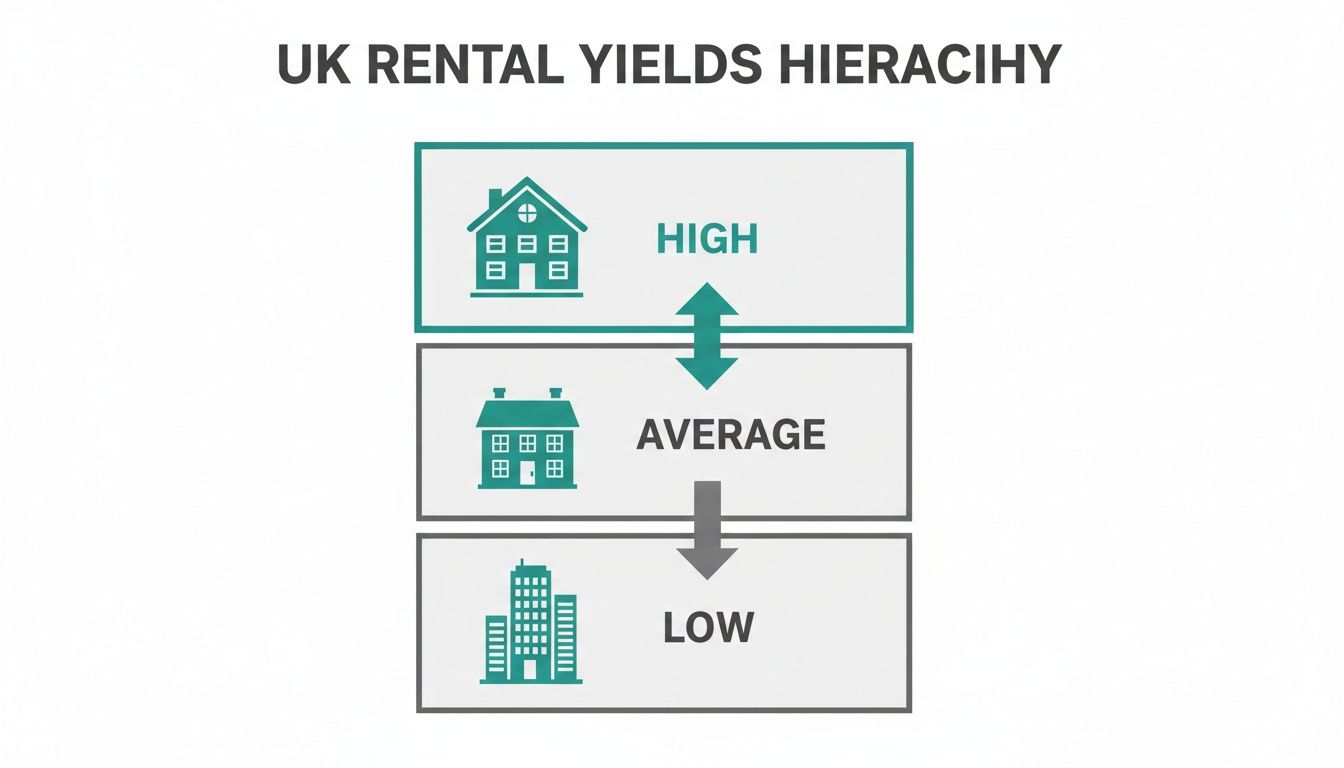
As the hierarchy illustrates, an HMO is expected to produce a much higher gross yield than a standard buy-to-let. Why? Because the running costs and management intensity are far greater—a crucial detail that gross yield alone completely fails to explain.
The Hidden Costs That Erode Your Returns
The gap between gross yield (your top-line income) and net yield (your actual take-home profit) is filled with unavoidable expenses. A simple rent-to-value calculator doesn't account for these, which is why a more detailed analysis is crucial before you commit to any deal.
Key UK-specific costs you must factor in include:
- Stamp Duty Land Tax (SDLT): An upfront purchase tax that can add thousands to your initial investment, directly hitting your overall return. For buy-to-let properties, a 3% surcharge applies on top of standard rates.
- Maintenance and Repairs: From a leaky tap to a full boiler replacement, these costs are inevitable. A common rule of thumb is to budget 1% of the property's value annually for maintenance.
- Management Fees: If you use a letting agent, expect to pay between 10% and 15% of the monthly rent. This is a major and recurring operational cost that vanishes from your income every single month.
- Void Periods: It's rare for a property to be occupied 100% of the time. Budgeting for at least one month of vacancy per year is a sensible precaution against lost income between tenancies.
These operational costs relentlessly chip away at your gross rental income. For a deeper understanding of the different types of property yields and how to calculate them, you can learn more about how to calculate property yields in our detailed guide.
To see this difference in action, here's a clear breakdown of what separates your headline gross figure from the more realistic net yield.
Gross Yield vs Net Yield Key Differences for UK Investors
| Metric | What It Includes | What It Reveals |
|---|---|---|
| Gross Yield | Just the annual rental income and the property's purchase price. | A quick, top-level comparison metric. Good for initial filtering but dangerously misleading on its own. |
| Net Yield | All operating costs: voids, maintenance, management, insurance, and service charges. | A much more realistic picture of the property's operational profitability before financing and tax. |
This table makes it obvious: without factoring in the operating costs, you're not analysing a real investment, you're looking at a fantasy. But even net yield doesn't tell the whole story.
The Impact of UK Tax Regulations
Beyond the day-to-day running costs, specific UK tax legislation can dramatically alter the profitability of a buy-to-let investment, especially for higher-rate taxpayers.
One of the most significant regulatory changes in recent years has been Section 24, which fundamentally changed how mortgage interest is treated for tax purposes. This legislation alone can turn a profitable property into a loss-making one for the unprepared investor.
Section 24 of the Finance Act 2015 restricts mortgage interest tax relief for individual landlords. In short, you can no longer deduct all of your mortgage interest costs from your rental income before calculating your tax bill. Instead, you now receive a tax credit based on 20% of your interest payments. For many, this pushes their declared income into a higher tax bracket and massively reduces their net profit.
This is precisely where basic tools fail. A generic rent-to-value calculator completely ignores the devastating impact of Section 24. A sophisticated analysis tool built for the UK market, like DealSheet AI, automatically incorporates these tax rules, giving you a true and realistic picture of your post-tax profit and ensuring you don't walk into a deal blind.
How Gross Yield Stacks Up Against Other Key Metrics
A smart property analysis is never about a single number. While the rent-to-value ratio gives you a vital first impression, relying on it alone is like trying to navigate a city with only a compass—you know the general direction, but you're missing the actual map.
To really get under the skin of a deal's potential, you need a full dashboard of metrics. Each one tells a different part of the story, revealing truths that gross yield simply can't. This is what separates amateur speculation from professional, profitable investing.
Net Yield: The Reality Check
The first and most important step beyond gross yield is to calculate the net yield. This metric paints a far more realistic picture of a property's day-to-day performance by actually accounting for its running costs.
Net Yield is what's left after you subtract the unavoidable expenses—like maintenance, insurance, management fees, and void periods—from your gross rental income. It answers the question: "How much money is this property actually making before I pay the mortgage and tax?"
This distinction is critical. A high gross yield can easily be wiped out by high service charges or punishing maintenance costs. Historical data shows us exactly why a simple rent-to-value calculator isn't enough. While the ONS private housing rental price data might show rising rents, profitability for many is being squeezed by stagnant prime yields and tax changes like Section 24, which hammers returns for higher-rate taxpayers.
Cash-on-Cash Return: The Investor's Perspective
For any investor using a mortgage, Cash-on-Cash Return is arguably one of the most powerful metrics you can look at. It completely shifts the focus from the property's total value to the actual cash you've pulled out of your own pocket.
- What It Measures: This metric calculates your annual pre-tax cash flow (your net income after paying the mortgage) as a percentage of the total cash you invested (your deposit, SDLT, legal fees, and other buying costs).
- Why It Matters: It shows you the return on your money, not the bank's. Two properties with the exact same net yield can have wildly different Cash-on-Cash Returns depending on the mortgage terms. It's the ultimate measure of how hard your personal capital is working for you.
Return on Investment (ROI): The Complete Picture
Finally, Return on Investment (ROI) offers the most complete, long-term view of your investment's total performance. It goes beyond just rental income to include the other major reason we invest in property: capital appreciation.
ROI considers your total profit—that's your net rental income plus the capital growth—against your total investment cost. Think of it as the ultimate scorecard for your deal, showing the combined power of both cash flow and equity growth over time.
A proper analysis tool like DealSheet AI is designed to lay all these figures out side-by-side. Instead of wrestling with spreadsheets, you can instantly see the gross yield, net yield, Cash-on-Cash Return, and ROI for any UK property. It lets you evaluate every angle of a deal in seconds, giving you the clarity you need to make the right call.
How DealSheet AI Puts It All Together

All the metrics, pitfalls, and UK-specific headaches we've just walked through are precisely why a simple rent to value calculator just doesn't cut it for serious investors. You end up spending more time fighting the calculator than you do analysing the deal.
This is the exact problem DealSheet AI was built to solve. It's not just another calculator; it's a deal analysis partner that understands the realities of the UK market from the moment you paste in a property link.
It looks far beyond a simple gross yield. The platform automatically factors in the real costs that kill profits, like Stamp Duty Land Tax (SDLT). Crucially, it models the true financial impact of Section 24 mortgage interest rules, giving you a proper after-tax cash flow forecast. This is the difference between a surface-level guess and a professional underwriting.
From Portal Link to Full Analysis in Seconds
The whole process is designed for the speed today's market demands. Just copy a property link from Rightmove or Zoopla, and DealSheet AI instantly pulls the data to build a complete financial model.
You get every key metric calculated and laid out side-by-side: Gross Yield, Net Yield, Cash on Cash Return, and ROI. No more manual data entry. No more fragile spreadsheets.
This is about replacing hours of guesswork with a reliable, repeatable process. It's about making confident decisions because you know the numbers have been run correctly, every single time.
Whether you're just starting out or managing a large portfolio, the goal is to spend less time analysing and more time deciding. You can see the full suite of property analysis features we've built for UK investors on our website.
Ready to see how it works? You can download DealSheet AI from the App Store and get a free 3-day trial. Stop guessing and start knowing your numbers.
Frequently Asked Questions
How Often Should I Re-Evaluate My Portfolio's Rent to Value Ratio?
As a rule of thumb, it's smart to review your portfolio's yields annually, or whenever a tenancy is up for renewal. UK rental markets move quickly, and what was a strong return last year might be underperforming today.
A quick annual check-up ensures your assets are pulling their weight. For instance, updating the rent forecast in an app like DealSheet AI instantly shows you how the numbers are tracking against your original goals. This gives you solid data to back up rent reviews or refinancing decisions.
Is a Rent to Value Calculator Useful for a BRRRR Strategy?
Honestly, a basic rent to value calculator is pretty limited for a BRRRR (Buy, Refurbish, Refinance, Rent) deal. It only looks at the final "Rent" part of the equation and completely ignores the stages that make or break the project: the refurb budget, financing costs, and the all-important uplifted value.
For a BRRRR, you need a tool that understands the entire lifecycle of the deal. DealSheet AI has dedicated templates for BRRRR projects that model each phase, calculating the metrics that actually matter—like your total profit and true return on investment after you've pulled your cash out.
Does the 1 Percent Rule for Rent Work in the UK?
In a word, no. The 1% rule—which suggests the monthly rent should be at least 1% of the purchase price—is a US-based guideline that almost never works in the UK. Our property prices are simply too high relative to rents for it to be a useful filter.
If you try to apply it here, you'll end up dismissing virtually every viable deal on the market. A much better approach is to research local comparable rents to find a realistic figure, then use a UK-focused analysis tool to calculate an accurate, location-specific yield. Forget the American rules of thumb; they just don't translate.
Ready to move beyond basic calculations and analyse deals like a professional? DealSheet AI gives you the complete picture, from gross yield to post-tax cash flow, in seconds. Download the app and start your free 3-day trial today.