
How to Calculate Property Yields: A UK Investor's Guide for 2026
How to Calculate Property Yields: A UK Investor's Guide for 2026
Before you get lost in property listings, there's one skill every UK investor needs to master: how to calculate property yields. The basic formula is simple: (Annual Rental Income ÷ Property Purchase Price) × 100. But relying on back-of-the-envelope maths in 2026 is a recipe for expensive mistakes. This guide will walk you through the exact calculations you need, from a quick initial filter to a detailed profitability analysis. To analyse deals in seconds, you need a tool that handles the complexity for you. The DealSheet AI app automates these calculations, factoring in everything from Stamp Duty to agent fees, giving you an instant, accurate picture of your potential return.
Why Property Yield Is Your Most Important Metric

A property might tick every box visually—great location, modern kitchen, perfect layout—but if the numbers don't stack up, it's a financial trap waiting to happen. This is where yield comes in.
It's the ultimate measure of a buy-to-let's performance, expressing its annual rental income as a percentage of its value. This single metric cuts through the noise and tells you exactly how hard your capital is working for you.
For investors, particularly in the competitive UK market, understanding this concept is the difference between building a profitable portfolio and acquiring a collection of expensive liabilities.
The Foundation of Smart Decisions
Think of yield as a universal language for property investment. It lets you compare a terraced house in Manchester with a modern flat in Bristol on a level playing field, regardless of their purchase prices. A higher yield generally signals a better return on your initial investment from rental income alone.
This calculation is the cornerstone for assessing potential returns before you even think about making an offer.
For instance, a terraced house in a high-yield hotspot like Burnley (BB11 postcode) purchased for £120,000 with a monthly rent of £650 gives you an annual rent of £7,800. This results in a solid gross yield of 6.5%, putting it right up there with the UK's top-performing areas. If you're curious, you can find more insights on high-yield UK postcodes on PropertyData.co.uk.
A property's appearance can be deceiving, but its yield tells the true financial story. It's the objective benchmark that should guide every purchase decision, protecting your capital and driving genuine growth.
Gross vs Net Yield: A Quick Primer
Throughout this guide, we'll explore different ways to calculate property returns. The two you'll use most often are Gross Yield and Net Yield. It's crucial to know the difference and when to use each one.
Here's a quick breakdown to keep things clear.
Gross Yield vs Net Yield At a Glance
| Metric | What It Measures | When to Use It |
|---|---|---|
| Gross Yield | Annual rental income as a percentage of the property's purchase price. Ignores all costs. | Quick, initial screening of dozens of properties to create a shortlist. A fast filter, not a final decision tool. |
| Net Yield | Annual rental income minus all operating costs, as a percentage of the total purchase cost. | Detailed due diligence on your shortlisted properties. This is the number that reflects real-world profitability. |
Mastering these two calculations will empower you to make much smarter, evidence-led decisions.
But before diving deep into the maths, it's worth understanding exactly what is a good rental yield in today's market, as this figure can vary dramatically depending on your strategy and location.
Using Gross Yield to Quickly Filter Deals

Gross yield is your first line of defence against bad investments. It's the rapid, back-of-the-envelope calculation that tells you if a property is even worth a second look, acting as a powerful filter to eliminate unsuitable listings in seconds.
This metric is all about speed and efficiency. It helps you avoid spreadsheet paralysis and focus your energy only on genuine opportunities. The calculation itself is beautifully simple, measuring the total annual rent against the purchase price to give you a clear, if simplistic, picture of its earning potential.
Gross Yield Formula: (Annual Rental Income ÷ Purchase Price) × 100
This single number allows you to quickly compare dozens of properties, saving you countless hours of deep analysis on deals that were never going to work anyway.
Applying the Gross Yield Formula
Let's put this into practice with a real-world scenario. Imagine you're looking at a two-bedroom terraced house for sale in a suburb of Leeds for £180,000. After a quick check of local rental comparables on Rightmove and Zoopla, you reckon a realistic monthly rent would be £950.
Here's how you'd calculate the gross yield:
- Work out the Annual Rent: £950 (monthly rent) × 12 = £11,400
- Apply the Formula: (£11,400 ÷ £180,000) × 100 = 6.33%
Just like that, you have a benchmark. You can now compare this 6.33% yield against other properties in Leeds and across your target investment areas to see how it stacks up.
The Importance of Realistic Rental Comparables
One of the biggest mistakes investors make at this early stage is using inflated rental estimates provided by the selling agent. Their goal is to sell the property, not to guarantee your rental income. Always, always do your own research.
Using an estate agent's optimistic rental figure without verification is a rookie error. Spend ten minutes checking actual rental listings for similar properties on the same street—it's the most valuable due diligence you can do at this stage.
To find accurate comparables, just hop online:
- Search Rightmove and Zoopla for properties currently available to rent in the immediate vicinity.
- Filter by the same number of bedrooms and property type.
- Note the asking rents and adjust for any obvious differences in condition or amenities.
This simple step ensures your initial filtering is based on reality, not fantasy. For those who want to dive deeper, our guide on using a UK rental yield calculator provides more advanced tips on this process.
What Is a Good Gross Yield in the UK for 2026?
The definition of a 'good' gross yield changes dramatically depending on where you are in the UK. A yield that would be considered excellent in one city might be completely unacceptable in another, as it's often a trade-off between cash flow and potential for capital growth.
In 2026, here's a rough guide to what UK investors are targeting:
- High-Yielding Northern Cities (e.g., Liverpool, Newcastle, Glasgow): Investors are often looking for gross yields of 7% or higher. These areas typically offer lower property prices relative to rental income, making them attractive for cash-flow-focused strategies.
- Mid-Range Markets (e.g., Birmingham, Leeds, Bristol): A gross yield between 5.5% and 7% is often seen as a solid target. These cities tend to offer a blend of decent rental returns and stronger prospects for long-term capital appreciation.
- Lower-Yielding Southern Towns (e.g., Reading, Cambridge, Brighton): Here, you might find that gross yields are as low as 4% to 5%. In these markets, the primary driver for investment is often the expectation of significant capital growth over time, rather than immediate rental profit.
Ultimately, your target gross yield should align with your personal investment strategy. By using it as your initial screening tool, you can efficiently discard the 90% of listings that don't meet your criteria and concentrate on the handful of deals with true potential.
Calculating Net Yield for True Profitability
Gross yield is a fantastic first-pass filter, but it tells you nothing about the actual money left in your pocket. This is where serious UK investors gain their edge: by meticulously calculating the net yield.
Net yield cuts through the noise and reveals the real financial performance of an asset after every single cost is accounted for. It transforms an optimistic headline figure into a realistic, bankable profit projection. A property that looks amazing with a 7% gross yield might actually be a pretty mediocre investment once you subtract the unavoidable running costs.
Honestly, this one calculation is the foundation of building a sustainable, long-term property portfolio.
The Formula for Net Yield
The calculation for net yield is a little more involved, but it paints a far more accurate picture of your investment's health. It considers not just the purchase price but also all the ongoing operational costs that eat into your returns.
Net Yield Formula: [(Annual Rental Income – Annual Operating Costs) ÷ Total Purchase Cost] × 100
Notice two crucial differences here from the gross yield formula:
- We subtract Annual Operating Costs from the rent.
- We use the Total Purchase Cost, not just the price on the listing.
That second point is a big one. Your total purchase cost isn't just the property price. It must include all the upfront fees like solicitor costs, survey fees, and most significantly, Stamp Duty Land Tax (SDLT). In the UK, investors pay a 3% surcharge on top of the standard SDLT rates. This can add thousands to your initial outlay and directly impacts your yield calculation from day one.
Uncovering the Hidden Operating Costs
One of the most common mistakes new landlords make is underestimating the sheer number and scale of operating expenses. Your mortgage payment is just the start. Getting a comprehensive list of annual costs is absolutely essential for an accurate net yield calculation.
Here are the typical expenses UK landlords must budget for:
- Letting Agent Fees: Usually 8-15% of the monthly rent for a full management service.
- Landlord Insurance: This is non-negotiable. It covers buildings, contents (if furnished), and public liability.
- Maintenance & Repairs: A sensible rule of thumb is to budget 10% of your annual rent for everything from a leaking tap to a boiler replacement.
- Void Periods: It's rare to have 100% occupancy. I always budget for at least one month per year where the property is empty (8.3% of annual rent).
- Service Charges & Ground Rent: If you're buying a flat or leasehold property, these fees are mandatory and can be substantial. Don't overlook them.
- Safety Certificates: Annual Gas Safety certificates (CP12) and Electrical Installation Condition Reports (EICR) every five years are legal requirements.
- Contingency Fund: An emergency fund for unexpected large expenses is vital for your sanity.
For a deeper dive into the numbers, our comprehensive guide on using a buy-to-let investment calculator can help you model these costs accurately.
Below is a more detailed checklist to help you catch everything when running your numbers.
Typical UK Landlord Operating Costs Checklist
| Cost Category | Typical Annual Cost (% of Rent or Fixed) | Notes |
|---|---|---|
| Management | 8-15% of rent | For fully managed service. Can be 0% if self-managing, but factor in your time. |
| Maintenance Reserve | 5-15% of rent | A conservative 10% is standard. Older properties may need more. |
| Void Periods | 4-8.3% of rent | Equivalent to 2-4 weeks or a full month of vacancy per year. |
| Landlord Insurance | £200 - £500+ | Varies by property size, type, and location. |
| Service Charge | £500 - £5,000+ | Only for leasehold properties (flats). Can be a major cash flow killer. |
| Ground Rent | £50 - £500+ | Also leasehold-specific. Check the lease terms carefully for escalation clauses. |
| Compliance & Safety | £150 - £300 | Includes Gas Safety (CP12), EICR checks, smoke/CO alarms. |
| Utilities (during voids) | £50 - £150 | You'll need to cover council tax and basic utilities when the property is empty. |
| Licensing | £0 - £1,000+ | Varies by council. Mandatory for HMOs and in selective licensing areas. |
| Accountancy Fees | £200 - £500+ | For your annual self-assessment tax return. |
This isn't an exhaustive list, but it covers the core expenses that will determine your true net profit. Always err on the side of caution with your estimates.
A Worked Example: The Gross vs Net Reality
Let's go back to our two-bedroom terrace in Leeds, which had a promising gross yield of 6.33%.
- Purchase Price: £180,000
- Annual Rent: £11,400
Now, let's factor in the real-world costs to find out what's really going on.
1. First, Calculate the Total Purchase Cost:
- Purchase Price: £180,000
- SDLT (including 3% surcharge): £5,400
- Solicitor & Survey Fees: £2,000
- Total Purchase Cost: £187,400
2. Next, Calculate the Annual Operating Costs:
- Letting Agent Fees (10% of rent): £1,140
- Landlord Insurance: £300
- Maintenance Fund (10% of rent): £1,140
- Void Period (1 month's rent): £950
- Annual Safety Certificates: £150
- Total Annual Costs: £3,680
3. Now for the Net Profit:
- Annual Rent (£11,400) - Annual Costs (£3,680) = £7,720
4. Finally, Calculate the Net Yield:
- (£7,720 ÷ £187,400) × 100 = 4.12%
The property's yield dropped from an attractive 6.33% to a much more sober 4.12%. This is the power of the net yield calculation—it forces you to confront the true costs of ownership and make decisions based on facts, not fiction.
This detailed analysis shows exactly why you can't rely on gross figures alone. The net yield is the number that truly matters for your cash flow, your mortgage applications, and your ability to build a resilient and profitable UK property portfolio. It's the metric that separates hopeful speculators from successful, strategic investors.
Advanced Metrics for Sophisticated Investors
Once you've got a handle on gross and net yield, it's time to level up your analysis. The next few metrics are what seasoned portfolio landlords really use to make critical decisions about finance and strategy.
We're moving beyond simple cash flow here. These numbers help you understand how leverage—using the bank's money—can amplify your returns. They answer a much more important question than "Is this property profitable?". They answer, "Is this the best place to put my cash?". Learning how to calculate property yields with these techniques gives you a much sharper picture of your investment's true performance.
This flowchart shows the simple but crucial step from a basic gross yield to a much more honest net yield.
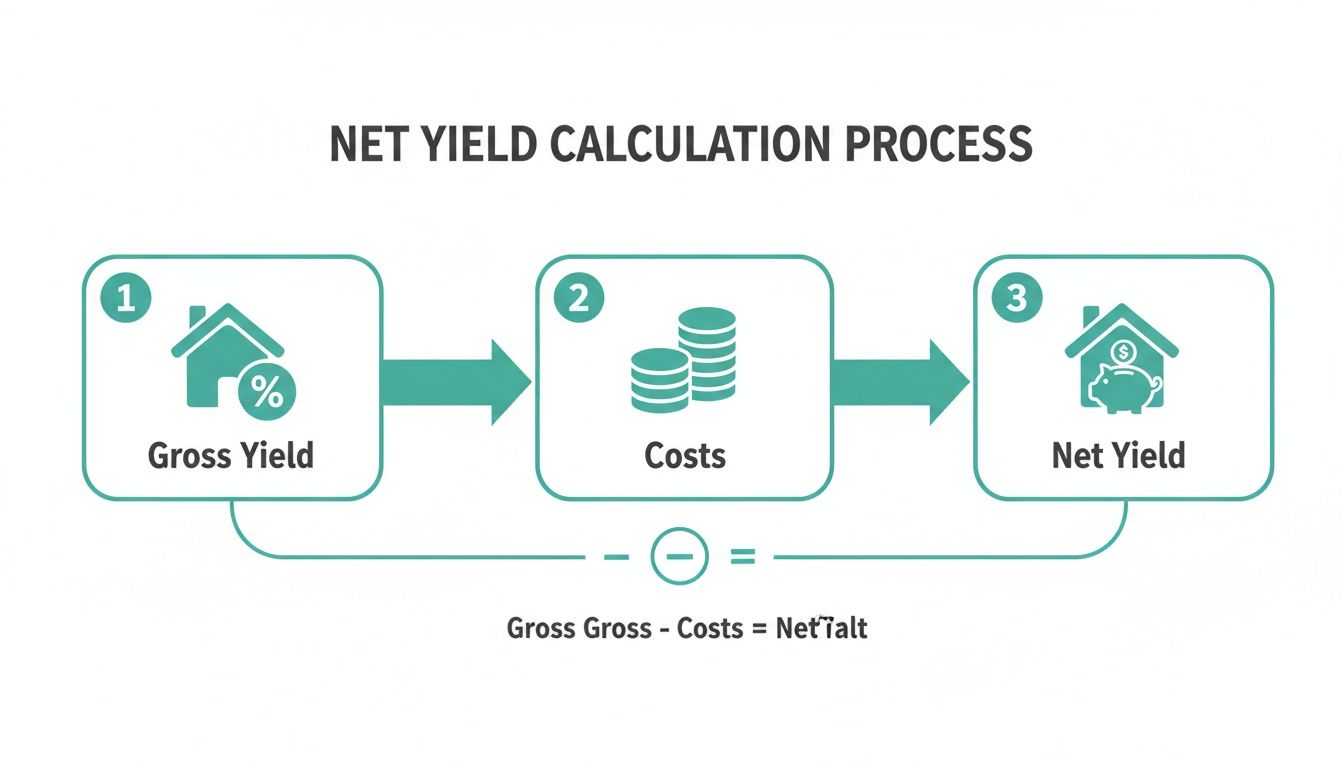
As you can see, subtracting the very real operating costs from your gross income is the only way to arrive at a figure you can actually take to the bank.
Return on Investment (ROI) and Cash-on-Cash Return
Net yield is a fantastic tool for comparing properties you might buy outright. But let's be realistic—most of us use mortgages. This is where Return on Investment (ROI) and its close cousin, Cash-on-Cash Return, become essential.
These metrics don't measure the return against the property's total value. Instead, they measure it against the actual cash you've personally pulled out of your bank account to make the deal happen. This is a complete game-changer because it reveals the true power of leverage.
The formula for Cash-on-Cash Return looks like this:
Cash-on-Cash Return = (Annual Pre-Tax Cash Flow ÷ Total Cash Invested) × 100
Here, "Annual Pre-Tax Cash Flow" is simply your net operating income minus your annual mortgage payments. The "Total Cash Invested" is everything you paid upfront: your deposit, Stamp Duty (SDLT), solicitor fees, broker fees, and anything else.
Think of it this way: Net yield measures the property's performance. Cash-on-Cash Return measures your money's performance. A good property with smart financing can produce an exceptional Cash-on-Cash return.
A UK Example of Cash-on-Cash Return
Let's go back to our Leeds terrace house from the last section.
- Total Purchase Cost: £187,400
- Net Annual Profit (before mortgage): £7,720
Now, let's say you secure a 75% loan-to-value (LTV) mortgage on the £180,000 purchase price.
1. Work out your Total Cash Invested:
- Deposit (25% of £180,000): £45,000
- SDLT, legal, and other fees: £7,400
- Total Cash Invested: £52,400
2. Figure out the Annual Mortgage Payments:
- Loan amount: £135,000
- Let's assume an interest-only mortgage at a rate of 5.5%: £7,425 per year
3. Calculate the Annual Pre-Tax Cash Flow:
- Net Profit (£7,720) - Mortgage Payments (£7,425) = £295
4. Finally, calculate the Cash-on-Cash Return:
- (£295 ÷ £52,400) × 100 = 0.56%
The result is a tiny 0.56%. This tells you instantly that at this interest rate, the deal is barely washing its own face. That slim profit margin has been almost completely wiped out by the cost of finance.
Without this calculation, you might have looked at the 4.12% net yield and thought it was acceptable. This is why cash-on-cash is so revealing. For a deeper dive into how these figures work together, check out our guide on using a UK property ROI calculator.
Understanding the Capitalisation Rate (Cap Rate)
Finally, let's touch on the Capitalisation Rate, or Cap Rate. While the formula looks a lot like net yield, it serves a different purpose. In the UK, investors and commercial surveyors mainly use Cap Rate to value multi-unit blocks or commercial properties, not your average single buy-to-let.
Here's the formula:
Cap Rate = (Net Operating Income ÷ Current Market Value) × 100
The crucial difference is that Cap Rate uses the Current Market Value, whereas net yield uses your original Total Purchase Cost. This makes it a live, dynamic measure of a property's value based on the income it generates, relative to what the market is paying for similar income streams right now.
Why Cap Rate Matters
Imagine you own a small block of four flats generating a combined Net Operating Income of £30,000 a year. If similar blocks in the area are changing hands at a 6% Cap Rate, you can get a quick estimate of your property's value.
- Estimated Value = Net Operating Income ÷ Cap Rate
- Estimated Value = £30,000 ÷ 0.06 = £500,000
Now, let's say you get creative. Through smart rent increases or finding cost efficiencies, you push the Net Operating Income up to £35,000. If the market Cap Rate holds steady at 6%, you've just "forced" the appreciation of your asset.
- New Value = £35,000 ÷ 0.06 = £583,333
By focusing on the numbers that actually drive value, you shift from being a passive landlord into an active asset manager. Mastering these advanced metrics is what separates the hobbyists from the serious players making sophisticated, high-performance investment decisions.
Adapting Your Numbers for Different UK Property Strategies
A standard buy-to-let is just one way to invest in property, and your calculations have to evolve with your strategy. Your basic yield formulas are a solid foundation, but if you apply them blindly to something like a House in Multiple Occupation (HMO) or a Serviced Accommodation unit, you'll get dangerously misleading results.
Knowing how to calculate property returns for different strategies is what separates the amateurs from the pros. Each model has a completely different cost structure and income profile, which means you need a tailored approach to your analysis. This is where a flexible tool becomes non-negotiable for accurately comparing what you could do with the same building.
Analysing a House in Multiple Occupation (HMO)
On paper, HMOs often look incredibly tempting. It's not uncommon to see gross yields that could easily double that of a standard single-let property just down the road. But—and it's a big but—the operating costs are in a different league, and your numbers have to reflect this reality if you want to avoid a cash flow nightmare.
When you're analysing an HMO deal, you have to factor in a whole host of extra landlord-paid expenses that simply don't exist in a typical buy-to-let.
- Council Tax: In almost every HMO, the landlord is on the hook for the entire council tax bill.
- Utilities: You'll also be covering gas, electricity, water, and broadband for the whole house, which can easily run into hundreds of pounds a month.
- Licensing Fees: Most UK councils now require a mandatory HMO licence. This can cost anywhere from £500 to over £1,500 and needs renewing every few years.
- Higher Maintenance & Voids: More tenants equals more wear and tear. Your maintenance budget needs to be bigger, and it's much smarter to model voids on a per-room basis instead of for the whole property at once.
If you're considering this route, our deep-dive article on student accommodation as an investment explores the specific nuances of this popular HMO sub-strategy.
Calculating Returns for Serviced Accommodation (SA)
Serviced Accommodation, often run as short-term lets on platforms like Airbnb and Booking.com, can generate even higher headline revenue than an HMO. But the operational intensity and the costs that come with it are on another level entirely. A standard net yield calculation is simply not fit for purpose here.
Your analysis must account for costs that feel more like running a small hotel than a rental property.
Serviced Accommodation is a hospitality business that uses property as its vehicle. Forgetting this and using standard BTL cost assumptions is the single fastest way to lose money in this strategy.
Key costs you absolutely must include are:
- Booking Platform Commissions: Expect to pay 15-20% of your booking revenue straight to the platform.
- Frequent Cleaning & Laundry: This is a major, recurring operational cost that happens between every single guest stay. It's not a minor monthly expense.
- Higher Utility Bills: You are responsible for all utilities, and guest usage is often much higher than in a standard rental.
- Management Fees: Specialist SA management companies charge a lot more than standard letting agents, often 20% + VAT of your gross revenue.
Modelling a Flip or BRRRR Project
For strategies like a property 'Flip' or a Buy, Refurbish, Refinance, Rent (BRRRR) project, traditional rental yield isn't your main focus during the initial analysis. Instead, you're all about the projected profit and Return on Investment (ROI).
Here, the calculation centres on the total capital you need to get the deal done versus the net profit you'll make when you sell, or the equity you'll create when you refinance.
Projected Profit Formula: (After Repair Value – (Purchase Price + Purchase Costs + Renovation Costs + Finance Costs + Selling Costs))
Your analysis needs to be meticulous, with detailed costings for every single stage:
- Purchase Costs: This includes your SDLT, solicitor fees, and survey costs.
- Renovation Costs: You need a detailed schedule of works with a healthy 10-15% contingency built in for surprises.
- Finance Costs: This covers arrangement fees, broker fees, and the monthly interest on any bridging or development finance you use.
- Selling Costs: Don't forget the estate agent fees (usually around 1.5% of the sale price) and the legal fees for the sale itself.
For a BRRRR, the goal is slightly different. You're calculating the 'equity left in' after refinancing onto a standard mortgage. This is what determines your ROI, as it shows how much of your initial capital you successfully pulled back out of the deal to use on the next project. Each strategy demands its own set of sums to give you a clear and accurate financial forecast.
So, What Do Your Yield Numbers Actually Mean?

Getting a yield figure is just data entry. Knowing what that number actually tells you is what separates hopeful speculators from wealthy, data-backed investors.
A 4.5% net yield might be a fantastic result for a hands-off, single-let in a prime London borough. But that same figure could be a serious red flag for a high-maintenance HMO in Liverpool. The number itself is meaningless without context.
This is the critical step. It's about understanding how your deal stacks up against local benchmarks and, most importantly, how resilient it is to future shocks. This is a crucial part of learning how to calculate property yields like a professional, not just an amateur with a calculator.
First, Benchmark the Deal
Your first job is to see how your calculated yield compares to the local market and your own investment goals. Is the 4.12% net yield we calculated earlier on that Leeds property any good? Who knows.
To find out, you need to analyse what similar properties have recently let for in the same postcode. Look for the typical net yields other investors are actually achieving for that exact property type in that specific area. This tells you whether your deal is a winner, just average, or a dud you should walk away from immediately.
A deal might look great in isolation, but it only becomes a true investment when you can prove it outperforms the local market. Without benchmarking, you're just guessing and could be leaving serious money on the table.
Next, Stress-Test Your Investment
Once you know the deal is competitive, the real analysis begins. This is where you deliberately try to break the numbers to expose any hidden risks before you commit a single penny. The two most powerful ways to do this are sensitivity analysis and break-even analysis.
-
Sensitivity Analysis: This is all about asking "what if?" What happens to my cash flow if mortgage rates jump by 1% or even 2% in 2026? What if I get hit with an unexpected £2,000 bill for a new boiler? By tweaking these variables, you see just how sensitive your profits are to negative events.
-
Break-Even Analysis: This calculation tells you the absolute floor for your investment—your break-even occupancy rate. At what point does the rental income exactly cover all your costs, including the mortgage? Knowing you can stay profitable even with a 20% vacancy rate gives you enormous peace of mind and proves the deal's resilience.
These two checks reveal the true strength of an investment. A deal that only works in a perfect world—with 100% occupancy and rock-bottom interest rates—is an incredibly fragile and risky proposition. The goal is to find opportunities that keep making you money even when things don't go exactly to plan.
This forward-looking interpretation is what separates a successful, robust portfolio from a collection of financial burdens waiting to happen.
Common Questions on UK Property Yields (and the Answers Investors Need)
We've walked through the mechanics of calculating property yields, from the quick back-of-the-envelope numbers to the more serious financial deep-dives. But a few practical questions always pop up when investors start applying these formulas to real-world UK deals.
Let's get them answered.
What's a Good Rental Yield in the UK?
Honestly, there's no single "good" number—it's entirely dependent on your strategy and where you're buying. A gross yield of 7% or more is often seen as a strong benchmark in many northern cities, where property prices are lower compared to the rent you can achieve.
On the other hand, a 4-5% gross yield might be perfectly acceptable in the South East. Investors there are often willing to trade lower cash flow for a better shot at long-term capital growth.
The figure that really matters for your bank balance is the net yield. Once all the bills are paid, most savvy investors are looking for a healthy 4-6% to make the deal worthwhile.
How Does Section 24 Affect My Net Yield Calculation?
This is a big one. The Section 24 mortgage interest relief rules can have a huge impact on your final profit, especially if you're a higher-rate taxpayer. The key thing to remember is that you can no longer deduct all your mortgage interest as a pre-tax business expense.
Instead, you get a tax credit equivalent to 20% of your mortgage interest payments.
This means your net yield calculation—which is always a pre-tax figure—doesn't actually change. However, your final, take-home profit will be lower. It's a crucial, separate calculation you must run after working out your operating net yield to see what the deal really delivers.
Should I Mix Capital Appreciation into My Yield Calculation?
In a word: no. Rental yield is a very specific tool. It's designed to measure one thing and one thing only: how well the property's income performs against its cost.
Capital appreciation—the increase in the property's market value over time—is a totally separate (and equally important) part of your overall return.
If you start mixing the two, you get a muddled number that doesn't accurately reflect the property's ongoing cash flow performance. Keep them separate to understand both parts of your investment return clearly.
Stop getting tangled up in spreadsheets and start making clear, data-driven decisions in seconds. DealSheet AI automates all these UK-specific calculations for you—from gross yield to ROI, across any property strategy.
Analyse your next deal with total confidence. You can download the app from the Apple App Store today.