
Your Ultimate Rightmove Deal Analyser Guide for UK Investors in 2026
Your Ultimate Rightmove Deal Analyser Guide for UK Investors in 2026
In the fast-paced UK property market, the best Rightmove deal analyser is an AI-powered tool that eliminates manual work and delivers instant, accurate insights. An effective analyser must convert a simple property listing into a comprehensive financial breakdown, covering everything from yields and cash flow to UK-specific taxes like Stamp Duty. For investors needing to make rapid, informed decisions, a tool like the DealSheet AI app is essential for success in 2026. Ready to upgrade your analysis? Download the DealSheet AI app here and turn property data into profitable decisions.
Why Manual Property Analysis Is Holding You Back
Trying to analyse Rightmove listings with a spreadsheet is like navigating London with a paper A-to-Z instead of a GPS. It's slow, you'll probably make a mistake, and you'll definitely miss the best opportunities. In the UK's dynamic property market, this old-school approach is a serious handicap that often leads to missed deals and costly miscalculations.
The challenges for UK investors are piling up. You're not just juggling an asking price and potential rent; you're navigating volatile market conditions, the minefield of Stamp Duty Land Tax (SDLT), and the brutal impact of Section 24 mortgage interest rules on your bottom line. A simple spreadsheet can quickly become a tangled mess of formulas that are a nightmare to update and even harder to trust.
The True Cost of Manual Calculations
Manually punching in data for every single deal isn't just tedious; it puts you at a huge strategic disadvantage. Every minute you spend copying and pasting figures is a minute you're not spending on negotiating, viewing properties, or building relationships with agents. The market doesn't pause while you double-check your calculations.
The real risk of manual analysis isn't just getting the numbers wrong—it's the paralysis that comes from having zero confidence in those numbers. When you can't trust your own analysis, you hesitate. In property, hesitation almost always means losing a great deal to a faster, better-equipped investor.
Navigating a Volatile UK Market
The UK property market demands investors to be both nimble and precise. Data from the Halifax House Price Index shows just how quickly conditions can pivot. The housing index peaked at an all-time high of 517.50 points in January 2026, yet by December 2025, year-over-year growth had slowed to just 0.30%.
This kind of volatility makes a fast and accurate Rightmove deal analyser essential for spotting opportunities the moment they appear. You can learn more about these market trends and their impact on UK house prices.
Here's a typical Rightmove property listing page that investors spend their time picking apart.

It gives you the basics—price, location, photos—but it's missing the financial metrics you actually need to make a proper investment decision.
This is where automation becomes a game-changer. For investors feeling swamped by data, an AI-powered tool is the key to shifting focus from painful calculations to high-level strategy. An app like DealSheet AI transforms this whole process, turning a simple Rightmove URL into a complete investment breakdown in seconds. It's time to stop guessing and start analysing with precision.
Manual Spreadsheets vs AI Deal Analysis
It's easy to get comfortable with a familiar spreadsheet, but the difference in speed, accuracy, and strategic insight is stark. When you're up against investors who can analyse a deal in 30 seconds, your manual process becomes a liability.
| Feature | Manual Spreadsheets | DealSheet AI |
|---|---|---|
| Speed | Hours per week of manual data entry | Instant analysis from a URL, PDF, or even a photo |
| Accuracy | High risk of formula errors, outdated rates, missed costs | Consistent, validated calculations for UK-specific rules |
| UK Tax Rules | Requires manual updates for Stamp Duty & Section 24 | Built-in logic for SDLT & Section 24, always up-to-date |
| Stress Testing | Complex to build and run multiple scenarios | One-click stress tests for interest rates, voids, and rent |
| Consistency | Assumptions vary from deal to deal, causing bias | Standardised analysis for true "apples-to-apples" comparison |
| Strategic Focus | Time spent on data entry and fixing formulas | Time spent on negotiation, sourcing, and decision-making |
Ultimately, clinging to spreadsheets means you're choosing to spend your most valuable resource—time—on low-value tasks. AI tools free you up to do what actually grows your portfolio: making smart, evidence-based decisions, fast.
How to Capture and Import Property Deals Instantly
The very first step in a proper Rightmove deal analyser workflow is getting the data in without friction. Slow, manual data entry is where momentum dies. The goal is to get from spotting a potential deal on Rightmove to deep analysis in under a minute. Forget about the old days of copy-and-paste drudgery.
You shouldn't be meticulously transferring the asking price, address, and bedroom count into a spreadsheet. The best tools automate this entirely, saving you precious time when the UK property market demands speed.
Three Effortless Ways to Get a Deal into the System
Capturing a property's details should be as simple as sending a link to a friend. With DealSheet AI, you've got three main ways to pull property information straight into your analysis dashboard. Each one is designed for a different real-world scenario.
-
Pasting the Rightmove URL: This is the workhorse method. Fast, simple, and direct. Just copy the property link from your browser and paste it straight into the app. The AI gets to work immediately, extracting key data like price, location, and property type.
-
Uploading an Agent's PDF Brochure: We all get those off-market deals or detailed brochures sent over by email. Instead of squinting at the PDF and manually typing out the information, you just upload the file directly. The tech scans the document and pulls the relevant figures for you.
-
Using a Screenshot: Sometimes you're on the move or spot a deal on a platform where copying a link is a pain. Just take a screenshot of the listing. The app's image recognition will read the text and populate the analysis fields for you.
The core principle is simple: if you can see the deal, you can analyse it. By removing the barrier of manual data entry, you ensure no opportunity is missed just because you didn't have time to build a new spreadsheet.
What About Messy or Incomplete Listings?
Let's be honest, not all Rightmove listings are created equal. Some have vague descriptions, others are missing a floor plan, or the agent might have conveniently forgotten a few key details. This is where a smart Rightmove deal analyser really proves its worth.
If the AI can't find a specific detail, it flags it for your attention. This lets you make a quick manual tweak without having to build the whole analysis from scratch. It's particularly useful for cleaning up messy information. You can read more about how AI can organise unstructured notes and apply that same logic to property listings.
This combination of automated extraction and easy manual override ensures you get a high-quality analysis every single time, even when you start with a low-quality listing.
Matching UK Investment Strategies to Properties
So, you've captured a property's details. What's next? This is the single most important decision point in the entire process: matching the property to the right investment strategy.
Get this wrong, and your entire financial model will be built on sand. A three-bedroom semi in a great school catchment could be a perfect Buy-to-Let (BTL), but it would almost certainly be a disastrous Flip. The strategy you choose completely changes the metrics you care about.
For a classic BTL investor, consistent monthly cash flow is king. But if you're a Flip investor, your world revolves around the After Repair Value (ARV) and the final net profit from the sale. Every strategy has its own financial DNA, and your analysis has to respect that from the very beginning.
The Seven Core UK Property Strategies
A powerful deal analyser needs to speak the language of UK investors. DealSheet AI is built around the seven most common strategies, making sure your calculations are always relevant to your goals.
- Buy-to-Let (BTL): The classic long-term hold for rental income and capital appreciation.
- House in Multiple Occupation (HMO): Renting out individual rooms to maximise rental yield.
- Buy, Refurbish, Refinance, Rent (BRRRR): A method focused on adding value and recycling your initial capital.
- Serviced Accommodation (SA): Short-term lets, often targeting tourists or business travellers, for higher nightly rates.
- Flip: Buying, renovating, and selling a property quickly for a one-off profit.
- Mixed Use: Properties combining commercial and residential elements.
- Auction: Deals often requiring faster financing and a different risk assessment.
Understanding the subtle differences is essential. If you want to go deeper, we break down each of these in our complete guide to UK property investment strategies.
The decision tree below shows just how simple it is to get a property's data into the system, which is the very first step before you even think about strategy.
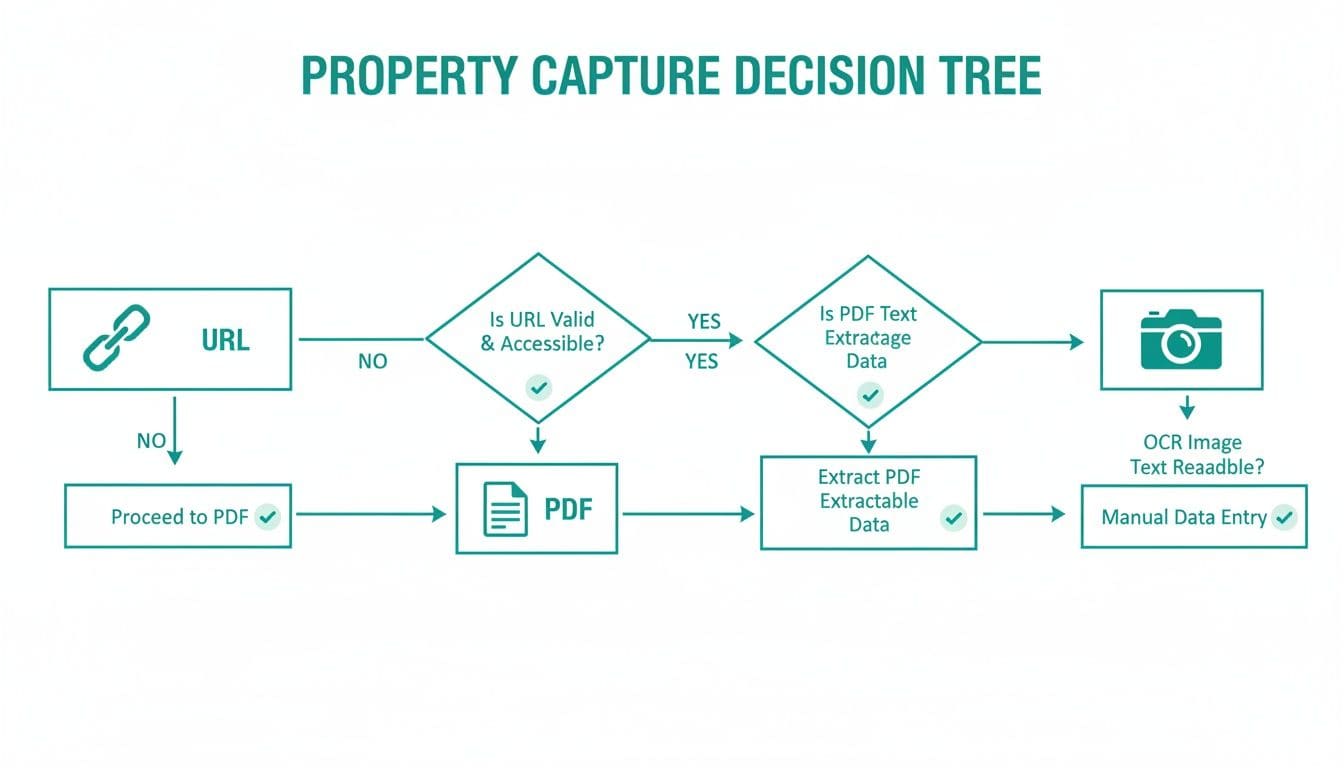
Whether you start with a URL, a PDF brochure from an agent, or just a screenshot of some notes, the process is incredibly flexible.
Aligning Metrics with Your Goals
The UK has a vast and varied housing market. The housing stock in England, Wales, and Scotland has ballooned from 3.8 million in 1851 to over 28 million today. This creates a huge number of opportunities but also demands a fast and accurate way to filter them. This is where a modern Rightmove deal analyser comes into its own, pulling the key details into your chosen strategy model automatically.
The single biggest mistake investors make is applying a one-size-fits-all analysis to every property. An HMO requires a completely different cost model and income projection compared to a Serviced Accommodation unit, and your tool must reflect that reality.
When you select the right strategy from the outset, you're ensuring every financial input—from the refurb budget and void period assumptions to financing costs and tax—is tailored to that specific goal. This alignment is what gives you the confidence to make decisions based on numbers that actually matter.
Key Metrics by UK Investment Strategy
To help you focus, here's a quick summary of the primary metric you should be watching for each of the core UK property strategies. While you'll look at many numbers, this is the one that often tells you most of the story.
| Investment Strategy | Primary Metric to Watch | Typical Goal |
|---|---|---|
| Buy-to-Let (BTL) | Monthly Cash Flow | Consistent, passive income after all costs and tax. |
| House in Multiple Occupation (HMO) | Net Yield | Maximising rental income from a single property asset. |
| BRRRR | Cash Left In (after refinance) | Recycling as much of your initial capital as possible. |
| Serviced Accommodation (SA) | Revenue Per Available Night (RevPAN) | Optimising income from a hospitality-based model. |
| Flip | Net Profit on Sale | A single, significant capital return after all costs. |
| Mixed Use | Blended Yield | Balancing commercial and residential income streams. |
| Auction | Discount to Market Value | Securing an asset below its true worth to create instant equity. |
Focusing on the right primary metric for your chosen strategy is what separates a quick, decisive analysis from a confusing spreadsheet that tells you nothing. This simple habit helps you kill bad deals faster and move on the good ones with conviction.
How To Interpret Yield ROI And Cash Flow Metrics
When your Rightmove deal analyser finishes crunching the numbers, a dashboard packed with figures will greet you. It's tempting to glaze over and hope the data speaks for itself, but each percentage and pound tells part of a bigger financial story. Your role? Connect the dots and figure out which deals deliver real value.
Before you swipe past to the next listing, take a moment to let the metrics sink in. They're not just abstract stats—they reveal whether a property will boost your returns or leave you under water.

Unpacking The Core Performance Metrics
Every number on that screen offers a different angle on profitability. Here's what to focus on:
- Gross Yield: Annual rent divided by purchase price, expressed as a percentage. Think of it as your headline figure—an initial signpost of income potential before any costs bite.
- Net Yield: Takes gross rent and deducts all running costs: mortgage interest, insurance, maintenance, management fees and voids. This gives you the clearest view of real profitability.
- Return on Investment (ROI): Known as cash-on-cash return, ROI compares annual pre-tax profit to the actual cash you've pumped in (deposit, SDLT, legal fees). In plain terms, it answers: "How much do I earn for every pound I invest?"
- Monthly Cash Flow: The amount left in your bank account each month after rent arrives and bills—including mortgage payments—are paid. Positive cash flow is what keeps your portfolio healthy.
What Makes A Good Deal In The UK
A "good" deal in Guildford might look very different to one in Glasgow. That's why you can't rely on a single UK-wide benchmark. You need local context.
A 5% Net Yield might feel exceptional in Central London, where strong capital growth underpins returns. However, in Manchester or Liverpool, investors often expect closer to 7–8% just to balance slower price appreciation.
Always compare your deal against regional averages, not a generic figure. If you're still wrestling with the maths, our guide on How to Work Out Yield on a Property walks you through each calculation.
Understanding Tax Implications
One of the biggest blind spots in manual spreadsheets is tax. Thankfully, an AI-powered tool can factor in complex UK rules automatically.
For example, DealSheet AI calculates Stamp Duty Land Tax (SDLT) based on your profile—first-time buyer, additional property owner, or company purchase. More critically, it incorporates Section 24 restrictions that cap mortgage interest relief for individual landlords. Viewing your post-tax cash flow can dramatically shift whether a property looks attractive or becomes a liability.
Common Analysis Mistakes and How to Avoid Them
When you're using a powerful Rightmove deal analyser, speed is a huge advantage. But it can also be a trap. If you move too quickly without a solid process, you can easily overlook the critical flaws that turn a "great deal" into an expensive lesson. Accuracy has to come first.
The most common mistakes investors make are often surprisingly simple. People get swept up in the headline numbers and gloss over the details that actually determine profitability. Getting this right is about building a reliable filter to weed out the bad deals so you can focus your energy on the winners.
Underestimating Refurbishment Costs
A fresh coat of paint and some new carpet can quickly spiral into a full rewire and a new boiler. One of the single biggest mistakes is a wildly optimistic refurbishment budget. A vague "light refurb" assumption can completely destroy your profit margins before you've even started.
To avoid this, create a baseline cost estimate. A good rule of thumb for UK properties is to budget:
- £1,000-£1,500 per square metre for a comprehensive renovation.
- £500-£700 per square metre for a lighter cosmetic update.
Always, always add a contingency fund of 15-20% on top. Surprises are inevitable in property renovation, and a healthy contingency means they won't derail your entire project.
Ignoring Local Void Periods and Tenant Demand
An empty property is a cash drain. So many investors fall into the trap of assuming their property will be tenanted 12 months a year. This is almost never the case, and failing to account for voids gives you a dangerously inflated cash flow projection.
Do your homework on the local market. Check how long similar properties are listed for rent on Rightmove and, more importantly, speak to a couple of local letting agents. If they tell you the average void period in the area is four weeks per year, build that directly into your calculations. A robust Rightmove deal analyser like DealSheet AI lets you adjust these assumptions to reflect reality on the ground.
Stress-testing your deals is non-negotiable. A property that looks great with a 5% interest rate might become a financial nightmare at 7%. Use the stress-testing features in DealSheet AI to see how interest rate hikes, extended voids, or lower-than-expected rent would hit your bottom line.
Using Overly Optimistic Mortgage Assumptions
Finally, don't ever base your analysis on a mortgage product you hope to get. Lenders' criteria, rates, and loan-to-value (LTV) limits are constantly changing. Using an unrealistic interest rate in your analysis gives you a false sense of security and makes a bad deal look good.
Always run your numbers using current, achievable mortgage rates. Your best bet is to check with a broker to understand what products you are genuinely likely to qualify for and use those precise figures in your analysis. If you're exploring more complex strategies, you might find our guide on how to evaluate HMOs and BRRRR deals particularly useful.
Common Questions About Analysing Rightmove Deals
Let's be honest, bringing a new tool into your property workflow always raises a few questions. And when it comes to something as vital as your Rightmove deal analyser, you need to be completely confident in how it works.
We get asked these questions all the time by UK investors, so here are some straight answers to give you that clarity. Making smart decisions fast is the name of the game in this market, and having the right answers helps build a much stronger investment strategy.
Just How Accurate Is an AI-Powered Analyser?
This is a fair question. The simple answer is that an AI-powered tool like DealSheet AI is consistently more accurate than a manual spreadsheet, mainly because it removes the risk of human error. We've all been there—a misplaced decimal or a forgotten formula in a spreadsheet can make a bad deal look brilliant.
The system uses pre-programmed, current UK tax rules, like SDLT and Section 24, and property-specific cost assumptions that often get missed in personal spreadsheets.
You can always tweak the inputs to perfectly match your own circumstances, of course. But the baseline calculations provide a standardised, reliable foundation for every deal. This consistency is something manual methods can rarely achieve, ensuring you're always comparing apples with apples.
Can I Analyse Deals That Aren't on Rightmove?
Yes, absolutely. While Rightmove is the go-to for many investors, a flexible tool has to handle every opportunity you come across.
You can analyse off-market deals just as easily by uploading an agent's PDF brochure, using a screenshot from Zoopla or OnTheMarket, or even by manually typing in the details from your own notes.
This means you can keep a single, consistent analysis process for every potential investment, no matter where it came from. It centralises your deal flow and allows for genuine side-by-side comparisons of on-market and off-market opportunities.
The ultimate goal is to build a single, searchable library of every deal you've ever looked at. A flexible tool makes this possible, turning your past analyses into a seriously valuable database for future decisions.
What's the Single Most Important Metric in a Deal?
There isn't one. The "most important" metric depends entirely on your investment strategy, and anyone who tells you otherwise is probably trying to sell you something. A good Rightmove deal analyser lays out all the key figures, letting you focus on what actually aligns with your financial goals.
For example:
- For a long-term Buy-to-Let investor, monthly cash flow after all costs and taxes is king. It's the money that actually hits your bank account.
- For a BRRRR investor, Return on Investment (ROI) after the refinance is everything. It dictates how much of your capital you can pull out to recycle into the next project.
- For a Flip investor, the only numbers that truly matter are the net profit and how quickly you can achieve it.
By selecting your strategy at the start of the analysis, you ensure the numbers most relevant to you are front and centre. You can explore more about building a solid investment foundation by checking out the resources on the DealSheet AI website.
Ready to stop wrestling with spreadsheets and transform your property analysis into an instant, data-led process? With DealSheet AI, you can analyse any UK property deal in seconds, giving you the confidence to act on great opportunities before the competition even gets started.
Download DealSheet AI from the App Store and start your free trial today.