
What is Gross Development Value? A 2026 Guide for UK Property Pros
What is Gross Development Value? A 2026 Guide for UK Property Pros
Gross Development Value (GDV) is the total projected value of a property development once it's completed and ready for sale on the open market. In short, it's the figure that tells you what your project will be worth before you deduct any costs. For any UK property developer, understanding what is gross development value is the critical first step; it's the number that determines a project's viability, secures finance, and ultimately defines your profit. Want to skip the manual calculations and get instant, data-backed GDV analysis for UK properties? The DealSheet AI app analyses deals in seconds.
This guide will break down exactly how GDV works, how to calculate it with practical UK examples for 2026, and how you can use it to make smarter, more profitable investment decisions.
Understanding Gross Development Value in UK Property
At its heart, what is gross development value? It's a forward-looking estimate of a project's total value when it's finished. It is your top-line revenue figure, the pot of money you'll generate before subtracting the costs of land, construction, finance, and fees. For any UK property investor, this metric is the foundation stone for every other calculation that follows.
Whether you're a seasoned developer or just starting out, an accurate GDV is non-negotiable. It dictates everything from whether a deal is viable in the first place to what your final profit margin looks like. Lenders lean on it to decide how much they'll lend you, and you'll use it to decide if a project is even worth your time.
Why GDV is a Cornerstone Metric
GDV acts as the primary benchmark for everyone involved in a development project. It's the clear, quantifiable target that defines financial success.
- For Developers: It's the first hurdle in your feasibility study. By stacking the estimated GDV against your total project costs (land, build, professional fees, finance), you can see your potential profit and make a clear go/no-go decision.
- For Lenders: Development finance providers in the UK absolutely depend on the GDV to assess their risk. The loan they offer is almost always a percentage of the GDV, a metric known as the Loan-to-GDV ratio. A shaky GDV means no funding.
- For Investors: It provides a simple way to compare different opportunities. By looking at the potential GDV against the required investment for various projects, investors can allocate their capital to the deals with the most promise.
Gross Development Value is not just a theoretical number; it's the financial compass for your entire development project, guiding every decision from acquisition to exit.
The importance of getting GDV right is reflected across the wider economy. The UK's construction sector is a huge contributor, with projections for 2026 suggesting it will add £37,984 million to the economy in a single quarter (Q3 2026). This shows the immense scale of development activity where GDV is the engine driving every single project. You can dig into more regional data from the Office for National Statistics (ONS).
Calculating Your Project's Gross Development Value
Figuring out your project's Gross Development Value isn't some complex bit of algebra; it's about disciplined market research. At its heart, the principle is dead simple: work out what your finished project will be worth by looking at what similar, completed properties have actually sold for nearby.
Think of it like a chef pricing a new dish. They don't just guess. They go out and see what similar meals are selling for at other restaurants. This isn't about guesswork; it's about grounding your valuation in solid, real-world data.
For developers and investors in the UK, this means a deep dive into portals like Rightmove and Zoopla, but with a forensic focus. You're not interested in the ambitious asking prices people start with. You're hunting for the actual 'sold' price data from the Land Registry, which tells you what real buyers were willing to pay.
The Step-by-Step Calculation Process
To get a reliable GDV, you need a repeatable method. Following these steps ensures your number is built on evidence, not just hope. A solid GDV is everything—it underpins your profit forecasts and is critical for securing finance.
- Find True Comparables: The first job is to find at least three to five recently sold properties that are as close as possible to what your finished project will be. Look for similar size, bedroom count, and style, ideally within a quarter-mile radius.
- Analyse Sold Prices: Next, use the Land Registry data (often found on the portals) to find the actual sale prices, not the initial listing prices. This is the only figure that truly reflects market value.
- Make Smart Adjustments: No two properties are ever identical, so you have to adjust your valuation for the differences. Does your project have a bigger garden, a higher-spec finish, or off-street parking that the comparables lack? Try to quantify these differences to sharpen your estimate. A brand-new kitchen, for example, might add £5,000 - £10,000 to the value compared to a dated one.
The whole point of a GDV calculation is to land on a figure that a third-party surveyor would agree with. It has to be backed up by tangible evidence from the local market, not wishful thinking.
This visual breaks down the simple journey from an initial idea right through to the final Gross Development Value.
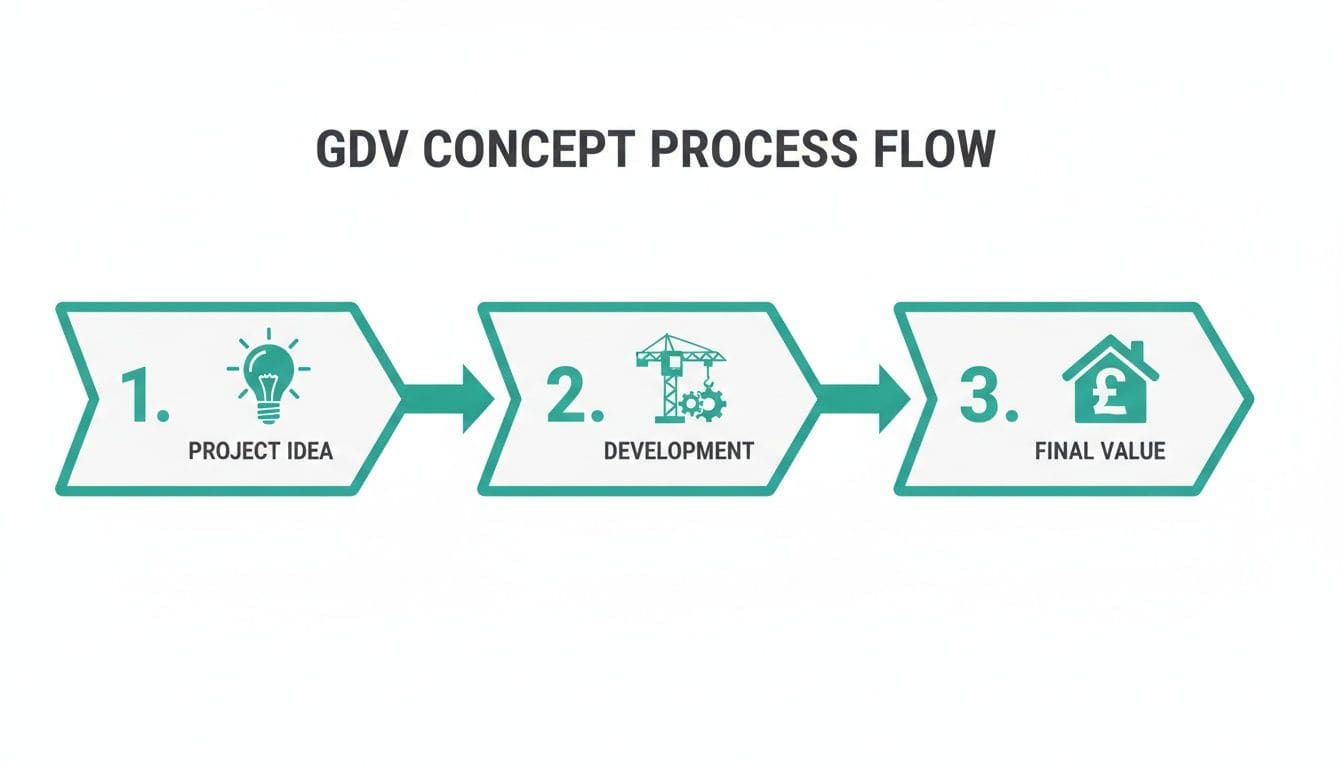
The flow from concept to completion really drives home that the final value is a direct result of the development work you put in.
Factoring in Project Costs
Now, while costs aren't technically part of the GDV formula, they are the other half of the story. A high GDV is completely meaningless if your development costs swallow up all the value you've created.
To get a true picture of your profit, you have to meticulously forecast every single expense, from buying the site to the final coat of paint. To get a better handle on this, check out our detailed guide on estimating building costs per square metre in the UK. It will help you understand the other side of the profitability equation, ensuring your fantastic GDV actually translates into profit in your pocket.
Real World UK Examples of GDV in Action
Theory only gets you so far. To really get your head around what is gross development value, you need to see how it plays out in actual UK property deals. Let's walk through four different scenarios, each showing how GDV is calculated based on the specific strategy you're using.
We'll use plausible figures to connect the GDV calculation directly to a project's potential profit. This shows you exactly how this single number guides investment decisions across the country, whether you're flipping a terrace or building a block of flats.
Example 1: Residential Flip in Manchester
Let's say you've found a tired, two-bedroom terraced house in a popular Manchester suburb. It's on the market for £170,000 but needs a full cosmetic refurb, including a new kitchen and bathroom. Your plan is to flip it for a profit within six months.
Your research on Rightmove and Zoopla shows three almost identical houses on the same street, all recently renovated to a high standard, have sold for an average of £245,000. With such solid comparable evidence, you can confidently set your Gross Development Value at £245,000.
This figure now becomes the target. All your costs—purchase, stamp duty, refurb, fees—must sit comfortably underneath it to leave a healthy profit margin.
Example 2: Commercial to Residential Conversion in Bristol
Next up, a disused ground-floor shop in Bristol. It has planning permission to be converted into two one-bedroom flats and the purchase price is £200,000. Here, the GDV isn't based on what the property is now, but what it will become.
You find that newly converted one-bed flats in the area are selling for around £190,000 each. This makes the calculation pretty straightforward:
- GDV = 2 flats x £190,000 per flat = £380,000
This £380,000 GDV is the number a lender will focus on. They'll use it to assess the project's viability and calculate their loan-to-GDV offer, which is what unlocks the finance you need to get the conversion done.
Example 3: HMO Conversion in Birmingham
Now let's look at a House in Multiple Occupation (HMO) project. You're buying a large 4-bedroom house in Birmingham for £250,000, with a plan to convert it into a 6-bedroom, all-ensuite HMO aimed at students and young professionals.
For an HMO, the GDV is usually calculated based on its rental income, using a commercial valuation method. First, you work out the potential rent. You establish that each room will comfortably let for £600 per month.
- Total Annual Rent: 6 rooms x £600/month x 12 months = £43,200
- Yield Calculation: You speak to local valuers who confirm high-quality HMOs are being valued on a 7.5% gross yield.
- GDV: £43,200 / 0.075 = £576,000
This method values the property as an income-generating asset, which is a common approach for buy-to-let investments. If you're interested in this strategy, our guide on the best areas for buy-to-let has more insights.
Example 4: Small New-Build Development
Finally, let's assess a plot of land in a London commuter town with planning permission for three detached four-bedroom houses. Here, the GDV is simply the total sales value of all the finished homes.
Your research shows that new-builds of this size and spec in the area are fetching prices around £650,000. The project's Gross Development Value is therefore:
- GDV = 3 houses x £650,000 per house = £1,950,000
This total figure becomes the cornerstone of the entire development appraisal. It dictates the budget for everything that follows—land purchase, construction, professional fees, and ultimately, your profit.
How GDV Unlocks Development Finance and Profit
Gross Development Value isn't just a valuation. It's the master key that unlocks your project's funding and the ultimate yardstick for your success. An accurate GDV calculation connects your project's potential to its real-world financial consequences, influencing both your lender and your own bottom line.
For any UK development lender, the GDV is the single most important number on the page. They use it to manage their risk, typically offering a loan based on a percentage of the final value. This is known as the Loan-to-GDV ratio.
If a lender offers a 65% Loan-to-GDV on a project with a £1 million GDV, their maximum loan will be £650,000. This shows why a robust, evidence-backed GDV is essential for securing the capital you need. You can find more detail on this in our guide on how to finance property development.
The Direct Link Between GDV and Profit
Your profit margin is directly tied to the accuracy of your GDV. The relationship is captured in a simple but powerful formula:
Profit = Gross Development Value (GDV) – Total Project Costs
Total costs cover everything from site acquisition and stamp duty to construction, professional fees, and finance charges. It doesn't take much of an error in your GDV to have a massive impact on your profit.
For instance, imagine a project with a projected GDV of £500,000 and total costs of £450,000, leaving a £50,000 profit. If your initial GDV was just 10% too optimistic and the finished project only sells for £450,000, your entire profit margin is wiped out. This is exactly why an accurate, well-researched valuation is absolutely non-negotiable for any serious UK developer.
GDV in Action on a National Scale
This principle applies to projects of all sizes, from a small two-bed flip to a mega-development. The Battersea Power Station project, for example, targeted a staggering £9 billion GDV—a figure that secured immense funding and defined its financial success from the outset.
On a broader scale, metrics derived from Gross Development Value are crucial for portfolio management. In recent years, a significant percentage of UK buy-to-let investors have used GDV-based stress tests to navigate tax changes and interest rate fluctuations, which significantly squeezed rental yields against a backdrop of modest economic growth.
Common GDV Mistakes and How to Avoid Them
An inaccurate Gross Development Value can poison a deal before the first brick is laid. While the concept seems simple enough, several common traps can catch out even experienced UK investors, turning a promising project into a financial headache.
Understanding these pitfalls is the key to building a robust, defensible, and realistic valuation that will actually stand up to lender scrutiny.
Relying on 'Asking Prices'
The most frequent error, by a long shot, is basing your GDV on optimistic 'asking prices' from property portals. An asking price is just a seller's hope; the only number that truly matters is the actual sold price recorded in the Land Registry.
Basing your entire financial model on aspirational figures is like building a house on quicksand. It's a recipe for disaster.
Overlooking Local Market Nuances
Another critical mistake is failing to account for specific, local market conditions. A valuation based on comparables just half a mile away can be dangerously misleading if your project is on the wrong side of a busy road or just outside a desirable school catchment area. Microlocations matter.
Similarly, the quality of your final finish has a direct impact on the end value. Your GDV must accurately reflect the specification you actually plan to deliver. Get this wrong, and you'll miss your target.
- Under-specifying: If your comparables are all high-end renovations with designer kitchens and you deliver a basic, landlord-grade finish, you will simply never achieve the projected GDV.
- Over-specifying: Conversely, installing a £30,000 kitchen in a starter-home area won't necessarily add £30,000 to the value. The finish must match what the local market expects and is willing to pay for.
A common mistake is treating GDV as a static, fixed-in-stone figure. In reality, it's a live estimate that must be stress-tested against potential market shifts. A 5-10% drop in local property values could easily wipe out your entire profit if you haven't built in a decent buffer.
Ignoring Essential Costs and Timelines
A robust GDV calculation has to be realistic about timelines. If similar properties in the area took nine months to sell, it's a huge mistake to assume yours will fly off the shelf in one.
This delay adds holding costs—things like council tax, insurance, and finance interest—which eat directly into your profit margin every single month.
It's also crucial to factor in all the associated expenses. While they aren't technically part of the GDV calculation itself, underestimating costs like Stamp Duty can make a profitable-looking deal completely unviable once you dig into the details.
To get this right, you can learn more by reading our detailed guide on what is Stamp Duty Land Tax and how it affects your bottom line.
By sidestepping these common errors, you move from guesswork to a data-driven approach, ensuring your Gross Development Value is a true reflection of the project's real-world potential.
Ditch the Spreadsheet: Automate Your GDV Analysis with DealSheet AI
After walking through the detail that goes into a credible Gross Development Value, one thing is clear: doing it by hand is a massive time sink, and it's frighteningly easy to make a costly mistake. This is where modern property tech gives savvy UK investors a serious edge, turning hours of painstaking research into a decision in seconds.
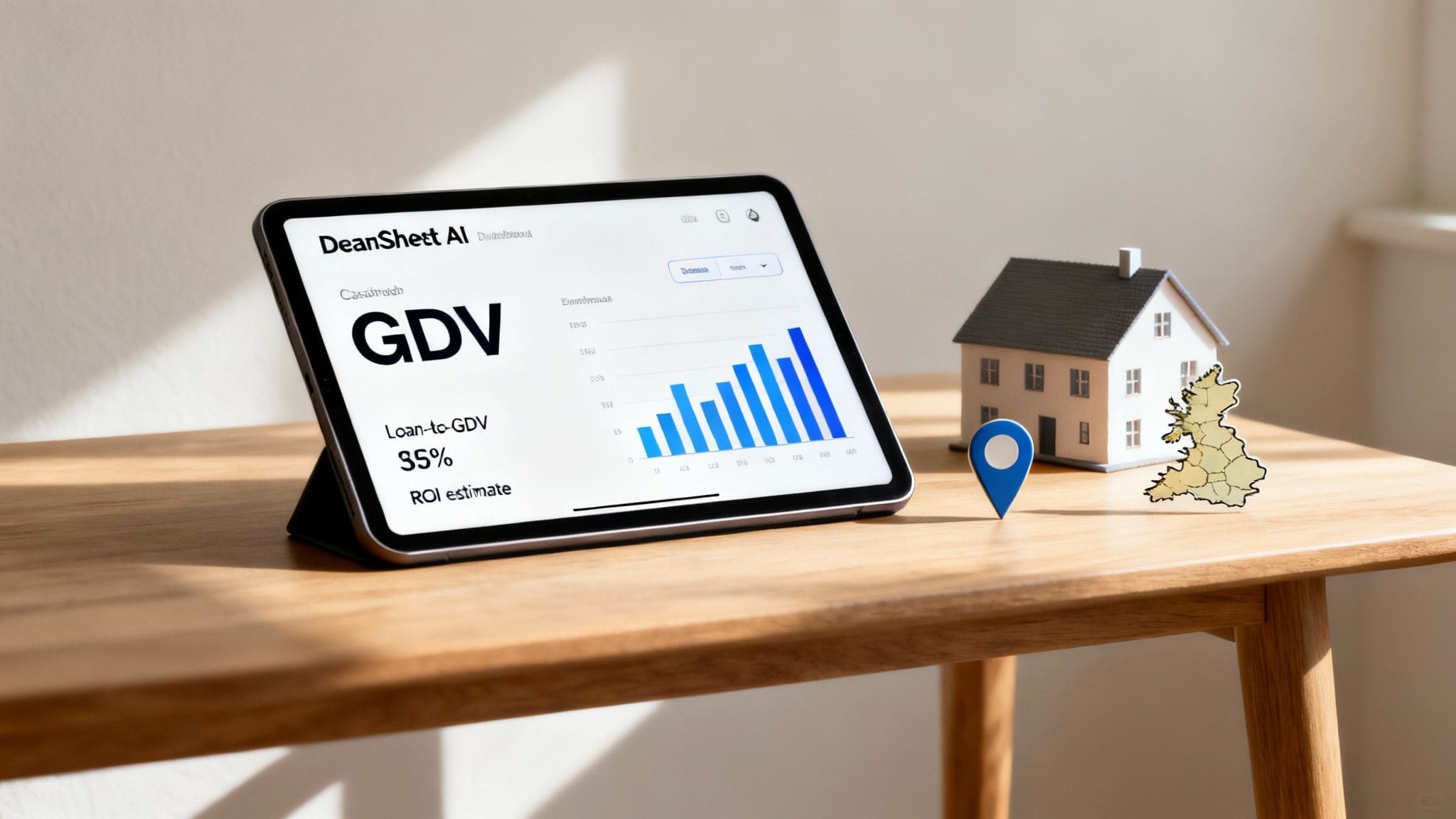
DealSheet AI is built to automate this entire analysis process. You just paste a property listing URL from Rightmove or Zoopla, and the app instantly gets to work, pulling out the key data points needed for a full financial appraisal.
From Manual Data Entry to Confident Decision Making
The real power of this isn't just speed; it's precision. Instead of manually punching numbers into a fragile spreadsheet, the app handles the heavy lifting. It applies UK-specific costs like Stamp Duty Land Tax and realistic refurbishment budgets automatically and consistently.
What you get back is a comprehensive financial summary that doesn't just answer the question "what is the gross development value?". It puts that number into the context of what actually matters to an investor. You'll see critical metrics like Return on Investment (ROI), net cash flow, and overall profitability calculated for you.
DealSheet AI is designed to move you beyond simple valuation and into proper deal analysis. It provides the financial clarity you need to make faster, more confident offers and build your property portfolio with precision.
Analyse More Deals, Find Better Opportunities
At the end of the day, successful property investment is a numbers game. The more deals you can accurately analyse, the higher your chances of finding that genuinely brilliant opportunity everyone else missed.
By automating the appraisal process, you can assess dozens of potential projects in the same time it would take you to manually analyse just one. You're no longer limited by the clock.
You can learn more about the specific calculations and features DealSheet AI uses to power its analysis. This is how you build a portfolio faster, make smarter offers, and operate with a level of confidence that manual methods simply can't match.
Got Questions About Gross Development Value?
To wrap things up, let's run through some of the most common questions that pop up for UK property developers and investors. Getting these straight will help cement your understanding of this crucial metric.
What's the Difference Between GDV and Market Value?
It's easy to mix these two up, but they're fundamentally about timing. Market Value is what a property is worth right now, in its current state, if you were to sell it today. It's the "as-is" price.
GDV, on the other hand, is a forecast. It's what you project the property will be worth in the future, after all your hard work is done and the development is complete. Think of it as what it's worth now versus what it could be worth later.
How Does Planning Permission Change the GDV?
In the world of property development, getting planning permission is often the main event. It's the single biggest lever you can pull to dramatically increase a site's value, and it has a massive, direct impact on GDV.
Why? Because planning consent is what turns a speculative idea into a real, financeable project. Imagine a tired old commercial building in a residential street. Its market value is low. But the moment you get planning permission to convert it into six flats, its value skyrockets—often overnight. That jump in value is a direct increase in the potential GDV, all before a single brick has been laid, because you've wiped out a huge chunk of the project's risk.
An approved planning application is the key that unlocks a site's true potential. It instantly boosts its end valuation, making it far more attractive to lenders and investors.
Can the GDV Change During a Project?
Absolutely. In fact, you should expect it to. GDV isn't a number you calculate once, file away, and forget about. Smart developers treat it as a live figure, constantly reviewing and adjusting it as the project moves forward. Several things can throw your initial estimate off course:
- Market Swings: The property market doesn't stand still. A sudden surge or dip in local house prices will have a direct knock-on effect on your projected end values.
- Changes in Spec: Decided to upgrade from laminate worktops to quartz, or add an extra en-suite? These changes to the final finish and layout can push your GDV up (or down).
- The Unexpected: You might uncover structural issues that force a change of plans, or find that a competitor is launching a similar scheme nearby. Both can impact your final product and its market value.
Revisiting your GDV regularly isn't a sign of a poorly planned project; it's a sign of a professional one. It keeps your numbers grounded in reality and ensures you stay on track to hit your profit targets.
Ready to analyse your next deal with precision and speed? Let DealSheet AI handle the complex calculations for you. Download the app from the App Store and turn property data into profitable decisions in seconds.