
A Guide to the Average Rent in Manchester UK for Investors in 2026
A Guide to the Average Rent in Manchester UK for Investors in 2026
If you're looking to invest in UK property, understanding the average rent in Manchester UK for 2026 is the perfect place to start. Across the city, you can expect monthly rents to range from around £907 to over £1,596, but this article will break down how those figures vary by area to help you find true investment opportunities. To turn those averages into actual, profitable deals, you need to go deeper. That's where modern tools like the DealSheet AI app come in, helping you analyse potential investments in seconds, not hours.
Your Guide to Manchester's Rental Market

Manchester's rental scene is a dynamic and rewarding landscape for UK property investors. Getting a grip on the headline figures is the first step, but the real money is made by understanding the huge variations that lie just beneath the surface.
The city is a real mix of opportunities, from high-demand student postcodes to quieter, family-focused suburbs. This means your investment strategy has to be just as flexible as the market itself.
Understanding the Numbers
Manchester has cemented its reputation as a serious property investment hotspot. As of early 2026, the city's average rental yield stands at an impressive 5.8%, a figure that sits comfortably above the national UK average of 4-5%. This attractive return is calculated across 32 different postcode districts, each with its own story to tell.
And those stories vary wildly. For instance, you could be looking at yields of 3.8% in M21 or a massive 7.3% in M18. This just goes to show how critical it is to do your homework on a specific location before you even think about putting in an offer. You can explore these rental yields in more detail to get a feel for what's driving the market.
For investors running high-cashflow strategies like Houses in Multiple Occupation (HMOs), certain postcodes are pure gold. Areas like M14, which covers Fallowfield and Rusholme, deliver exceptional yields hitting 7.8%. This is largely fuelled by the relentless demand from students at the city's major universities.
Manchester Average Rents and Yields at a Glance
To give you a clearer picture, here's a quick snapshot of how rental metrics can vary across different Manchester postcodes. Notice the significant difference between the lower and higher ends of the market—this is where granular analysis becomes essential.
| Metric | Low End (e.g., M26) | High End (e.g., M14) | City-Wide Average |
|---|---|---|---|
| Average Monthly Rent | £907 | £1,596 | £1,250 |
| Gross Rental Yield | 3.8% | 7.8% | 5.8% |
| Typical Property Type | Suburban Terraces | Student HMOs / Apartments | Mixed (Apartments, Terraces) |
As you can see, the "average" only tells part of the story. Your specific strategy—whether it's targeting young professionals in the city centre or students in Fallowfield—will dramatically change the numbers you should be looking at.
From Averages to Actionable Insights
This guide gives you a solid snapshot of what to expect from the average rent in Manchester. But to truly capitalise on the opportunities here, you have to move beyond averages and start analysing individual deals with laser precision.
Forget wrestling with manual spreadsheets. Modern tools are designed to give you a serious edge. The DealSheet AI app is built for exactly this purpose:
- Instant Analysis: Just paste a property link from Rightmove or Zoopla.
- Data-Driven Decisions: Get immediate insights into cash flow, ROI, and crucial UK tax implications.
- Strategy-Specific Calculations: Receive analysis tailored to your chosen investment model, whether it's a standard buy-to-let or a complex BRRRR project.
Finding Manchester's Most Profitable Postcodes
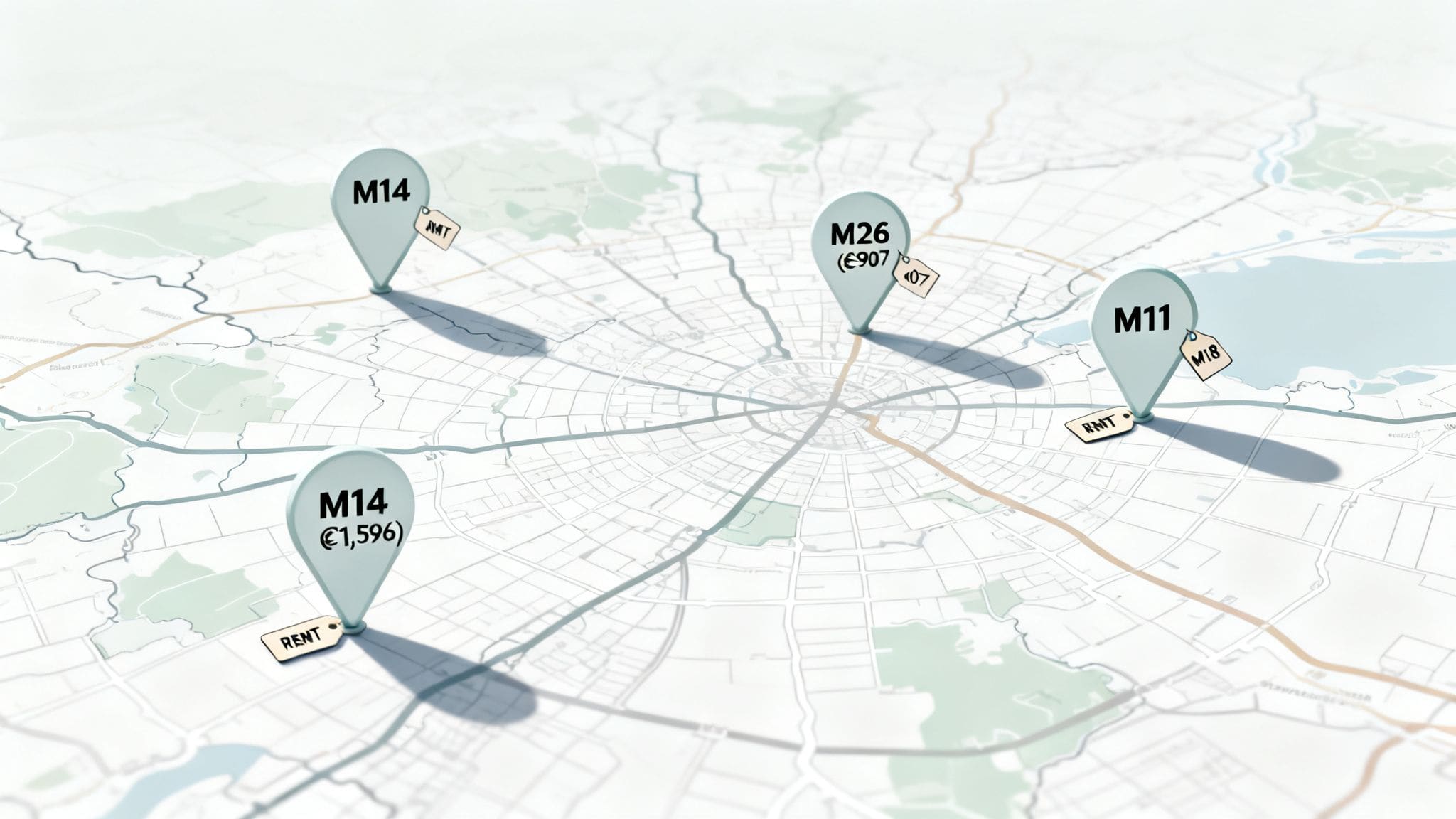
While the city-wide average rent gives you a useful benchmark, any savvy investor knows the real money is made in the details. Manchester isn't one single market; it's a collection of distinct neighbourhoods, each with its own rental pulse, tenant profile, and investment potential.
Pinpointing the right postcode is what separates a decent investment from a truly great one. A property in one part of the city might generate steady, reliable income from long-term families, while another just a few miles down the road could deliver significantly higher cash flow from the student crowd. Understanding these local nuances is everything.
High-Yield Student Hotspots
Certain postcodes have become legendary for high yields, almost entirely thanks to Manchester's huge student population. The M14 postcode, covering areas like Fallowfield and Rusholme, is the undisputed king here. Its doorstep proximity to the University of Manchester and Manchester Metropolitan University creates a relentless, year-on-year demand for rooms.
The strategy of choice? Almost always a House in Multiple Occupation (HMO). By renting on a per-room basis, landlords can push monthly rental income towards £1,600. This supercharges the numbers, turning what looks like a standard terraced house into a high-performance cash flow machine.
Uncovering Hidden Gems for Yield
Step away from the student-heavy zones, and you'll find other postcodes offering outstanding returns for investors willing to look a little closer. Areas like M11 (Openshaw) and M18 (Gorton) in East Manchester are emerging as yield powerhouses, with figures consistently topping 7%.
These neighbourhoods are riding a wave of regeneration and benefiting from much-improved transport links. This is attracting a solid mix of working professionals and families who want affordable housing without sacrificing an easy commute. It creates a strong, stable rental market with the potential for both healthy cash flow and future capital growth.
A few to keep on your radar:
- M11 (Openshaw): Offers excellent value with brilliant transport links into the city centre.
- M18 (Gorton): Undergoing significant redevelopment, making it very attractive for long-term growth.
- M23 (Wythenshawe): Its proximity to the airport and major employment hubs drives consistent tenant demand.
Accessible Entry Points and Tenant Profiles
For investors looking for a more accessible way into the market, postcodes like M26 (Radcliffe) present a compelling option. Yes, the rents are lower, but so are the purchase prices. This can make achieving a positive return much more straightforward, especially if you have less capital to start with.
The tenant profile in these areas tends to be families and long-term residents, which often means lower tenant turnover and more predictable income streams. That kind of stability is incredibly attractive for investors focused on a classic, hassle-free buy-to-let strategy.
The key takeaway is the sheer diversity within Manchester's rental market. Average rents can vary dramatically by postcode, from £209 per week in M26 to £368 in M14. This range, current as of early 2026, translates to monthly figures of £907 to £1,596. High-performers like M11 and M18 continue to attract HMO and buy-to-let pros looking for strong returns.
Manchester Postcode Rental Hotspot Analysis
So, how does this all stack up when you put it side-by-side? The best postcode for you depends entirely on your investment goals. Are you chasing the highest possible monthly cash flow, or is long-term capital growth your priority?
This table breaks down some of the key postcodes to help guide your thinking.
| Postcode | Main Area(s) | Average Monthly Rent (£) | Average Rental Yield (%) | Best Suited For (Strategy) |
|---|---|---|---|---|
| M14 | Fallowfield, Rusholme | £1,596 | 7.8% | Student HMOs, High Cash Flow |
| M18 | Gorton, Abbey Hey | £1,150 | 7.3% | Buy-to-Let, BRRRR |
| M11 | Openshaw, Clayton | £1,100 | 7.2% | Buy-to-Let, Value-Add |
| M23 | Wythenshawe, Baguley | £1,050 | 6.4% | Professional Lets, Buy-to-Let |
| M26 | Radcliffe, Ainsworth | £907 | 4.5% | Family Lets, Accessible BTL |
By analysing the data at this granular level, you move beyond generic city averages and start making strategic, data-driven decisions that align perfectly with your investment ambitions. For a broader look at identifying prime locations, you might find our guide on the best areas for buy-to-let investments in the UK useful.
So, What's Actually Fuelling Manchester's Rental Boom?
The relentless climb in the average rent in Manchester UK is no accident. It's the result of powerful economic and demographic forces colliding to create one of the UK's most resilient rental markets. If you're an investor, understanding these drivers is the key to seeing where the market is headed next.
Think of it as the perfect storm for rental demand, brewed from a mix of national pressures and Manchester's own unique strengths.
The National Affordability Squeeze
A huge part of Manchester's story is actually a national one: the widening chasm between house prices and what people can afford. Since 2015 alone, UK house prices have shot up nearly 30% faster than rents. For countless people, this has pushed the dream of homeownership further and further away, locking them into the rental market for the long term.
This isn't just a London problem anymore; it's a UK-wide reality that funnels demand directly into thriving regional cities. As more people become long-term tenants out of necessity, the clamour for quality rental homes in places like Manchester intensifies, which naturally drives rents upwards.
You can see this playing out in the national figures. Across Great Britain, the average private rent hit £1,327 in December 2025, a 9.1% jump from the previous year. For England alone, that figure was £1,369, up 9.2%. This nationwide pressure cooker helps explain Manchester's stellar performance, where city-wide yields reached 5.8% in early 2026—comfortably beating the UK benchmark. To get a feel for the bigger picture, you can explore more detailed regional rent statistics and see how different areas stack up.
A Magnet for Talent and Youth
Manchester has done an incredible job of positioning itself as the UK's 'second city'—a genuine alternative to London for ambitious graduates and young professionals. The city's thriving tech, media, and finance industries act like a giant magnet, constantly pulling in fresh talent looking for big career opportunities without the capital's eye-watering costs.
This demographic is the absolute lifeblood of the private rental market. They're typically looking for modern flats with great transport links and a buzzing city lifestyle on their doorstep.
- Graduate Retention: Unlike many cities that see their students leave after graduating, Manchester hangs on to them. They simply transition from student lets into the professional rental scene.
- Corporate Relocations: Big names like the BBC and a host of tech firms have set up major operations here, bringing thousands of well-paid employees who need somewhere to live.
- Young Professional Hub: Combine the career prospects with a world-class social scene, and it's easy to see why Manchester is such a desirable place for people in their 20s and 30s.
This constant, reliable stream of skilled tenants creates a deep and dependable tenant pool. For landlords, that means more confidence and far less risk of empty properties.
A City That Invests in Itself
You can't talk about the rental market without looking at the city itself. Manchester has seen decades of smart, strategic investment in its infrastructure and public spaces, making it an even better place to live.
The ever-expanding Metrolink tram system, the stunning regeneration of entire districts like Salford Quays and Ancoats, and the arrival of world-class cultural venues have all added to the city's appeal. This non-stop improvement doesn't just attract new faces; it gives current residents more reasons to stick around, creating a stable and growing demand that underpins the long-term rise in the average rent in Manchester UK.
Calculating Your True Investment Returns
Seeing a high figure for the average rent in Manchester UK is exciting, but it's only the first piece of the puzzle. The true measure of a successful property investment isn't the rent you collect; it's the profit you keep after every single cost has been paid.
This is where we move from headline numbers to the metrics that really count. Translating rental income into actionable insights like gross yield, Return on Investment (ROI), and net cash flow is what separates amateur landlords from professional investors. It's about understanding the complete financial picture, not just the income side of the equation.
This short flowchart illustrates some of the key forces pushing rental values up, which directly impacts the starting point of your calculations.
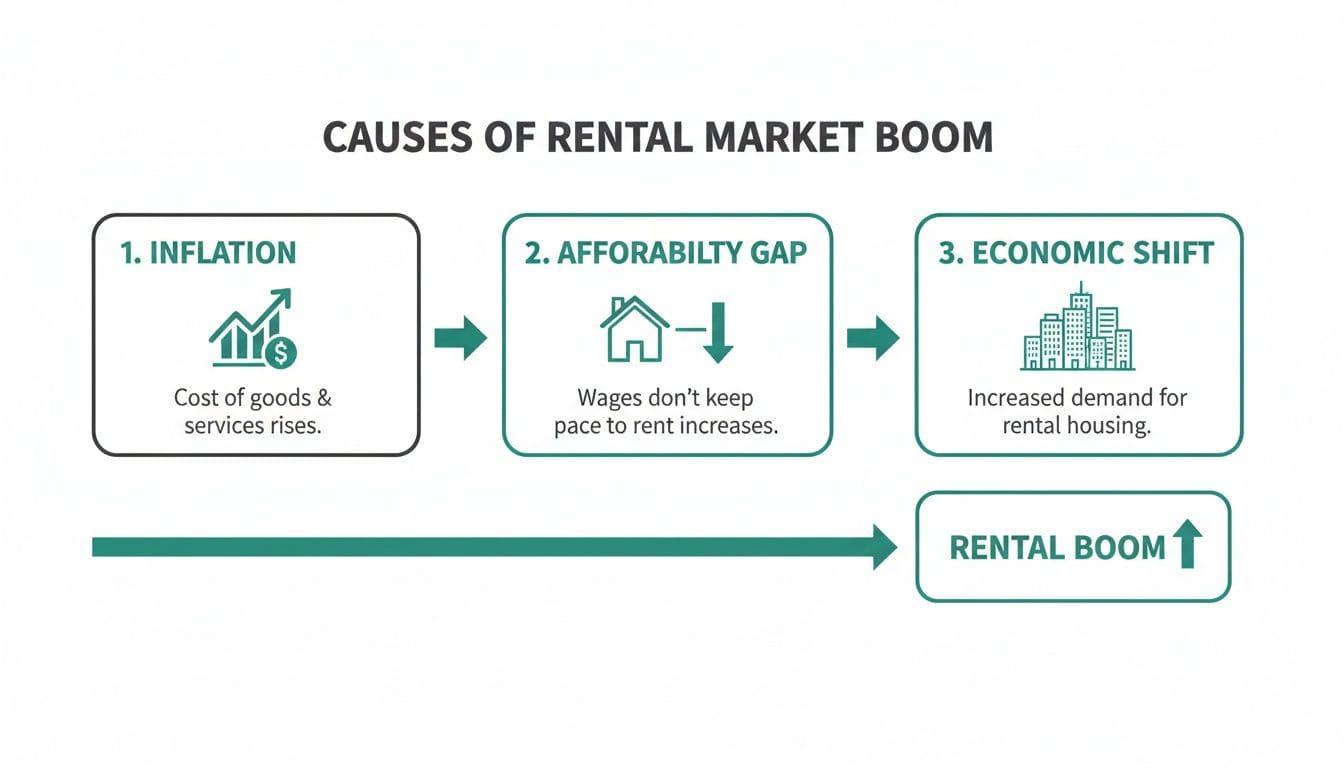
As you can see, a combination of national inflation, local economic strength, and a growing gap in housing affordability creates sustained demand. This underpins the rental figures you'll be using in your analysis.
From Gross Yield to Net Cash Flow
The journey to understanding your true return starts with the simplest metric and gets progressively more detailed. Each step peels back another layer, revealing a more accurate picture of your investment's performance. Let's walk through it.
First up is the Gross Yield. This is a quick, back-of-the-envelope calculation that gives you a baseline for comparing different properties. It ignores all your running costs and simply looks at the rental income relative to the property's price.
Gross Yield Formula: (Annual Rental Income / Property Purchase Price) x 100
For example, a £200,000 property in Manchester generating £1,100 per month in rent (£13,200 per year) would have a gross yield of 6.6%. While useful for an initial shortlist, it's a dangerously incomplete metric to base a final decision on.
Factoring in the Real-World Costs
To get to the real numbers, you have to account for every single expense. This is where many new investors trip up, underestimating the true cost of running a rental property in the UK.
Your list of deductions should include:
- Mortgage Interest: Crucially, remember the impact of Section 24 tax changes, which limit mortgage interest relief for individual landlords.
- Insurance: Both buildings and landlord-specific liability insurance are essential.
- Maintenance & Repairs: A standard rule of thumb is to budget 1% of the property value per year, but this can vary wildly.
- Management Fees: If you're using a letting agent, this is typically between 8% and 15% of the monthly rent.
- Void Periods: No property is occupied 100% of the time. Budget for at least a few weeks of vacancy per year.
- Service Charges & Ground Rent: These are common for leasehold properties, especially in Manchester's city centre.
- Licensing: For strategies like HMOs, council licensing fees are a mandatory and recurring cost.
By subtracting these annual costs from your annual rental income, you arrive at your Net Rental Income. This is a far more realistic figure.
Example: A High-Yield Student HMO
Let's apply this to a real-world Manchester scenario: a six-bedroom student HMO in the M14 postcode, purchased for £350,000.
- Purchase Price: £350,000
- Total Rent: 6 rooms @ £600/month = £3,600/month (£43,200 per year)
- Gross Yield: (£43,200 / £350,000) x 100 = 12.3%
Now, let's deduct the estimated annual running costs:
- Mortgage Interest: £9,000
- Insurance: £600
- Bills (inclusive): £4,800
- Management (12%): £5,184
- Maintenance: £3,500
- Licensing & Voids: £1,000
- Total Costs: £24,084
So, the Net Annual Cash Flow before tax is £43,200 (rent) - £24,084 (costs) = £19,116. This is the number that truly matters for your bank account.
Understanding these calculations is fundamental. For those who want to dive deeper, we have a complete guide on how to work out the yield on a property that covers these concepts in more detail. Mastering this maths is what empowers you to analyse any deal with complete confidence.
Analyse Manchester Property Deals in Seconds

It's time to move on from clunky spreadsheets and endless manual calculations. While you absolutely need to understand the numbers behind the average rent in Manchester UK, the old way of analysing each potential deal is slow and riddled with potential errors.
Modern tools offer a much faster, more reliable way to size up Manchester property deals, turning what used to be hours of due diligence into a job that takes just a few seconds.
Picture this: you find a promising listing online. The old-school approach meant painstakingly copying data into a spreadsheet, cross-referencing tax rules, and manually guessing at the running costs. There's a much more efficient way now.
From Property Listing to Full Analysis in Under a Minute
With tools like the DealSheet AI app, the entire process is crunched down. You just paste the property URL from a portal like Rightmove or Zoopla straight into the app.
In about 12 seconds, the app's AI kicks in. It intelligently pulls all the key data points—purchase price, location, property type, and bedroom count—and instantly runs a complete financial breakdown. This kind of speed gives you a massive edge in a fast-moving market like Manchester, letting you vet more opportunities and get offers in quicker than the competition.
UK-Specific Rules, Applied Automatically
One of the biggest headaches for UK property investors is navigating the tangled web of regulations and taxes. A simple slip-up on Stamp Duty Land Tax (SDLT) or the impact of Section 24 on mortgage interest relief can completely torpedo a deal's profitability.
A dedicated property analysis tool handles all this for you. The app automatically applies the correct UK tax rules based on the property's price and your own investor profile. It also estimates realistic running costs, pulling from a database of typical expenses for maintenance, voids, and management fees.
This automated approach ensures your analysis is not just fast, but also accurate and compliant with UK regulations. It removes the guesswork and gives you a solid foundation for your investment decisions.
Seven Strategies, One Simple Input
Manchester's diverse market demands a flexible approach. A property might look okay as a standard Buy-to-Let, but could it perform even better as a high-yield HMO or a premium Serviced Accommodation unit?
Instead of building separate, complicated financial models for each scenario, a powerful app can run the numbers for multiple strategies all at once.
- Buy-to-Let (BTL): The standard single-let analysis.
- House in Multiple Occupation (HMO): Per-room rental calculations.
- Buy, Refurbish, Refinance, Rent (BRRRR): Factors in the renovation costs and refinance potential.
- Serviced Accommodation (SA): Models nightly rates and higher operational costs.
- Flip: Calculates purchase, renovation, and selling costs to determine the profit.
This multi-strategy analysis uncovers the true potential of a property, helping you pinpoint the most profitable way forward. For a deeper look into the specific calculations, our guide on the UK property investment calculator breaks it all down.
Stress-Testing for a Resilient Portfolio
Finally, a truly robust deal analysis goes beyond today's numbers; it prepares you for tomorrow's uncertainties. What happens to your cash flow if interest rates jump by 1% or 2%? The ability to stress-test your potential portfolio against these shifts is crucial for building long-term resilience.
Modern tools let you model these scenarios instantly, showing you the exact impact on your bottom line. You can compare multiple deals, generate professional PDF reports for lenders or partners, and ultimately make smarter, data-driven decisions. This is the modern investor's toolkit.
Wrapping Up: Building Your Manchester Investment Strategy for 2026
So, where do the real opportunities lie for Manchester property investors as we look towards 2026? If this guide has shown one thing, it's that while the average rent in Manchester UK is a useful starting point, serious returns are found by going much deeper. The city's powerful economic engine and relentless rental demand make for a resilient market, but that's just the backdrop.
A winning strategy isn't about picking a trendy postcode and hoping for the best. It's about sharp, accurate deal analysis. The difference between a high-yield student HMO in Fallowfield (M14) and a steady family let in Radcliffe (M26) is vast, and knowing which one fits your goals separates a profitable portfolio from a financial headache. Every move you make must be backed by solid numbers, not just city-wide averages. That's the bedrock of a proper plan, and you can learn more about this in our guide on how to build a property portfolio.
Key Takeaways for Your 2026 Strategy
To turn what you've learned into actual results, anchor your thinking to these core ideas. They'll help you cut through the noise in Manchester's market and build something that lasts.
- Look Beyond the Obvious. Student hotspots are great, but the real momentum is often elsewhere. Regeneration zones in East Manchester, like Gorton (M18) and Openshaw (M11), offer a powerful mix of immediate cash flow and genuine capital growth potential.
- Know Your Numbers Inside-Out. Gross yield is just a headline. You have to factor in everything—from the sting of Section 24 on your tax bill to the reality of void periods—to see your true net cash flow. This is non-negotiable.
- Embrace Modern Tools. The market moves too fast for manual spreadsheets. Your competitive edge comes from analysing deals quickly and accurately.
The most critical takeaway is this: you have to shift from passive research to active analysis. This guide gives you the 'what' and the 'why', but your success hinges on applying it to real deals on the market today.
Your Next Step: From Research to Results
The whole point of this is to build a tangible, profitable investment portfolio. The average rent in Manchester UK is the starting line, not the finish. The real work begins when you start analysing actual properties for sale right now.
This is where theory meets reality. Moving from reading articles to crunching the numbers on live deals is how you build the confidence and, frankly, the muscle memory required to invest successfully.
Don't let analysis paralysis get in your way. The tools exist to help you make smart decisions without getting bogged down. By downloading the DealSheet AI app and starting your free trial, you can start assessing real Manchester properties in seconds, turning the insights from this guide into your next profitable investment.
Frequently Asked Questions
When you're trying to move from city-wide averages to a specific, profitable deal, a lot of questions come up. Here are some of the most common ones we hear from investors looking at Manchester.
What Is a Good Rental Yield in Manchester for 2026?
The city-wide average is a healthy 5.8%, but what counts as "good" really comes down to your strategy. For a standard buy-to-let where you're aiming for long-term growth, hitting anything over 5% is a solid return in today's market.
But if you're running a more intensive strategy like an HMO, you need to be aiming much higher. In student-heavy postcodes like M14, yields can and absolutely should push past 7.5%. That premium reflects the extra management and effort involved. Honestly, if you're looking at an HMO in a prime patch and the numbers come out below 7%, it's a big red flag that the purchase price is probably too steep.
Are Rents in Manchester Cheaper Than London?
Yes, and it's not even close. The average rent in Manchester is significantly lower than in the capital. Right now, in early 2026, you're looking at an average monthly rent in London of over £2,100. Manchester is closer to £1,250.
This affordability gap is one of the biggest engines of Manchester's growth. It pulls in young professionals and businesses who want a great quality of life without London's eye-watering costs. For investors, this translates into a much more accessible market with lower buy-in prices and powerful, sustainable rental demand.
Which Areas in Manchester Have the Highest Rents?
The biggest rental figures tend to cluster in two main zones: the city centre (postcodes M1, M2, M3) and the prime student district of M14, which covers Fallowfield and Rusholme.
- City Centre: This is where professionals want to be. The constant demand for modern apartments in prime locations keeps rental values at a premium.
- M14 (Fallowfield/Rusholme): While a single flat here might rent for less than one in the city centre, this area is dominated by large HMOs. When you look at the total rent for a whole property, these student houses push the average to the highest in the city, often clearing £1,596 per month.
It's absolutely critical to remember the difference between high rent and high yield. The city centre has impressive rents, but the purchase prices are just as steep, which often squeezes yields. You can find much punchier returns in areas like Gorton or Openshaw. To get your head around this properly, check out our guide explaining what rental yield is for a full breakdown.
How Does Property Type Affect Average Rent?
The type of property you buy has a massive impact on your rental income. You simply can't compare the rent from a sleek two-bedroom apartment in Salford Quays with a three-bed terrace in a suburb like Radcliffe—they serve completely different markets.
Generally, city-centre flats pull in young professionals and command high rents per square foot. Move out a little, and you'll find the larger terraced or semi-detached houses are the go-to for families and students. It's these larger properties, especially when converted into HMOs, that offer the potential for the highest overall rental income by letting on a room-by-room basis.
Ready to stop guessing and start analysing? DealSheet AI turns complex property data into clear, actionable insights in seconds. Paste any property link and get an instant breakdown of your potential returns. Download the DealSheet AI app today and start your free trial to make your next Manchester investment your best one.