
UK Building Cost Per Square Metre: A 2026 Guide for Investors
UK Building Cost Per Square Metre: A 2026 Guide for Investors
For any UK property investor, developer, or self-builder, understanding the building cost per square metre is the critical first step in determining a project's viability. This single metric provides the answer to whether a deal is worth pursuing, estimating the core construction expense before you commit serious capital. For 2026, a realistic ballpark figure for a new build in the UK sits between £1,800 and £3,000+ per square metre, but this is just a baseline. To turn this estimate into an actionable insight, you need to factor in location, specification, and fees, a process that can be done in seconds with the DealSheet AI app.
Let's be clear: the baseline figure doesn't include the land, professional fees, or the dreaded VAT. The final cost is a moving target, heavily influenced by where in the UK you're building, the quality of finish you're aiming for, and the sheer complexity of the job. This guide will break down these variables to give you a clear framework for accurate cost estimation.
Decoding The Building Cost Per Square Metre In The UK

So, what is this figure, really? In essence, it's a quick-and-dirty benchmark that helps you compare the potential costs of different projects. It's a dynamic number, not a fixed constant, that shifts and slides based on a whole host of factors we'll break down in this guide.
Get this estimate wrong at the start, and you're setting yourself up for a world of pain. It can lead to crippling budget overruns, stalled projects, and profits that evaporate before your eyes.
Why This Metric Matters So Much
The cost per square metre provides the crucial baseline for all your initial financial modelling. It's what allows you to quickly sanity-check a project's potential, whether you're looking at a simple side-return extension, a tricky HMO conversion, or a full-blown new build from the ground up.
By establishing a realistic cost benchmark early on, you can filter out the non-starters and focus your time and energy on the deals that have a genuine shot at success. It turns your initial due diligence from pure guesswork into a data-driven exercise.
A solid grasp of this metric is essential for several key moves:
- Initial Deal Analysis: Running the numbers in minutes to decide if a project is even worth a second look.
- Budget Formulation: Building a detailed and realistic budget that accounts for all your construction spend.
- Securing Finance: Walking into a lender's office with a credible cost plan that gives them the confidence to back you.
- Profitability Forecasting: Accurately calculating your end profit by subtracting total costs from the property's final value. If you need a refresher on this, check out our guide on understanding Gross Development Value.
Ultimately, mastering the nuances of the UK building cost per square metre gives you the power to make smarter, more strategic decisions. It's about minimising your risk while maximising that all-important return on investment. This guide will give you the framework and the benchmarks you need to start building your estimates with real confidence.
The Key Factors That Drive Your Build Cost
Ever wondered why one property project costs £2,000 per square metre while a near-identical one just down the road blows past £3,500? The answer isn't black magic; it's a handful of critical variables that every savvy investor needs to get to grips with. Think of your budget like a car's spec sheet—every single choice, from the postcode to the plug sockets, has a price tag attached.
Getting a handle on these drivers is what separates a wild gamble from a calculated investment. When you can break a project down into its core components, you shift from vague guesswork to methodical estimating, giving you genuine control over your financial destiny.
Location: The Postcode Premium
The first and often biggest factor is your project's postcode. The old saying "location, location, location" isn't just for estate agents; it's a fundamental truth in construction. A build in Central London will always cost more per square metre than a similar job in Liverpool or Newcastle.
This isn't just an arbitrary markup. It's rooted in some hard economic realities:
- Labour Rates: Skilled tradespeople simply charge more where the cost of living is higher, like in the South East.
- Logistics and Access: Squeezing materials and machinery onto a tight urban site with no parking is a logistical nightmare compared to working on a wide-open suburban plot. That complexity costs money.
- Local Authority Fees: Planning applications, building control inspections, and other council charges can vary hugely from one borough to another.
- Material Supply: Being miles from the nearest quarry or supplier can quietly add up, especially for heavy materials like aggregates and concrete.
The regional difference is massive. For a typical 3-bedroom house in the UK, the numbers tell the story. Detailed 2026 benchmarks show the North of England has a mid-range cost of £2,477 per sq m (excluding VAT). By contrast, London's mid-range benchmark hits £2,973 per sq m, with high-end projects soaring far higher. This is exactly why smart investors often find bigger margins in northern markets, as you can see from a deeper dive into these UK cost variations and their impact.
Specification Level: Basic Versus Bespoke
Once you've factored in location, the next biggest lever on your budget is the level of specification. This is where your personal choices directly and immediately impact the final building cost per square metre. It's the difference between standard-issue and statement luxury.
Think of it like choosing the options on a new car. The base model with cloth seats works just fine, but upgrading to heated leather seats will cost you thousands. The exact same principle applies to your build.
Your project's specification is the sum of thousands of individual product and material decisions. A 'basic' finish might be perfectly acceptable for a budget rental, but a 'high-end' finish is required to achieve a premium sales price or nightly rate.
A few key areas where your choices will really move the needle on cost include:
- Kitchens & Bathrooms: These are easily the most expensive rooms per square metre. The price gap between basic laminate worktops and premium quartz, or between standard ceramic tiles and bespoke porcelain, can run into the tens of thousands.
- Windows & Doors: Standard uPVC windows are a cost-effective choice. High-performance aluminium or timber-framed glazing systems, on the other hand, can easily double or triple that part of the budget.
- Flooring: Opting for luxury vinyl tile (LVT) instead of engineered oak or polished concrete will create a significant cost difference across the whole property.
- Mechanical & Electrical (M&E): A basic radiator system is far cheaper than underfloor heating. Simple pendant lights are a fraction of the cost of a fully integrated smart lighting system.
Labour and Material Costs
The construction market is never static. The costs of both labour and materials are constantly shifting based on supply, demand, and the wider economy. In 2026, while some of the post-pandemic supply chain chaos has settled down, a persistent shortage of skilled labour continues to push prices up.
A bricklayer's day rate, a plasterer's price per metre, and an electrician's hourly charge all feed directly into your final build cost. In the same way, the price of essentials like timber, steel, insulation, and plasterboard can change from one month to the next, hitting your bottom line. This is why securing fixed-price quotes from trusted contractors is one of the best ways to protect your budget from nasty surprises.
Professional Fees And Hidden Costs
Finally, there are several crucial costs that sit outside the direct "bricks and mortar" budget but are completely non-negotiable. Forgetting these can wreck a project's profitability before a single spade hits the ground.
Make sure you have these essentials covered:
- Professional Fees: Budget for 10-15% of the construction cost to cover your architect, structural engineer, surveyors, and project manager.
- VAT: While new builds are generally zero-rated for VAT on labour and materials, most conversions and refurbishments are not. At 20%, this is a huge line item that you simply can't afford to overlook.
- Contingency Fund: This is the golden rule of any build project. You must set aside 15-20% of the build cost for renovations and 10-15% for new builds. This is your safety net for the problems you don't yet know you have.
- Other Charges: This catch-all covers everything from planning fees and building insurance to utility connection charges and potential legal costs.
Mapping Out Regional Cost Variations Across The UK
When it comes to the final building cost per square metre in the UK, one factor trumps all others: location. You can plan the exact same project down to the last brick, but if you build it in Manchester, it will have a completely different price tag to an identical one in Bristol. For any serious property investor, getting your head around these regional differences isn't just interesting—it's a massive strategic advantage.
These cost gaps aren't random. They're driven by hard economic realities on the ground. You've got higher labour rates in the more affluent areas, logistical headaches getting materials to remote sites, and different planning demands from one local authority to the next. All these things add up to create a huge spread in construction costs across the country.
Think of it as a financial map of the UK. Knowing this terrain is a critical part of your due diligence, allowing you to tweak your budget based on where you plan to build and ensuring your numbers are based on reality, not just a vague national average.
Estimated Regional Building Costs Per Square Metre for 2026 (Mid-Range Specification)
Let's take a quick financial tour of the UK to see how the building cost per square metre typically stacks up for a mid-range new build in 2026. These figures will always move around a bit, but they give you a solid baseline and highlight exactly why a 'one-size-fits-all' approach is so dangerous.
| UK Region | Estimated Cost per m² (ex. VAT) |
|---|---|
| Greater London | £2,900 - £3,500+ |
| South East | £2,600 - £3,100 |
| The Midlands | £2,200 - £2,600 |
| The North | £2,000 - £2,400 |
| Scotland | £2,100 - £2,500 |
| Wales | £2,000 - £2,400 |
As the table shows, a project in the North could easily be over 25% cheaper per square metre than a similar build in London. That's an absolutely massive difference when you're running the numbers on potential returns. It's why investors searching for the best areas for buy-to-let are often drawn to regions where build costs are lower, but the rental demand is still rock-solid.
Understanding The Core Drivers
So, what's really behind these big regional swings in price? You can boil it down to a few core elements that will directly hit your budget.
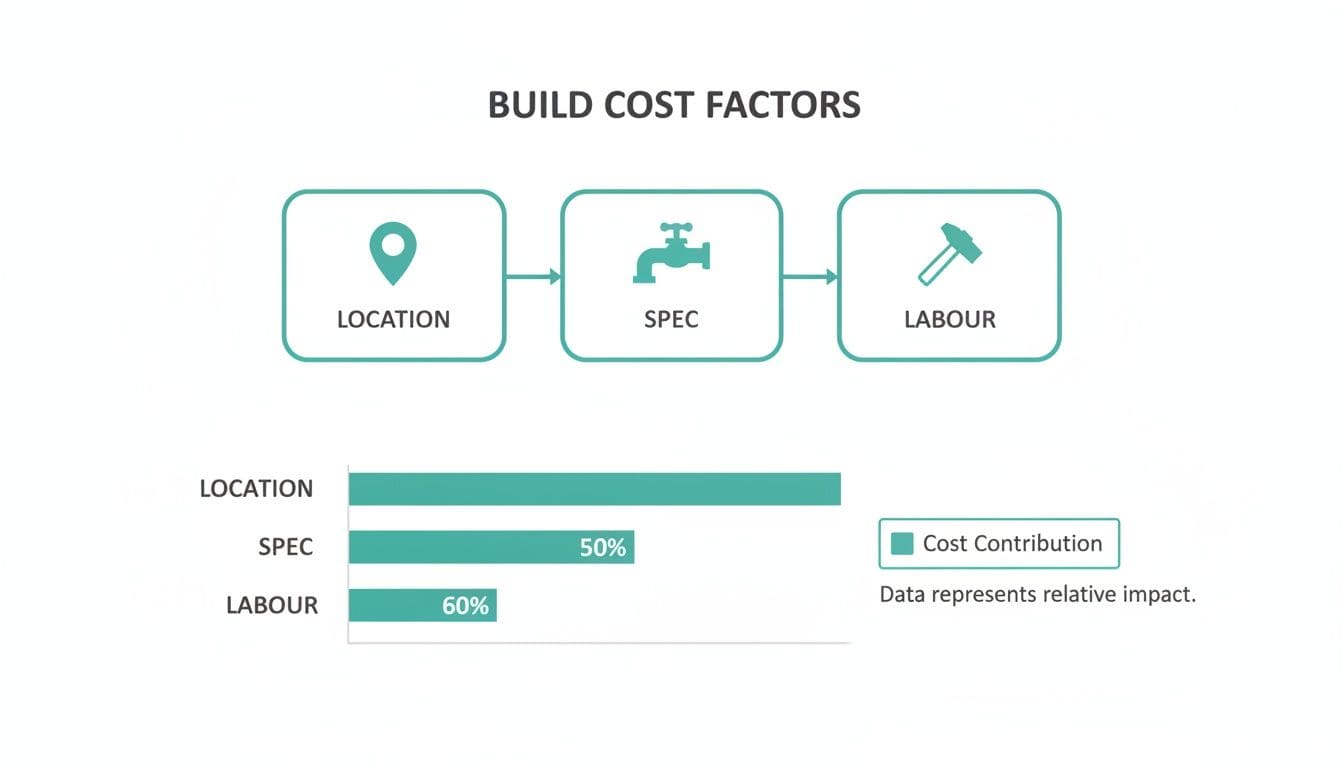
As you can see, you're in control of the specification level, but the external pressures from the local area and the labour market are fixed constraints you simply have to budget for.
By acknowledging and quantifying these regional differences upfront, you transform your investment strategy from hopeful guesswork into a calculated business plan. It's about knowing the financial terrain before you commit your capital.
This knowledge is what allows an investor in Sheffield to understand precisely why their budget won't stretch as far for a similar project down in Brighton. They can then adjust their strategy, either by focusing on higher-yielding northern opportunities or by making damn sure their southern project has the Gross Development Value (GDV) to support those inflated costs.
Ultimately, mastering this regional cost map is essential for maximising your returns across the UK property market.
Putting The Numbers to Work in Your Investment Strategy
Knowing the theory behind building cost per square metre is one thing, but the real magic happens when you apply it to an actual deal. This is where abstract numbers get turned into a concrete project budget, letting you see if a potential investment has legs. To show you how it's done, let's walk through some real-world examples for a few of the most common property investment strategies here in the UK.
The whole point is to give you a simple, repeatable framework you can use to knock together a preliminary budget for any project that crosses your desk. By sticking to a consistent formula, you can quickly get a feel for a deal's viability and decide whether it's worth a closer look. It's about moving from endless analysis to decisive action.
The Core Budgeting Formula
Before we dive into specific scenarios, let's lock in the basic formula. Sticking to this structure ensures you're not just looking at the raw construction costs, but all the other crucial expenses that can trip you up.
For any project, your first-pass budget should look something like this:
Total Estimated Budget = (Area in m² x Cost per m²) + Professional Fees + VAT + Contingency Fund
This formula forces you to think beyond the headline build cost. It makes you account for the experts you'll need (like architects and engineers), the taxman's cut, and that all-important safety net for when things inevitably go wrong.
Example 1: The BRRRR Extension
A classic move for investors using the Buy, Refurbish, Refinance, Rent (BRRRR) model is to add value by building an extension. Let's model a common project: adding a 20 sq m single-storey rear extension to a terraced house in the Midlands to create a modern, open-plan kitchen-diner.
We'll assume a good quality, mid-range finish that's perfect for a professional rental.
- Area: 20 sq m
- Cost per sq m: £2,400 (Midlands mid-range estimate)
- Professional Fees: 12%
- VAT: 20% on fees and the build cost
- Contingency: 15%
Let's crunch the numbers, step-by-step:
- Base Build Cost: 20 m² x £2,400/m² = £48,000
- Professional Fees: 12% of £48,000 = £5,760
- Subtotal (Build + Fees): £48,000 + £5,760 = £53,760
- VAT on Subtotal: 20% of £53,760 = £10,752
- Contingency Fund: 15% of £53,760 = £8,064
- Total Estimated Budget: £53,760 + £10,752 + £8,064 = £72,576
That detailed breakdown shows you exactly how a £48,000 build cost quickly balloons into a project needing over £72,000 of capital.
Example 2: The HMO Loft Conversion
For anyone running Houses in Multiple Occupation (HMOs), maximising every inch of space is the name of the game. A loft conversion is a brilliant way to add extra, high-value bedrooms. Let's imagine we're converting a loft to create two en-suite bedrooms, adding 30 sq m of new living space to a property in the North of England.
This kind of job needs careful planning to make sure it meets all the strict HMO regulations.
- Area: 30 sq m
- Cost per sq m: £2,200 (North mid-range estimate)
- Professional Fees: 15% (Higher to cover the structural complexity)
- VAT: 20%
- Contingency: 20% (A bigger buffer for the risks of working with an existing structure)
Now, let's run the numbers for the conversion:
- Base Build Cost: 30 m² x £2,200/m² = £66,000
- Professional Fees: 15% of £66,000 = £9,900
- Subtotal (Build + Fees): £66,000 + £9,900 = £75,900
- VAT on Subtotal: 20% of £75,900 = £15,180
- Contingency Fund: 20% of £75,900 = £15,180
- Total Estimated Budget: £75,900 + £15,180 + £15,180 = £106,260
As you can see, the higher contingency and professional fees for a more complex structural job have a massive impact on the final budget. Understanding how to finance property development is absolutely critical when the costs start climbing to this level.
Example 3: The Small New-Build Development
Finally, let's look at something a bit more ambitious: a small new-build project. The plan is to build a block of two flats on a plot of land in the South East, with a total Gross Internal Area (GIA) of 120 sq m.
New builds play by different VAT rules, which is a huge advantage for developers.
- Area: 120 sq m
- Cost per sq m: £2,800 (South East mid-range estimate)
- Professional Fees: 10%
- VAT: 0% on the build cost (it's zero-rated), but 20% on fees
- Contingency: 10% (Lower for a new build on a clear site with fewer unknowns)
Here's how the budget for the new-build flats breaks down:
- Base Build Cost: 120 m² x £2,800/m² = £336,000
- Professional Fees: 10% of £336,000 = £33,600
- VAT on Fees Only: 20% of £33,600 = £6,720
- Contingency Fund: 10% of (£336,000 + £33,600) = £36,960
- Total Estimated Budget: £336,000 + £33,600 + £6,720 + £36,960 = £413,280
The zero-rated VAT on the construction itself provides a massive saving, but the sheer scale of the project still demands a very serious budget. These examples really hammer home why a simple building cost per square metre figure is only ever the starting point for a much more detailed financial deep-dive.
Common Budgeting Mistakes That Derail Projects
Getting the numbers right is one thing, but knowing where they can go spectacularly wrong is just as important. Even the most carefully planned project can be completely derailed by a few common financial traps. And these aren't just rookie errors; they catch out seasoned investors who get complacent or rush their due diligence.
Calling out these frequent and costly mistakes isn't about scaremongering. It's about building financial resilience into your projects from day one. By seeing these pitfalls coming, you can protect your capital, safeguard your profits, and keep your development firmly on track.
Underestimating Professional Fees
One of the most frequent oversights is treating professional fees like a minor afterthought. The reality is, the bills for your architect, structural engineer, quantity surveyor, and project manager add up to a significant slice of the total budget. These are the experts who make sure your project is designed properly, is structurally sound, and sails through building regulations.
Trying to cut corners here is a classic false economy. A top-notch professional team will almost always save you more money than their fees cost through clever design, efficient problem-solving, and avoiding costly mistakes.
As a solid rule of thumb, you should be earmarking between 10% and 15% of your total construction cost just for professional fees. Forgetting this can blow a huge hole in your budget before a single brick has been laid.
Forgetting About VAT
Value Added Tax (VAT) is the stealth cost that can single-handedly wreck a project's profitability if you don't account for it properly. While new-build residential properties are typically zero-rated for VAT on labour and materials, this is absolutely not the case for most other types of work.
For conversions, extensions, and refurbishments, you must factor in VAT at the standard rate of 20%. This applies to labour, materials, and your professional fees. It's an enormous line item that cannot be ignored. A £100,000 extension doesn't cost £100,000; it costs £120,000 once the VAT is added. Forgetting this simple fact is a catastrophic and completely avoidable mistake. Understanding your tax obligations is critical, and this includes other property-related taxes; you can learn more by reading our guide on Stamp Duty Land Tax.
Running With an Insufficient Contingency Fund
No build project in the history of property has ever gone perfectly to plan. There will always be surprises, from a sudden price hike on plasterboard to nasty issues you uncover once you start knocking down walls. Your contingency fund isn't an optional extra; it's your essential financial safety net.
Too many investors make the mistake of being wildly optimistic, setting aside a flimsy 5% or, even worse, nothing at all. This is a recipe for disaster, forcing you to halt work midway through or scramble for expensive emergency funding when a problem inevitably crops up.
- For renovations and extensions: A contingency of 15-20% of the total build cost is essential. You're dealing with an existing structure, and the chances of finding unforeseen issues are high.
- For new builds: A minimum of 10-15% is a much safer bet, giving you cover for potential ground issues or supply chain delays.
Failing to Account for Groundworks Issues
The costs hidden beneath the surface are often the most dangerous. You simply cannot know the true state of the ground until you start digging, and this is where budgets can unravel with terrifying speed.
The list of potential problems is long and expensive to fix:
- Poor Soil Conditions: If the ground can't support standard foundations, you could be looking at costly engineered solutions like piled or raft foundations.
- Contamination: Discovering asbestos or other contaminants on-site can trigger eye-watering remediation bills and long delays.
- Uncharted Services: Hitting unknown water pipes or electrical cables can bring work to a grinding halt and lead to significant costs for rerouting.
- High Water Table: This can massively complicate foundation work and require specialised waterproofing, adding thousands to your bill.
The solution is proactive due diligence. Always commission a proper ground investigation or geotechnical survey, especially for new builds. It's an upfront cost, yes, but it's a tiny price to pay to avoid a five or even six-figure problem down the line.
Using Technology To Stress Test Your Numbers

In today's property market, getting your numbers right isn't just an advantage; it's a matter of survival. Relying on clunky old spreadsheets and back-of-the-envelope maths is slow, clunky, and leaves far too much room for a catastrophic error. The investors who are consistently winning are the ones who have moved on, using modern, dynamic tools to analyse deals faster and with far more confidence, especially when it comes to the building cost per square metre.
This is where good tech stops being a 'nice-to-have' and becomes your most important strategic partner. Applications like DealSheet AI are built to do the heavy lifting, turning what used to be hours of complex financial modelling into a simple, rapid process.
From Guesswork to Data-Backed Decisions
Imagine this for a workflow: you spot a promising property on Rightmove, paste the link into the app, and select your strategy—say, a BRRRR or a Flip. Instantly, the system gets to work.
It applies realistic build costs based on current data, factors in regional multipliers for where the property is, calculates all the relevant UK taxes like SDLT, and spits out a complete financial forecast. Your due diligence is transformed from a time-sucking chore into a powerful, data-driven exercise that takes seconds, not hours. You get an immediate, clear picture of a deal's potential before you've invested any serious time or money.
The most powerful feature of modern property tools is the ability to stress-test your assumptions. It's not just about getting an initial answer; it's about understanding how fragile that answer is.
Stress-Testing Your Build Costs
The real strength here is in managing risk. What happens if your initial estimate for the building cost per square metre is off by 15%? How does a sudden spike in material prices hammer your final Return on Investment (ROI)?
Instead of trying to unpick and rebuild a fragile spreadsheet, you just adjust a slider in the app. This lets you model different scenarios on the fly and see exactly how a cost overrun would eat into your profit margin and overall cash flow. This instantly turns a simple calculator into an essential risk management tool, allowing you to make decisions backed by robust, flexible data. You can explore this concept further by learning about a comprehensive property ROI calculator for the UK.
Got Questions? We've Got Answers
Navigating the numbers on a property project can feel like wading through treacle. To help you cut through the confusion, here are some straight answers to the questions we hear most often about building cost per square metre in the UK.
Does The Building Cost Per Square Metre Include Professional Fees?
Typically, no. That headline cost per square metre figure you see flying around is almost always just for the construction itself—the bricks and mortar. Professional fees are a separate, but absolutely essential, layer of cost.
As a solid rule of thumb, you should budget for an extra 10-15% on top of your total construction cost to cover the experts you'll need, like architects, structural engineers, and surveyors.
How Much Contingency Should I Add To My Build Budget?
A healthy contingency fund isn't a "nice to have"; it's the safety net that stops unforeseen problems from derailing your entire project. The amount you set aside really depends on the type of work you're doing.
- Renovations & Extensions: For any project involving an existing building, a contingency of 15-20% of the total build cost is a smart move. You never know what you'll uncover once you start knocking down walls.
- New Builds: If you're starting from scratch on a straightforward site, a buffer of 10-15% gives you a much safer financial cushion against the unexpected.
Is It Cheaper To Renovate Or Build A New House?
This is the classic "how long is a piece of string?" question. The answer depends entirely on the scope of the project. A light, cosmetic refurb will always be leagues cheaper per square metre than a new build.
However, if you're talking about a huge 'back-to-brick' renovation with major structural changes, the costs can quickly spiral. It's not unheard of for a massive renovation to approach, or even exceed, the building cost per square metre of a brand-new house, especially if the old property is hiding some nasty surprises.
Stop letting complex calculations slow you down. Get instant, data-driven deal analysis with DealSheet AI and make your next investment decision with complete confidence. Download the DealSheet AI app today and start stress-testing your build costs in seconds.