
Your Guide to the UK Buy to Let ROI Calculator in 2026
Your Guide to the UK Buy to Let ROI Calculator in 2026
Getting your head around the potential return on investment (ROI) is the single most important step in UK property investing. A solid buy-to-let ROI calculator is the tool that separates a calculated business decision from a costly gamble. This guide provides the answer by walking you through exactly how they work, which numbers truly matter for UK landlords in 2026, and how to sidestep the common pitfalls that catch out even experienced investors.
For those who need to analyse UK deals instantly and accurately without getting bogged down in complex spreadsheets, the DealSheet AI app offers a powerful, UK-specific solution right on your phone. It is the essential buy to let ROI calculator for today's market.
How to Properly Calculate Buy To Let ROI

Running the numbers is the bedrock of any successful property venture. It's what transforms an emotional viewing into a clear-headed business transaction. A reliable buy-to-let ROI calculator provides the financial clarity you need to compare opportunities, secure funding, and build a portfolio that actually performs.
Without a firm grip on your numbers, you're investing blind. A property that looks great on the surface can quickly become a financial drain once you factor in taxes, voids, and unexpected maintenance. This is where a methodical approach to ROI becomes non-negotiable.
The Importance of UK-Specific Calculations
The UK property market plays by its own rules, and these rules can seriously impact your returns. Generic, one-size-fits-all calculators often miss these critical details, leading to dangerously inaccurate forecasts for 2026 and beyond.
You absolutely have to account for UK-specific factors, including:
- Stamp Duty Land Tax (SDLT), especially the 3% surcharge for second homes.
- Section 24 Mortgage Interest Relief restrictions, which completely change how landlords are taxed.
- Regional variations in rental demand, property values, and running costs.
Fail to account for these, and your final ROI figure could be wildly optimistic. That's why a dedicated UK buy-to-let ROI calculator isn't just a nice-to-have; it's essential.
The UK's buy-to-let sector has seen incredible growth. It's evolved from a niche market in 1996 to a landscape where 2.65 million landlords now own over £1 trillion in property. The outstanding buy-to-let mortgage stock, just £9 billion in 2000, hit £140 billion by 2008, with lending reaching £41.3 billion in 2022. You can get a sense of the market's journey from this detailed overview from FJP Investment.
A proper ROI calculation is your financial compass. It guides you away from unprofitable deals and points you toward assets that align with your long-term wealth-building goals.
Ultimately, mastering ROI calculation empowers you to make confident, data-driven decisions. It lets you quickly assess whether a property's asking price is justified by its potential income, ensuring every purchase contributes positively to your financial future. As you get started, it's also useful to get the fundamentals right; our guide on how to calculate property yield is a great place to begin.
Deconstructing the Core ROI Formulas
At its heart, any decent buy-to-let ROI calculator is really just running a few core formulas to give you a full financial picture. Getting your head around these isn't just some academic exercise; it's about learning the language of property investment so you can instantly tell if a deal has potential or is a dud.
These formulas build on each other, taking you from a quick first glance to a much more detailed, real-world analysis. Each calculation tells a different part of the story, and once you master them, you'll have the toolkit to properly dissect any opportunity and see what the numbers are really telling you.
Gross Rental Yield: The Quick Snapshot
Think of Gross Rental Yield as the sticker price on a car. It's a fast, simple number that gives you an immediate impression but definitely doesn't tell the whole story.
It's perfect for that initial filtering stage when you're scrolling through dozens of listings and just need a way to quickly shortlist the ones that might be worth a closer look.
The calculation is dead simple:
Gross Rental Yield = (Annual Rental Income / Property Purchase Price) x 100
So, if a property costs £200,000 and brings in £1,000 a month in rent (£12,000 a year), the Gross Yield is 6%. It's a useful number for broad comparisons, but it completely ignores all the running costs that will inevitably eat into your actual profit.
Net Rental Yield: The Realistic View
This is where the analysis starts to get serious. Net Rental Yield gives you a far more accurate picture of a property's profitability because it forces you to factor in the unavoidable costs of being a landlord. It answers the crucial question: "After I've paid all the bills, what is this property actually earning me?"
To work it out, you first need to figure out your Net Operating Income (NOI).
-
Step 1: Calculate Net Operating Income (NOI) NOI is your annual rental income minus all your annual running costs. This includes things like insurance, letting agent fees, maintenance, service charges, and an allowance for void periods.
-
Step 2: Calculate Net Yield Net Rental Yield = (Net Operating Income / Total Investment Cost) x 100 And note, your Total Investment Cost isn't just the purchase price; it includes all your initial setup costs like legal fees and any upfront renovation work.
This metric is leagues more insightful than its gross cousin. For a deeper dive into the nuances of getting this right, our complete guide on how to calculate property rental yield breaks it down even further.
Cash-on-Cash Return: The Investor's Metric
If you're using a mortgage to invest, Cash-on-Cash Return is arguably the most important number on the page. It cuts through the noise and measures the return you're making specifically on the actual cash you've put into the deal out of your own pocket.
This is the formula that truly highlights the power of leverage. It shows you exactly how hard your own capital is working for you.
- Annual Pre-Tax Cash Flow = Annual Rent - (Annual Operating Costs + Annual Mortgage Payments)
- Total Cash Invested = Deposit + Closing Costs + Refurbishment Costs
Then, the formula is simply:
Cash-on-Cash Return = (Annual Pre-Tax Cash Flow / Total Cash Invested) x 100
Let's put some numbers on that. Say you put down a £50,000 deposit and paid another £10,000 in fees and refurb costs, making your total cash investment £60,000. If your annual cash flow, after all expenses and the mortgage are paid, is £4,800, your Cash-on-Cash return is 8%.
This figure tells you the direct return on your capital, making it an absolutely critical indicator for anyone looking to build a leveraged portfolio.
Getting UK-Specific Taxes and Costs Right for 2026
Trying to analyse a UK property deal with a generic, international ROI tool is like navigating London with a map of New York. You're in the right country, but the local rules are completely different, and you'll end up hopelessly lost. A proper buy to let ROI calculator has to be built from the ground up for the UK's unique tax and regulatory minefield.
Get this wrong, and it's not just a minor miscalculation. You could turn what looks like a profitable deal on paper into a very real financial headache. Mastering these UK-specific costs isn't just good practice—it's the bedrock of responsible, successful property investing in 2026.
Stamp Duty Land Tax (SDLT) Explained
One of the first, and biggest, financial hurdles you'll face as a UK property investor is Stamp Duty Land Tax (SDLT). This is the tiered tax you pay when buying a property, but for investors, there's a sting in the tail.
Since 2016, if you're buying an additional residential property in England or Northern Ireland (which covers almost all buy-to-let deals), you have to pay a 3% surcharge on top of the standard SDLT rates. This is a huge upfront cost that directly inflates your "Total Cash Invested," hitting your Cash-on-Cash Return from day one. For a full breakdown, check out our guide on Stamp Duty Land Tax.
The Impact of Section 24 Mortgage Interest Relief
Section 24, often dubbed the "tenant tax," is probably the most disruptive change UK landlords have seen in a generation. Before it came in, landlords could deduct all their mortgage interest from their rental income before calculating their tax bill—treating it, quite rightly, as a business expense.
Now, that deduction is gone. Instead, individual landlords get a tax credit equal to 20% of their annual mortgage interest.
This is a game-changer, especially for higher-rate taxpayers. If you're paying 40% or 45% tax, you no longer get full relief on your single biggest expense. The end result is a much bigger tax bill and a seriously reduced net profit, which can absolutely demolish an otherwise solid ROI.
Any credible UK buy to let ROI calculator must model this tax credit system accurately. It can't just treat mortgage interest as a simple deductible. For many investors, this single change has made operating through a limited company a far more tax-efficient route.
Other Essential UK Deductions and Considerations
Beyond the big two, a proper ROI analysis has to account for a few other uniquely British costs and allowances to paint a true financial picture.
- Capital Allowances: While you can't claim for the cost of the property itself, you might be able to claim capital allowances on fixtures and fittings in communal areas, particularly in properties like HMOs.
- Repairs vs. Improvements: UK tax law makes a critical distinction here. The cost of repairs (like fixing a leaky tap) is a day-to-day expense you can deduct from your rental income. A capital improvement (like adding a conservatory), however, is not. That cost gets added to your purchase price to reduce your Capital Gains Tax bill when you eventually sell.
- Capital Gains Tax (CGT): When you sell your buy-to-let, you'll likely pay CGT on the profit you've made. While this doesn't impact your annual rental ROI, it's a massive part of your total return on investment over the entire time you hold the asset.
The UK's rental market is constantly adapting to these pressures. Lenders have tightened up, with the median Interest Coverage Ratio (ICR) for new mortgages hitting nearly 300% in 2022—a big jump from 242% in 2015. Despite this, gross yields have held up, with UK Finance reporting an average of 7.26% in Q2 2023, helped along by a 6.1% rise in private rents in the year to October 2023. You can read more in the Bank of England's deep dive into the buy-to-let sector and financial stability.
A Practical Buy to Let ROI Calculation Example for 2026
Theory is one thing, but walking through a real-world scenario is where the numbers really come to life. Let's crunch the figures for a typical UK investment property to see how a buy-to-let ROI calculator breaks it all down. Think of this as a repeatable process you can use for your own deal analysis.
Let's imagine you've found a promising 3-bedroom terrace house in a regional UK city, on the market for £225,000. It's in decent nick and you reckon it could pull in a monthly rent of £1,150.
Step 1: Laying Out the Initial Investment
First up, we need to figure out the total cash you'll need to get the keys. This is always more than just the deposit – a lot more.
- Purchase Price: £225,000
- Deposit (25%): £56,250
- Stamp Duty Land Tax (SDLT): This includes the 3% second property surcharge, bringing the bill to £8,750.
- Solicitor Fees: Budget around £1,500.
- Survey Costs: A Level 2 survey will set you back about £500.
- Mortgage Arrangement Fee: Let's say £1,000.
Add it all together, and your Total Cash Invested comes to £68,000. This is the number that really matters when we get to your Cash-on-Cash Return.
Step 2: Calculating Annual Operating Costs
Next, we need to map out all the recurring annual expenses that will eat into your rental income. A realistic budget here is absolutely crucial for getting an honest net profit figure.
- Annual Gross Rent: £1,150 x 12 = £13,800
- Letting Agent Fees (10% + VAT): £1,380 + £276 = £1,656
- Landlord Insurance: Around £300 per year.
- Maintenance & Repairs (5% of rent): A prudent contingency of £690.
- Void Period Allowance (3 weeks rent): Approximately £796.
- Gas Safety Certificate: An annual cost of £80.
Your Total Annual Operating Costs are £3,522.
This flowchart shows the key tax hurdles a UK investor has to clear, all of which chip away at your final ROI.
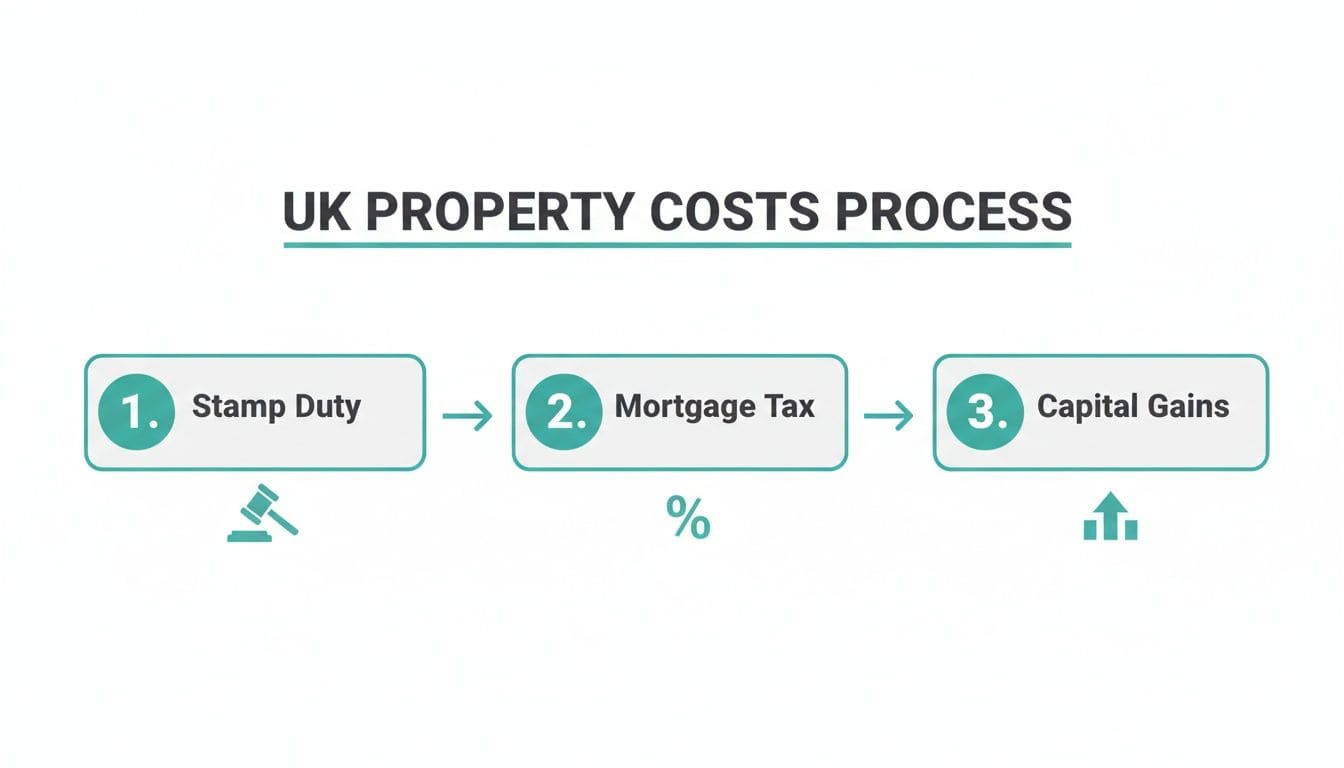
As you can see, from the initial whack of Stamp Duty to the eventual Capital Gains bill when you sell, UK taxes are a constant companion on your investment journey.
Step 3: Running the ROI Calculations
With all our figures laid out, we can finally get to the good stuff – calculating the key ROI metrics.
1. Gross Rental Yield This gives us a quick, top-level glance at the deal.
- (£13,800 Annual Rent / £225,000 Purchase Price) x 100 = 6.13% Gross Yield
2. Net Rental Yield Now for a much more realistic view. This one factors in your running costs but ignores the mortgage for a moment.
- Net Operating Income = £13,800 (Rent) - £3,522 (Costs) = £10,278
- (£10,278 NOI / £225,000 Purchase Price) x 100 = 4.57% Net Yield
See how quickly that shiny yield drops once real-world costs are thrown in? This is a critical step that many new investors skip. For a deeper dive into all the necessary inputs, our guide to the UK property investment calculator adds more context.
3. Cash-on-Cash Return And now, for what is arguably the most important metric for any investor using a mortgage. We need to bring in the finance costs. Let's assume you've got an interest-only mortgage of £168,750 at a 5.5% interest rate.
- Annual Mortgage Interest Payments: £168,750 x 5.5% = £9,281
- Annual Pre-Tax Cash Flow: £10,278 (NOI) - £9,281 (Mortgage) = £997
Cash-on-Cash Return = (£997 Annual Cash Flow / £68,000 Total Cash Invested) x 100 = 1.47%
This final figure is the true measure of how hard your £68,000 is actually working for you. It shows that while the gross yield looked pretty attractive at first glance, the combination of UK-specific upfront costs and today's financing expenses paints a much more modest picture for your initial return.
Interpreting Your UK Buy to Let ROI Calculator Results for 2026
Right, you've punched the numbers into a buy to let roi calculator. That's the easy part. The real skill is knowing what those figures actually mean for your strategy and your bank account.
An ROI percentage isn't just a number; it's the story of a property's potential. It tells you whether you've found a cash-generating workhorse or a long-term wealth builder. Understanding that story is what separates the pros from the amateurs who get dazzled by a big headline figure. A "low" ROI in one area could be a goldmine for capital growth, while a high one might just be hiding a world of risk.
So, What's a "Good" ROI in the UK Market?
This is the million-dollar question, and the honest answer is: it depends entirely on your goals and where you're investing. There's no single magic number. What's "good" for you is dictated by the job you need the property to do.
- You're Chasing Cash Flow: If your main goal is monthly income to supplement your salary or build a pot of cash, then Cash-on-Cash Return is your king. Investors in places like the North of England often won't touch a deal unless it's hitting 8% or more. They're prioritising strong rental yields over the hope of rapid house price rises.
- You're Playing the Long Game (Capital Growth): On the flip side, if you're focused on building wealth through appreciation over a decade or more, you might happily accept a lower Cash-on-Cash Return, maybe around 4-5%. This is typical in the South East, where sky-high property prices squash yields but offer a better shot at long-term growth.
- You Want a Bit of Both (Balanced Strategy): Most investors sit somewhere in the middle. A common approach is to look for a Net Rental Yield of over 5%—enough to make sure the property pays for itself with a bit left over—while also targeting a total annual return (including projected capital growth) of 10% or more.
Regional differences aren't just a footnote; they're the whole story. A fascinating 10-year review from 2014-2024 showed just how much this matters. The average UK landlord saw a 42% total return over that decade. Not bad. But investors in the North West? They saw a whopping 120% appreciation. London, for all its hype, only managed 65%. It's a stark reminder that high yields in one region can massively outperform the capital appreciation of another. You can dig into these numbers on the Landlords Guild's regional return analysis.
Let's put this into a clearer perspective.
Regional UK Rental Yields vs Capital Growth Outlook
The UK isn't one single property market. What works in Manchester won't fly in Mayfair. The table below gives a rough idea of how yields and growth potential stack up across different regions, helping you align your expectations with reality.
| UK Region | Average Gross Yield (%) | 10-Year Capital Growth (%) | Primary Investment Focus |
|---|---|---|---|
| North West | 6.5 - 8.0 | 120 | High Yield / Strong Cash Flow |
| Yorkshire & Humber | 6.0 - 7.5 | 85 | Balanced (Yield & Growth) |
| Scotland | 7.0 - 8.5 | 78 | High Yield / Cash Flow Focus |
| East Midlands | 5.5 - 6.5 | 95 | Balanced (Growth Focus) |
| South East | 4.0 - 5.0 | 75 | Capital Growth / Long Hold |
| London | 3.5 - 4.5 | 65 | Prime Capital Growth |
Note: Figures are indicative and based on historical performance and market forecasts. Always conduct your own local due diligence.
As you can see, chasing the highest yield might mean sacrificing some long-term growth, and vice-versa. There's no right or wrong answer—only what's right for your portfolio.
Stress-Testing Your Deal with Sensitivity Analysis
A single ROI calculation is just a snapshot. It's based on today's interest rates, today's rents, and today's costs. But what happens if rates jump up? Or if the property sits empty for a couple of months between tenants? This is where sensitivity analysis becomes your best friend. It's all about stress-testing the deal by tweaking the key numbers to see how fragile it really is.
Sensitivity analysis is like checking a ship is seaworthy before you sail. It tells you how your investment will handle stormy economic weather, not just a calm, sunny day.
Fire up your buy to let roi calculator again and start playing with the most critical variables:
- Mortgage Rate Hikes: How does your Cash-on-Cash Return look if your mortgage rate goes up by 1%? What about 2%? At what point does your monthly cash flow go negative? This is your break-even point.
- Longer Void Periods: Instead of assuming a few weeks empty, model what a two or three-month void does to your annual numbers. Does the property still wash its own face over the year?
- Surprise Maintenance Bills: What happens if the boiler dies? Double your annual maintenance budget in the calculator. Does the investment still make sense?
By running these "what if" scenarios, you stop being a simple number-cruncher and start thinking like a strategic investor. It exposes the property's financial breaking points, giving you the confidence that your deal is robust enough to handle the inevitable bumps in the road. This is how you build a portfolio that lasts.
Automating Your Analysis with DealSheet AI

Manual spreadsheets are fast becoming a liability for serious UK property investors. Let's be honest, they're slow, dangerously prone to human error, and they struggle to keep pace with the constant shifts in UK tax law. For the modern investor looking for an edge, technology offers a faster, more reliable path to accurate deal analysis.
This is where a specialised buy to let ROI calculator app really comes into its own. The modern approach isn't about building a better spreadsheet; it's about replacing hours of tedious data entry with instant, data-driven insights.
The Power of Instant Analysis
Imagine finding a promising property online and knowing its true investment potential in under a minute. DealSheet AI, an application purpose-built for the UK market, makes this possible. Instead of firing up Excel and building a model from scratch, you simply paste a property listing link or upload an agent's PDF.
The AI instantly gets to work, extracting the essential data points:
- Purchase price and full address
- Property type and number of bedrooms
- Rental estimates and key features
From there, it constructs a complete financial model, saving you from the manual grind and potential mistakes of transferring data. This isn't just about speed; it's about starting your analysis from a foundation of accuracy.
Using an automated tool like DealSheet AI means you're no longer just calculating ROI; you're executing a deal analysis system. It brings consistency and reliability to every single property you assess, allowing for true side-by-side comparisons.
UK-Specific Intelligence Built-In
Here's where a generic calculator falls flat and a dedicated UK tool excels. DealSheet AI is programmed with the complexities of the British property market at its core. It doesn't just run the numbers; it applies the rules.
This built-in intelligence automatically handles the critical factors we've discussed:
- Accurate SDLT Rates: The app calculates the precise Stamp Duty Land Tax you'll pay, including the correct surcharge for additional properties based on the purchase price. No more looking up tax bands.
- Section 24 Modelling: It correctly models the impact of Section 24 tax changes, applying the 20% tax credit rather than incorrectly treating mortgage interest as a simple deductible expense.
- Realistic Cost Assumptions: The platform uses intelligent, realistic estimates for everything from letting agent fees to maintenance voids, making sure your net profit figures are grounded in reality.
This comprehensive approach means you get instant and accurate cash flow projections and ROI metrics you can actually trust. It transforms the buy to let ROI calculator from a simple tool into a powerful decision-making platform. By automating these complex UK-specific calculations, you can focus your energy on strategy, not spreadsheets.
You can explore more about the app's capabilities by reviewing the full list of DealSheet AI features on our website.
Frequently Asked Questions
When you're getting serious about property investment, the numbers can feel a bit overwhelming. Let's tackle some of the most common questions UK investors ask when using a buy to let ROI calculator.
What Is a Good ROI for a UK Buy to Let Property in 2026?
Honestly, there's no magic number. A "good" ROI completely depends on your strategy and where you're investing.
If you're chasing high cash flow in the North of England, you might be targeting a Cash-on-Cash Return of 8% or more. But if you're playing the long game with a capital growth strategy in the South East, you might be perfectly happy with a lower 4-5% return, banking on the property's value climbing over time.
For a balanced portfolio, many investors I know aim for a net yield that stays above 5% and a total annual return (that's cash flow plus appreciation) of 10% or more.
How Does Section 24 Affect My ROI Calculations?
This one is absolutely critical. Section 24 is the tax rule that stopped individual landlords from deducting their mortgage interest before calculating their tax bill. Instead, you now get a tax credit equal to 20% of your interest costs.
For anyone in the higher (40%) or additional-rate (45%) tax brackets, this is a game-changer. It can seriously eat into your net profit and drag down your final ROI. It's vital that any buy to let ROI calculator you use models this properly—as a tax credit, not a simple expense deduction. Getting this wrong gives you a dangerously optimistic picture of your returns.
Should I Include Potential Capital Growth in My ROI?
For the sake of clarity, it's smart to keep them separate at first. When you're running your initial numbers—like Net Yield and Cash-on-Cash Return—focus entirely on the property's performance based on rent and running costs.
This tells you whether the investment can stand on its own two feet, month in, month out. You should absolutely forecast potential capital appreciation as part of your total return, but I always advise treating it as a bonus. A prudent investment strategy is built on sustainable cash flow, not just hopeful appreciation.
Analyse any UK property deal in seconds and make data-backed decisions with confidence. Download the DealSheet AI app to automate your ROI calculations and get an edge in today's market. Get started with a free trial on the App Store.