
How to Calculate Property Yield in the UK: A 2026 Investor's Guide
How to Calculate Property Yield in the UK: A 2026 Investor's Guide
Knowing how to calculate property yield is the single most critical skill for any UK property investor, and the core of the answer lies in two key formulas: Gross Yield for a quick assessment, and Net Yield for true profitability. This guide will walk you through both, but for serious UK investors wanting to make data-driven decisions in seconds, not hours, the most actionable insight is to use a modern tool. The DealSheet AI app handles all the number-crunching for you, so you can focus on finding the right opportunity in a fast-moving market.
Your Guide to UK Property Yields
Getting to grips with property yield calculations is the absolute foundation of a successful buy-to-let strategy in the UK. It's the main metric that tells you how hard your money is working. Without it, you're investing blind, unable to properly compare one deal against another or forecast your real-world returns.
The concept itself is simple: yield just expresses your annual rental income as a percentage of the property's value. The difference between a quick, back-of-the-napkin guess and a genuinely useful calculation, however, is all in the details.
Why Yield Matters More Than Just Rent
New investors often get fixated on the monthly rent figure, but that number is pretty meaningless without context. A property bringing in £1,500 a month might sound better than one bringing in £900. But if the first property cost £500,000 and the second cost £150,000, the cheaper property is actually delivering a far stronger return on your investment.
At its core, yield is a measure of efficiency. It's not just about how much money a property makes, but how much it makes relative to what it cost you. Mastering this puts you in control.
In the UK, the basic gross yield formula is straightforward. But be careful with national averages, as they can be misleading.
For example, let's say the UK average house price in 2026 continues its steady trajectory. With rising rents, the average gross rental yield might hover around 7.0% in Q1 2026, according to projections based on recent trends.
The catch? Net yields are almost always 1.5% to 2.0% lower once you factor in real-world costs like repairs, insurance, and management fees. That means the very same property might only deliver a true net return of 5.0% to 5.5%.
Understanding this distinction is the first step. If you want to dig deeper, you might be interested in our guide on what is a good rental yield, which explores the different targets investors aim for with various UK strategies.
Calculating Gross Yield: Your First Look at a Deal
Gross yield is the essential starting point for analysing any potential property investment. Think of it as the quick, back-of-the-envelope calculation that tells you if a deal is even worth a second glance.
It gives you a raw, unfiltered measure of a property's earning potential relative to its price, making it perfect for rapidly comparing multiple opportunities without getting bogged down in the details just yet.
The formula itself is refreshingly simple, which is exactly why it's so useful for that initial screening.
Gross Yield = (Annual Rental Income / Property Purchase Price) x 100
This calculation spits out a percentage, showing you the total annual rent as a proportion of what you paid for the building. It completely ignores all running costs, mortgage payments, and taxes, giving you a pure, top-level view.
A Real-World UK Example
Let's put this into practice with a realistic scenario. Imagine you're looking at a two-bedroom flat for sale in a popular part of Leeds for £180,000. After a bit of research on the local market, you find that similar properties are consistently renting out for £950 per calendar month (PCM).
First, you need to work out the total annual rent.
- £950 (Monthly Rent) x 12 = £11,400 (Annual Rent)
Next, you plug these numbers into the gross yield formula.
- (£11,400 / £180,000) x 100 = 6.33%
So, the gross yield for this Leeds flat is 6.33%. This single number now gives you a benchmark. You can use it to compare this property against others you might be considering in Leeds, Manchester, or anywhere else in the UK.
Gross Yield Calculation Examples Across UK Cities
To see how much location matters, here's a quick comparison of potential gross yields for a typical two-bedroom flat across different UK cities. It really highlights how regional variations in purchase prices and rents can dramatically change the numbers.
| City | Average Purchase Price | Average Monthly Rent | Calculated Gross Yield |
|---|---|---|---|
| London (Zone 3) | £450,000 | £1,800 | 4.80% |
| Manchester | £210,000 | £1,100 | 6.29% |
| Birmingham | £195,000 | £975 | 6.00% |
| Glasgow | £160,000 | £950 | 7.13% |
| Liverpool | £150,000 | £850 | 6.80% |
As you can see, a higher purchase price doesn't always mean a better yield. Investors often find stronger initial returns in regional cities where the gap between property prices and rental income is more favourable.
The Most Common Mistake to Avoid
The biggest pitfall investors fall into at this stage is using unrealistic rental figures. It's so tempting to just use the optimistic 'asking rent' from a property listing, but this can lead to dangerously inaccurate projections.
A property might be advertised at £1,000 PCM, but if everything comparable in the area has recently been let for £925, you absolutely must use the lower, evidence-based figure.
To avoid this trap, always verify your rental comparables:
- Check recently let properties: Use platforms like Rightmove and Zoopla to see what similar properties have actually been let for, not just what they're being advertised for. There can be a big difference.
- Speak to local letting agents: This is a crucial step. Call two or three local agents and ask for their honest, professional opinion on the achievable rent for that specific property. They have the most up-to-date pulse on the market.
Getting this number right is critical because your entire analysis is built upon it. An inflated rental estimate will make every subsequent calculation, from net yield to ROI, completely unreliable.
If you're looking for a tool to help with these initial figures, our simple buy-to-let yield calculator can be a great starting point for running quick numbers. But remember, gross yield is only the first step on the journey of how to calculate property yield accurately. It gets the conversation started, but it certainly doesn't finish it.
Mastering Net Yield to Uncover True Profitability
If gross yield tells you if a property is in the running, net yield tells you if it's a genuine contender. To really get your head around how to calculate property yield, you have to move beyond the surface-level figures. Net yield is where you discover an investment's actual performance and potential cash flow.
The formula builds on what we've already covered, but it adds a crucial layer of real-world grit.
Net Yield = [(Annual Rental Income – Annual Operating Costs) / Total Investment] x 100
This calculation forces you to face up to the actual costs of being a landlord in the UK. It's what gives you a much clearer, and often more sobering, picture of your profitability.
Identifying Your Annual Operating Costs
The gap between gross and net yield is all down to one thing: Annual Operating Costs. These are the relentless, ongoing expenses that chip away at your rental income. Getting this list right is non-negotiable for an accurate calculation.
Your checklist should always include these usual suspects:
- Letting Agent Fees: For a full management service, expect to pay between 8-15% of the monthly rent.
- Landlord Insurance: This is an absolute must-have to protect your building and cover your liability.
- Maintenance and Repairs: Things will break. A sensible budget is key, and many experienced investors set aside 10% of the annual rent or a fixed amount each month.
- Service Charges & Ground Rent: If you're buying a leasehold property like a flat, these can be a hefty annual cost you can't ignore.
- Void Periods: No property is occupied 100% of the time. Being prudent and budgeting for 2-4 weeks of vacancy a year will save you from nasty surprises.
- Safety Certificates: The legal stuff—annual Gas Safety certificates (CP12), Electrical Installation Condition Reports (EICR), and Energy Performance Certificates (EPC)—all come with a price tag.
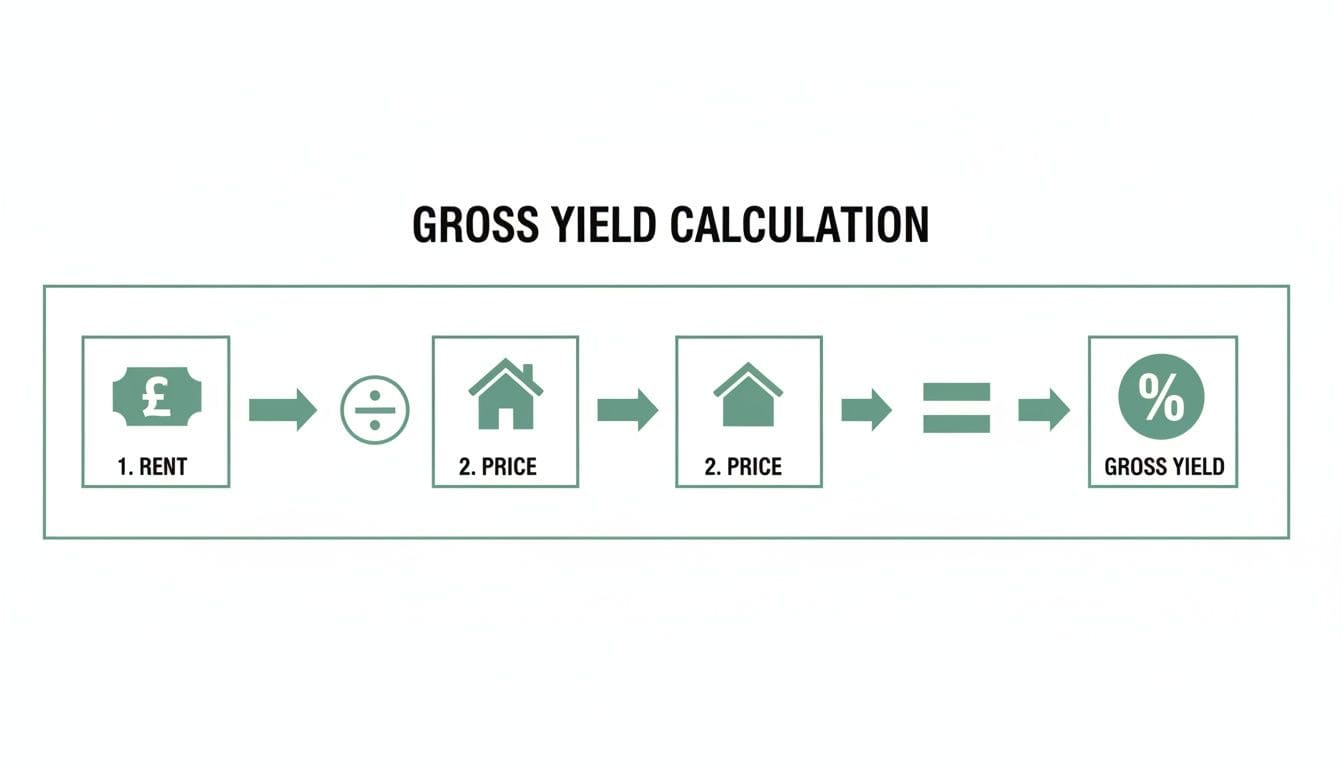
While this graphic shows the simple formula for gross yield, calculating net yield means subtracting all those hidden operational costs from the rental income before you do the final division. It's a simple change, but it makes all the difference.
Expanding the Definition of Total Investment
Another critical adjustment for an honest net yield calculation is expanding what "Total Investment" actually means. It's never just the purchase price. To get a true reflection of your return, you have to include every penny of upfront capital needed to get the property ready for tenants.
This includes:
- Purchase Price: The headline figure you agreed to pay for the property.
- Stamp Duty Land Tax (SDLT): This is a major upfront cost for property investors in the UK. For a deeper dive, check out our guide on what is Stamp Duty Land Tax.
- Legal & Conveyancing Fees: The costs for the solicitor to handle the purchase.
- Refurbishment Costs: Any money spent getting the property into a lettable condition, from a lick of paint to a new kitchen.
- Mortgage & Broker Fees: Don't forget the arrangement fees from your lender.
Leeds Flat Example: The Net Yield Reality
Let's revisit our Leeds flat, which we bought for £180,000 with an annual rent of £11,400.
First, let's get real about the total upfront investment:
- Purchase Price: £180,000
- SDLT (for a second property): £6,400
- Legal Fees: £1,500
- Initial Refurbishment: £2,000
- Total Investment: £189,900
Next, let's work out the annual operating costs:
- Letting Agent Fees (12% of rent): £1,368
- Insurance & Service Charge: £1,800
- Maintenance Budget (10% of rent): £1,140
- Total Annual Costs: £4,308
Now we can figure out the net annual income:
- £11,400 (Annual Rent) - £4,308 (Costs) = £7,092
Finally, let's plug all that into the net yield formula:
- (£7,092 / £189,900) x 100 = 3.73%
Just like that, the attractive 6.33% gross yield has tumbled to a much more realistic 3.73% net yield. This is the number that truly matters for understanding the property's financial health and whether it's actually a good investment.
Calculating ROI for a Complete Financial Picture

Once you bring a mortgage into the mix, net yield stops telling the whole story. For any UK investor using finance, the most important metric suddenly shifts from the property's performance to the performance of your own cash.
This is where Return on Investment (ROI) and, more specifically, Cash-on-Cash Return become the numbers that truly matter. These metrics measure how hard your actual deposit and upfront costs are working for you, not the total value of the asset. It's a crucial distinction because leverage can massively amplify your returns.
While there are a few ways to slice and dice ROI on a rental property, the Cash-on-Cash method is the most direct and honest for buy-to-let investors.
The formula is beautifully simple and powerful:
Cash-on-Cash Return = (Annual Pre-Tax Cash Flow / Total Cash Invested) x 100
This calculation shows you the return you're getting specifically on the money that has actually left your bank account. To really get to grips with how to calculate property yield in a real-world, leveraged scenario, this is the figure you need to nail.
Working Out Your Pre-Tax Cash Flow
Your annual pre-tax cash flow is simply what's left in the pot after you've paid all your operating costs and your mortgage for the year.
It's a straightforward calculation:
- Start with your Annual Rental Income.
- Subtract all your Annual Operating Costs (the same ones we used for net yield).
- Then, subtract your Annual Mortgage Payments (which includes both principal and interest).
The figure you're left with is your profit before you have to think about the tax man. So, if your net annual income (rent minus operating costs) was £7,092 and your annual mortgage payments were £4,800, your pre-tax cash flow would be £2,292.
The Big Impact of UK Tax Rules
Getting this number right is especially critical for UK landlords because of the infamous Section 24 mortgage interest relief rules. Since 2020, landlords can no longer deduct their mortgage interest costs from their rental income to lower their tax bill. Instead, you get a tax credit equal to 20% of your interest payments.
This means your taxable profit is calculated on your rental income before mortgage interest is taken off. For higher-rate taxpayers, this can push you into a much larger tax liability than you might expect. Knowing your precise cash flow before tax is the non-negotiable first step to forecasting what your post-tax position will actually look like.
Calculating yield in the UK has to be set against long-run price growth. The UK housing index averaged about 238 points from 1983 to 2026, but by Q1 2026, it is projected to climb past 520 points based on historical trends. This explains why older landlords often report impressive yields on cost: someone who bought a buy-to-let for £80,000 in 2000 that now rents for £900 per month is enjoying a 13.5% gross yield on original cost, whereas a new investor buying the same property at £220,000 only sees 4.9% gross yield. This highlights the importance of calculating yield on both purchase price and current value. Discover more insights about UK house price trends on Trading Economics.
This long-term appreciation is a huge part of the total return story, but Cash-on-Cash Return keeps you laser-focused on the income performance of your invested capital right now. To dive deeper into this, check out our guide on what is a good ROI on rental property, which breaks down the different targets investors should be aiming for.
How Strategy and Location Completely Change Your Numbers
A 7% yield isn't just a number; it's a story. But the story changes dramatically depending on the strategy behind it. A 7% yield on a standard family buy-to-let in a sleepy commuter town is a world away from a 7% yield on a high-turnover city-centre flat or a complex House in Multiple Occupation (HMO).
Your investment strategy fundamentally reshapes both your income potential and your cost structure. How you calculate your yield has to adapt to the specific beast you're analysing. A simple, single-family let has a fairly predictable cost profile, whereas an HMO introduces a whole different level of complexity and expense.
Comparing UK Investment Strategies
Think about the completely different financial DNA of various UK property strategies. An HMO, for example, might look incredible on paper, often boasting double-digit gross yields. That's because you're renting out individual rooms, which collectively pull in more rent than letting the entire property to one family.
But—and it's a big but—the operating costs are drastically higher:
- Hefty Management Fees: HMOs are management-intensive. Agents know this, and you can expect to pay fees of 15% or even more.
- Sky-High Bills: In most HMOs, the landlord covers everything: all utilities, council tax, and broadband. This can easily add hundreds of pounds to your monthly outgoings.
- Regulatory Hoops: Complying with HMO licensing means extra costs for fire safety gear, specific room standards, and other red tape, bumping up both your initial and ongoing expenses.
- Constant Churn: Individual tenants move far more often than families. This means more frequent void periods and the recurring hassle and cost of finding new tenants.
A high gross yield on an HMO isn't a luxury; it's an absolute necessity to cover the sheer operational weight of running it. The net yield often ends up looking surprisingly similar to a standard buy-to-let, but with a whole lot more hands-on work.
Why Hyper-Local Data is Everything
Just as strategy flips the numbers, location is the ultimate decider. National or even city-wide averages are next to useless when you're looking at a specific deal on a specific street.
UK property yield calculations are massively influenced by regional and sector-specific trends. For instance, while some reports might quote an average UK gross rental yield of 7.0% in Q1 2026, that figure papers over enormous cracks. A city like Leeds might show yields over 7.7% for certain apartments, while yields on prime London property barely scrape past 3%. You can explore more about these regional yield differences to get a sense of the massive variations at play.
This is exactly why your analysis has to be hyper-local. Rents can vary street by street, and your running costs are also tied to the postcode. When you learn how to calculate property yield properly, you learn to tune out the noise of broad averages. You focus only on the hard data for the deal in front of you—the actual, achievable rent and the real-world running costs for that specific property.
From Manual Spreadsheets to Automated Analysis

After wading through the details of SDLT, void periods, and strategy-specific costs, one thing becomes clear: figuring out how to calculate property yield by hand is a minefield. The classic spreadsheet is not only slow but notoriously fragile—a single typo or a misplaced formula can turn what looks like a great deal into an expensive mistake.
In the UK's fast-moving market, this manual approach just doesn't cut it anymore. While it's vital to understand the principles behind the numbers, the actual process of running them needs to be fast, accurate, and repeatable. This is where modern property investment tools offer a serious edge, moving you from tedious data entry to getting instant, reliable insights.
The Shift to Instant Deal Underwriting
The modern solution is to automate the whole underwriting process. Imagine just dropping in a property link and, seconds later, seeing a complete financial breakdown. This is exactly what tools like DealSheet AI are built for, instantly pulling property data and applying UK-specific financial models.
The app automatically calculates and presents the numbers that matter:
- Gross Yield
- Net Yield
- Cash-on-Cash Return / ROI
This jump from manual to automated isn't just about saving time. It's about making smarter, more confident decisions backed by solid data. It takes the guesswork and spreadsheet errors out of your analysis for good.
Ultimately, the goal is to spend less time wrestling with numbers and more time finding and securing the next profitable deal. For a deeper dive, check out our guide on using a modern property investment calculator in the UK.
Got Questions About Property Yield?
Even when you've got the formulas down, the real world throws up a few curveballs. When you actually start to calculate property yield on a live deal, specific questions always pop up. Let's tackle the most common ones UK investors ask.
What's a Good Rental Yield in the UK in 2026?
Honestly, a "good" rental yield in 2026 is all about your strategy and where you're buying. There's no single magic number.
For most standard buy-to-let investors, a gross yield of 5-8% is a solid target. But in high-growth hotspots like London, you might accept a lower yield of 3-4%, because you're banking on capital appreciation to do the heavy lifting.
On the flip side, head to many northern cities, and you can find gross yields pushing past 8%. If you're running a high-cashflow strategy like a House in Multiple Occupation (HMO), you'll need a gross yield of 10% or more just to make the numbers work, thanks to the much higher running costs.
How Do Void Periods Hit My Yield Calculation?
Void periods—when your property is sitting empty between tenants—are a direct hit to your annual income. They drag your yield down, so you absolutely have to budget for them when working out your net yield. Ignoring them is just wishful thinking.
A sensible, conservative approach is to assume the property will be vacant for 2-4 weeks a year. That's roughly 4-8% of your potential annual rent wiped out.
So, for a property renting at £1,000 a month (£12,000 a year), you shouldn't be basing your sums on the full £12k. A much safer, more realistic calculation would use an income of £11,000-£11,500. That's how you get to a net yield figure you can actually trust.
Calculating yield on your original purchase price tells you how well your initial investment has performed over time. But calculating it on the property's current market value shows you how efficiently that capital is working for you right now.
If the yield on your property's current value is looking really low, that's often a sign. It might be time to think about refinancing to pull out some equity or even selling up to reinvest that cash into a harder-working asset.
Tired of wrestling with spreadsheets? Let DealSheet AI do the heavy lifting for you. Get instant, accurate yield analysis for any UK property so you can make smarter decisions, faster. Download the app from the App Store and see for yourself.