
How to Calculate Rental Yield UK: A 2026 Investor's Guide
How to Calculate Rental Yield UK: A 2026 Investor's Guide
To calculate rental yield in the UK, you divide the annual rental income by the property's total purchase price and multiply by 100. This gives you the basic gross yield, a crucial starting point for assessing any buy-to-let investment. However, to truly understand profitability in 2026, you must calculate the net yield, which accounts for all operational costs. This guide will walk you through both essential calculations. For instant, accurate analysis, the DealSheet AI app can take any property listing and provide a full financial breakdown in seconds, doing all the heavy lifting for you.
Your Guide to UK Rental Yield Calculations

Rental yield is the bedrock metric for any UK property investor. It's a simple percentage that shows you the annual return on your investment, making it a powerful way to compare different opportunities on a like-for-like basis. Whether you're just starting out or you're a seasoned landlord, getting your head around yield is non-negotiable.
This guide will break down exactly what you need to know. We'll get into the two main types of yield and, crucially, why knowing the difference is so important for your financial planning.
Gross Yield vs Net Yield At a Glance
Before we dive into the worked examples, it helps to see the two main yield calculations side-by-side. Gross yield is your quick filter; net yield is your reality check.
| Metric | Formula | What It Tells You | Best For |
|---|---|---|---|
| Gross Yield | (Annual Rent / Purchase Price) x 100 | The raw, pre-cost earning potential of a property. | Quickly comparing multiple properties at the start of your search. |
| Net Yield | ((Annual Rent - Annual Costs) / Total Investment) x 100 | A realistic measure of profitability after all expenses are paid. | Making a final investment decision and forecasting actual cash flow. |
Relying only on the gross yield is one of the most common mistakes new investors make, and it often leads to overestimated returns and, frankly, poor investment choices. The net yield is the number that truly reflects what will end up in your pocket.
For many investors in 2026, a gross yield between 5% and 8% is a solid target. But this can vary massively by region—you'll often see higher yields in northern cities compared to the south.
Throughout this guide, we'll walk through clear, real-world examples to show you how to calculate both. We'll also look at how to adapt these formulas for different property investment strategies in the UK, like HMOs or serviced accommodation, which have their own unique cost structures. And finally, we'll touch on the crucial UK tax implications that have a huge impact on your final returns.
Understanding the Gross Rental Yield Formula
When you first start to calculate rental yield in the UK, gross yield is the first, quickest number you'll come across. Think of it as a rough-and-ready filter. It's the metric that helps you sift through dozens of listings to decide which ones are even worth a second glance.
The formula itself couldn't be simpler:
(Annual Rental Income ÷ Property Purchase Price) × 100 = Gross Rental Yield (%)
This calculation deliberately ignores all the running costs. Its job isn't to tell you what profit you'll make, but to give you a consistent baseline to compare the raw income potential of one property against another.
A Practical Example in the North West
Let's put this into practice. Imagine you're eyeing up a two-bedroom terrace in a solid rental area of Greater Manchester, a region well-known for delivering strong returns for landlords.
- Property Purchase Price: £180,000
- Monthly Rent: £1,100
First, you need to work out the total annual rent. That's simply £1,100 multiplied by 12 months, which gives you £13,200.
Now, you just plug those numbers into the formula: (£13,200 ÷ £180,000) × 100 = 7.33%.
This 7.33% figure is your gross rental yield. It's an immediate signal that, on paper, this property generates a very healthy return for its price. This is especially true when you consider the North West often boasts average gross yields between 6.5% and 8.5%, driven by huge tenant demand in cities like Manchester and Liverpool where property prices haven't run away quite as much. For more on this, you can explore the UK's top buy-to-let locations.
The Limitations of Gross Yield
So, it's a useful starting point. But relying only on gross yield is a classic rookie mistake.
It gives you a best-case, almost fantasy, number because it completely ignores the operational costs that will inevitably chip away at your actual profit. It's a bit like a car's top speed—an impressive figure, but totally irrelevant to your daily commute through traffic.
To really know if an investment stacks up, you have to dig into the costs. That's where net yield comes in, and it paints a much more realistic picture. We've got a detailed article that helps you understand what is a good rental yield in a lot more detail.
Calculating Net Rental Yield for True Profitability
While gross yield offers a quick first impression, it's the net rental yield that reveals the true financial health of a property investment. Honestly, this is the only figure serious investors really focus on. Why? Because it accounts for the unavoidable costs of being a landlord, showing you what you will actually earn.
Ignoring these costs is a shortcut to making a very poor investment decision. I've seen it happen time and time again.
The formula to work out your net rental yield is a bit more involved, but it's where the truth lies:
(Annual Rental Income - Annual Operating Costs) ÷ Total Property Cost × 100 = Net Rental Yield (%)
The "Annual Operating Costs" figure is where the real work—and the real risk—is. It's a comprehensive list of all the money you'll spend just to keep the property running smoothly throughout the year.
Breaking Down Your Annual Operating Costs
To get an accurate net yield, you have to be brutally honest and factor in every foreseeable expense. A small oversight here can have a massive impact on your projected profits down the line.
Here are the core costs you absolutely must include in your sums:
- Mortgage Interest: If you have a buy-to-let mortgage, remember that only the interest portion of your monthly payment is an operating cost. The capital repayment is you paying down your loan, not an expense.
- Insurance: This isn't just one thing. It includes buildings insurance (almost always a mortgage requirement) and specific landlord insurance, which covers things like liability and loss of rent.
- Maintenance and Repairs: A common rule of thumb I use is to budget 1% of the property's value annually for maintenance. For a £180,000 property, that's £1,800 per year set aside for everything from a dripping tap to a boiler service. Don't skip this.
- Letting Agent Fees: If you use an agent for tenant-find or full management services, their fees (typically 8-15% of the rent) must be deducted.
- Service Charges and Ground Rent: These are common with leasehold properties like flats and can easily add up to thousands per year. They're a deal-killer if you don't account for them.
- Void Periods: It's incredibly naive to assume 100% occupancy. I always budget for at least one month per year where the property might be empty between tenancies.
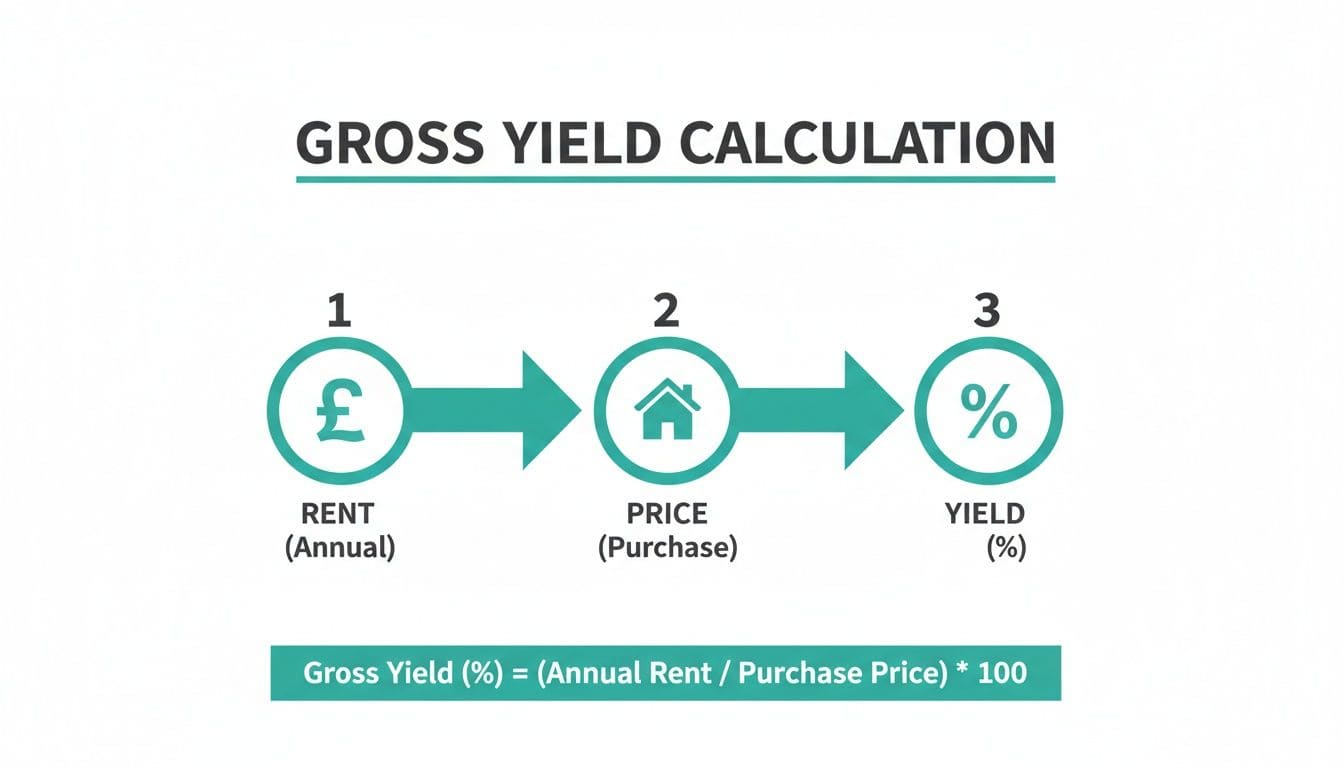
The diagram below breaks down the simple inputs for a gross yield calculation. Think of this as the starting point for your much more detailed net analysis.

This just shows how the annual rent and purchase price combine to give you that initial, high-level gross yield figure before we get into the real numbers.
From Gross Promise to Net Reality
Let's get back to our £180,000 Manchester property with its promising 7.33% gross yield. Now, we'll layer in some realistic annual costs to see what's really going on.
- Mortgage Interest: £4,500
- Insurance: £300
- Maintenance (1%): £1,800
- Letting Agent Fees (10%): £1,320
- Total Annual Costs: £7,920
With these costs, our annual profit drops from £13,200 to just £5,280. Ouch. The net yield calculation now looks like this: (£5,280 ÷ £180,000) x 100 = 2.93%.
That promising 7.33% has been more than halved. This is precisely why a thorough buy-to-let profit calculator is essential for accurate forecasting.
This reality check is crucial, especially as overall costs for landlords continue to climb. In fact, while rental income for UK landlords hit a five-year high of £55.53 billion in 2023-24, allowable expenses also jumped by 14%, underscoring just how vital precise tracking has become. You can read the full government statistics on property rental income for yourself.
This manual process can be time-consuming and, frankly, prone to error. This is where tools like DealSheet AI really prove their worth. They prevent these mistakes by automatically applying realistic cost estimates, ensuring your decisions are based on sober reality, not optimistic guesswork.
Tweaking Your Maths for Different Property Plays
A standard buy-to-let calculation is perfect for a simple terraced house rented out to a family. But the UK property market is a far more creative and complex beast.
Once you start exploring more advanced strategies like Houses in Multiple Occupation (HMOs) or Serviced Accommodation (SA), that basic net yield formula needs a serious rethink to stay relevant. These strategies can rocket your income, but they also bring a completely different cost structure to the table.
Failing to account for these nuances is the quickest way to misjudge a deal and saddle yourself with a dud. Any serious investor needs to know how to properly calculate rental yield UK figures for these specific models.
How to Calculate Yield for an HMO
An HMO, where you're renting out individual rooms to separate tenants, flips the financial dynamics on their head. Your income is no longer one neat payment but a bundle of smaller ones. More importantly, your expenses climb—a lot.
In a typical HMO, the landlord picks up the tab for costs that a standard buy-to-let tenant would cover themselves. This means you need a much more granular list for your "Annual Operating Costs".
Key costs to add for any HMO calculation include:
- All Utilities: This means council tax, gas, electricity, water, and decent broadband. These can easily run to several hundred pounds per room, per year.
- Licensing Fees: Most councils now require an HMO licence, which can cost anywhere from £500 to over £1,500 and needs renewing every few years. You have to factor in the annualised cost.
- Increased Maintenance: With more people hammering the communal areas like kitchens and bathrooms, wear and tear accelerates. Many seasoned HMO landlords budget 10-15% of their gross rent for maintenance, not the standard 1% you might see elsewhere.
- Communal Area Cleaning: Regular professional cleaning of shared spaces is pretty much non-negotiable for keeping a high-quality property and happy tenants.
Calculating Yield for Serviced Accommodation
Serviced Accommodation (SA), or short-term lets, operates more like a mini-hotel than a traditional rental. Income is based on nightly rates, which can swing wildly with the seasons, local events, or even just the day of the week. This makes forecasting your annual income the first major hurdle.
Instead of a fixed monthly rent, you have to estimate an average nightly rate (ANR) and an average occupancy rate. A realistic occupancy for a new SA unit might be 60-70%, not 100%. Don't fall into that trap.
For example, a property with an ANR of £120 and 65% occupancy would have a gross annual income of: £120 x 365 days x 0.65 = £28,470.
The expense side is also far more hands-on:
- Platform Fees: Booking platforms like Airbnb and Booking.com will take their cut, typically around 15% of the booking value.
- Cleaning and Laundry: This is a huge, recurring operational cost that happens after every single stay. It's a relentless cash drain if not managed properly.
- Restocking Supplies: You'll be constantly replenishing consumables like coffee, tea, soap, and toilet paper.
- Higher Utility Bills: You're on the hook for all the bills, and usage is often much higher than in a standard let.
How a Mortgage Shifts Your Focus to ROI
Finally, while yield is great for measuring a property's performance against its total value, throwing a mortgage into the mix introduces a different, more personal metric: Return on Investment (ROI). You might also hear this called "cash-on-cash return."
This calculation focuses purely on the actual cash you've personally sunk into the deal.
The formula is simple: (Annual Profit ÷ Total Cash Invested) × 100 = ROI (%)
Your "Total Cash Invested" is everything you paid out of pocket: your deposit, Stamp Duty, legal fees, broker fees, and any refurb costs. This number tells you how hard your money is actually working for you. For most investors using leverage, a high ROI is the name of the game.
Trying to manually adapt spreadsheets for each of these strategies is not only a headache but also an open invitation for errors. The DealSheet AI app is built to handle this complexity, offering dedicated templates for HMO, SA, and BRRRR deals. Each one is pre-loaded with the right cost assumptions, letting you evaluate complex property deals with the confidence and speed you need.
How UK Taxes and Regulations Affect Your Real Yield
Calculating your rental yield in a vacuum is a surefire way to misjudge a deal. Your real return isn't what you make before tax; it's what you keep after HMRC has taken its slice.
Ignoring this simple truth can quickly turn a profitable-looking deal on paper into a financial headache in reality. The numbers you use to calculate rental yield UK figures have to reflect the ground truth of being a UK landlord.
Two major UK-specific factors can completely change your final net yield: Stamp Duty Land Tax (SDLT) and the infamous Section 24 mortgage interest relief rules. Let's break down why they matter so much.
The Impact of Stamp Duty Land Tax
Stamp Duty is a huge upfront cost that many new investors forget to include in their initial calculations. For buy-to-let properties, you'll pay a higher rate of SDLT, which must be added to your 'Total Property Cost' for an accurate net yield or ROI calculation.
Forgetting to account for SDLT is a critical error. On a £250,000 property purchase, the SDLT for a buy-to-let investor could easily be around £9,000. This immediately increases your total investment and crushes your resulting net yield and ROI from day one.
This isn't just a minor detail; it's a massive cash outlay that directly eats into the profitability of your investment before you've even collected the first month's rent. To get a precise figure for your deal, our comprehensive Stamp Duty Land Tax calculator guide breaks down exactly how it works.
Understanding Section 24 Mortgage Interest Relief
This is probably the single most impactful regulatory shift for individual landlords in recent memory. Before Section 24, you could deduct all your mortgage interest from your rental income before working out your tax bill. Not anymore.
Now, if you own property in your personal name, you can no longer deduct mortgage interest as a business expense. Instead, you get a tax credit equal to just 20% of your interest payments. While this doesn't affect basic-rate taxpayers, it can be absolutely devastating for higher-rate (40%) and additional-rate (45%) taxpayers.
Let's look at a quick example to see the damage.
| Metric | Held Personally (Higher-Rate Taxpayer) | Held in a Limited Company |
|---|---|---|
| Annual Rental Income | £15,000 | £15,000 |
| Mortgage Interest | £6,000 | £6,000 |
| Taxable Profit | £15,000 (Interest not deductible) | £9,000 (Interest is a deductible expense) |
| Tax Due Before Credit | £6,000 (40% of £15,000) | £1,710 (19% of £9,000) |
| Tax Credit Applied | -£1,200 (20% of £6,000) | N/A |
| Final Tax Bill | £4,800 | £1,710 |
As you can see, the tax bill for a higher-rate taxpayer is almost three times higher when owning the property personally. This single rule can completely wipe out the profit from a leveraged portfolio.
It's easy to get caught out by these mandatory costs, especially when you're analysing multiple deals. Here's a quick summary of the key UK costs you absolutely must factor into your net yield and ROI calculations.
Key UK Costs Affecting Your Net Yield
| Cost Category | Description | Impact on Calculation |
|---|---|---|
| Stamp Duty Land Tax (SDLT) | A tax paid on property purchases. Higher rates apply to second homes and buy-to-lets. | Increases your initial 'Total Property Cost', directly reducing your ROI and net yield from the start. |
| Section 24 Tax Rules | Prevents individual landlords from deducting mortgage interest as an expense for tax purposes. | Drastically increases the tax bill for higher-rate taxpayers, crushing after-tax cash flow and profitability. |
| Letting Agent Fees | Fees for tenant find, rent collection, and full management (typically 8-15% of rent). | A recurring operating cost that must be deducted from rental income to find your true net profit. |
| Landlord Insurance | Specialist insurance covering buildings, contents, and liability. | An essential annual operating expense that reduces your net income. |
| Compliance Costs | Mandatory safety certificates (Gas Safety, EICR), EPCs, and property licensing fees. | These are unavoidable running costs that must be budgeted for, reducing your overall cash flow. |
Failing to account for these isn't optional—it's the difference between a successful investment and a costly mistake.
This is precisely why accurately modelling your tax position is non-negotiable. Tools like DealSheet AI are built to handle these UK-specific rules automatically, applying the correct SDLT rates and modelling the brutal impact of Section 24 based on your ownership structure. It ensures your calculations are always grounded in reality, not wishful thinking.
Any Lingering Questions About Rental Yield?

Even when you've got the formulas down, a few practical questions always pop up the moment you start plugging in numbers from a real-world deal. The gap between a neat formula and a messy property listing can be a bit confusing. This section tackles some of the most common queries investors have, helping you troubleshoot your own analysis and make calls with more confidence.
What's a Good Rental Yield in the UK for 2026?
Honestly, a "good" rental yield is a moving target. It depends entirely on your strategy and, crucially, your location.
Down in pricier spots like London or the South East, many investors are perfectly happy with a gross yield of 5% or more. They're often playing a longer game, balancing a slightly lower yield against the potential for stronger capital growth.
But head up to higher-yielding regions like the North West or Scotland, and the goalposts move. A good gross yield there could easily be 7% to 9%.
The number that really matters, though, is your net yield.
A solid net yield is one that leaves you with sustainable, positive cash flow after every single cost—including your mortgage and tax—has been paid. For most investors, a net yield clearing 4% is considered strong, but the ultimate goal is always healthy monthly cash flow.
How Do One-Off Costs Like a New Boiler Affect My Yield Calculation?
This is a fantastic question because it gets right to the heart of operational costs versus capital expenditure.
A one-off cost like a new boiler or a roof repair isn't something you'd typically include in your annual net yield calculation. That formula is designed to measure the property's routine, year-on-year performance.
Instead, you should account for these big, infrequent expenses in a couple of ways:
- A Maintenance Fund: Proactive investors set aside a percentage of the property's value (a common rule of thumb is 1-2% annually) into a separate pot. This fund is there to absorb major capital costs when they inevitably arise, without derailing your monthly cash flow.
- Return on Investment (ROI): If you know you have to pay for a new boiler right away as part of a refurb, that cost should be added to your 'Total Cash Invested' figure when calculating your ROI. This gives you an accurate picture of the total capital you had to deploy just to get the property ready for tenants.
Should I Use the Purchase Price or the Current Market Value?
The answer depends entirely on what you're trying to figure out. Each value tells you something different and equally useful.
When you're analysing a new deal, always use the total purchase cost. That's the purchase price plus all your acquisition fees like Stamp Duty and legal costs. This tells you the yield on your initial investment and is absolutely critical for deciding whether to even go ahead with the purchase.
However, for a property you already own, calculating the yield based on its current market value is an incredibly powerful health check. This shows you how efficiently your capital is working for you right now. If the yield on its current value is looking a bit feeble, it might be a signal to sell and reinvest that equity into a higher-performing asset.
Can I Trust the Rental Yield Quoted on a Property Listing?
Approach any yield quoted by an agent with a very healthy dose of scepticism.
They almost always advertise the gross yield, and it's usually based on a pretty optimistic rental estimate and the property's full asking price. They rarely, if ever, account for the things that will actually eat into your profit, like service charges, void periods, or other running costs.
Always, always do your own homework. Verify what rent is actually achievable by checking similar, recently let properties on Rightmove or Zoopla, and then run your own detailed gross and net yield calculations. It's the only way to get a forecast that's anywhere close to reality.
Analysing deals quickly and accurately is what separates successful investors from the rest. Instead of juggling error-prone spreadsheets, DealSheet AI lets you transform any property listing into a comprehensive financial model in seconds. Get the clarity you need to stop second-guessing and start making confident investment decisions by downloading the app today.
Discover how DealSheet AI can transform your property analysis on the App Store