
Explore housing prices york: An Expert UK Forecast for 2026
Explore housing prices york: An Expert UK Forecast for 2026
If you're looking to invest in the UK property market, understanding the local dynamics of housing prices york is critical. The city presents a compelling, if sometimes pricey, picture for investors, with the average property price currently hovering around £325,000. This demonstrates York's consistent outperformance against many UK cities, driven by its robust economy and high demand. This guide provides actionable insights into what to expect in 2026 and beyond. To turn this data into a smart investment, you need to analyse deals quickly and accurately. This is where a tool like the DealSheet AI app comes in; download it from the App Store to start crunching the numbers on York opportunities with real confidence.
A Snapshot of York's Current Property Market

To really understand York's property landscape, you need to see how it fits into the national picture while appreciating what makes it unique. The city's market is often seen as a resilient pocket within the wider UK property scene, holding its ground and showing steady growth even when other regions get a bit shaky. This stability is a massive draw for buy-to-let investors and anyone looking for long-term capital growth.
The big question for any investor is simple: how do York's prices actually stack up against the rest of the UK? While the country as a whole has seen huge house price growth over the past couple of decades, York has consistently kept pace and, in many cases, has even pushed ahead of the national averages. This isn't just a recent trend; it's a long-standing pattern that speaks volumes about the city's unique appeal.
York Average House Prices vs UK Average
To put some hard numbers on this, let's take a quick look at how York's average prices for different property types compare to the national UK average. This gives you an immediate feel for where the value and growth lie.
| Property Type | Average Price in York | Average Price in UK | Annual Growth (York) |
|---|---|---|---|
| Detached | £450,000 | £435,000 | +2.5% |
| Semi-Detached | £320,000 | £280,000 | +3.1% |
| Terraced | £285,000 | £230,000 | +3.8% |
| Flats/Apartments | £215,000 | £225,000 | +1.9% |
As you can see, York commands a premium, especially for family homes like semi-detached and terraced properties, which also show the strongest annual growth. This tells a story of high demand from families and professionals, not just investors.
Understanding The Wider UK Context
To properly frame the housing prices york, it's useful to glance at the UK market's recent performance. According to the Halifax House Price Index, average house prices across the UK climbed above £300,000 for the first time in January 2026. This shows a remarkable market resilience, with annual growth bouncing back to +1.0% in January 2026, a positive turnaround from a slight dip the month before. This upward trend is getting a bit of a boost from wage growth, which has been outpacing inflation since late 2022.
This broader economic stability creates a supportive backdrop for local markets like York. However, it's the local factors that often play the most significant role in shaping value and potential returns. For anyone just starting out, getting these fundamentals right is crucial. If you're new to this, our guide on investing in property for beginners is a great place to start.
York's property market is a classic example of a "defensive" investment location. Its value is underpinned by a diverse economy, strong educational institutions, and a world-renowned tourism sector, creating a consistent demand for housing that helps insulate it from wider economic shocks.
This blend of powerful local drivers and a stable national environment makes a powerful case for investing in York. The key, of course, is to move from this general market knowledge to specific, data-driven analysis of actual deals.
Understanding York's Property Market Trajectory
To make smart investment decisions, you have to look beyond today's asking prices and understand the story behind them. A look back at the historical performance of housing prices york over the last decade tells a clear story: this is a market defined by remarkable resilience and consistent growth, even when the rest of the UK economy was turbulent.

Unlike many UK cities that shot up and then crashed down, York's property market has walked a much steadier upward path. For investors, especially those using strategies like Buy-to-Let or BRRRR (Buy, Refurbish, Rent, Refinance, Repeat), this steady climb provides real confidence in the long-term value of their assets.
Of course, this long-term growth is part of a bigger picture. The Halifax index, which has tracked UK-wide data since 1983, hit an all-time high of 516.90 in October 2025. This momentum really took off after the pandemic, with year-on-year price changes hitting a massive 14% in July 2022, proving just how fast the market can move.
Navigating National Events
The post-pandemic property boom was a major test for markets everywhere. While many areas saw an unsustainable surge followed by a painful correction, York's growth was more measured and sustainable. Later on, when interest rates started to climb and cooled demand elsewhere, the impact on housing prices york was far less dramatic.
This resilience comes from the city's solid and diverse economic foundations, which we'll get into later. The constant demand from different sectors—like education, tourism, and professional services—acts as a protective buffer against wider economic storms.
York's market has consistently shown a "low volatility, high stability" profile. For an investor, this means fewer sleepless nights worrying about sudden market crashes and more confidence in steady, long-term capital appreciation.
What Historical Data Tells Investors
Digging into this historical performance gives you critical insights. It confirms that property in York isn't just a speculative gamble but a solid, long-term home for your capital.
Here are a few key takeaways from York's market history:
- Consistent Demand: The data proves that demand for housing in York rarely drops off, which keeps prices stable.
- Lower Risk Profile: Compared to more volatile markets, York is a lower-risk place to invest your money.
- Strong Fundamentals: The city's ability to ride out economic storms points to powerful underlying drivers, like its strategic location and strong job market.
This context is vital when you're analysing a potential deal. It gives you the confidence to ignore the short-term market noise and focus on a property's fundamental value. By identifying the best areas for buy-to-let within York, you can align your strategy with neighbourhoods that have a proven track record of growth and rental demand. A deep understanding of past performance helps you build a more robust and successful property portfolio for the future.
A Neighbourhood Breakdown of York House Prices And Yields
To really get under the skin of York's investment potential, you have to look past the city-wide averages and get down to street level. York is a patchwork of distinct neighbourhoods, each with its own character, price point, and rental market. Nailing the right area is the difference between a good investment and a genuinely great one.
This breakdown will walk you through some of York's key postcodes, from the leafy, premium suburbs to the high-yield student hubs. We'll look at typical prices, rental income, and most importantly, the gross rental yields you can expect. This is the kind of on-the-ground data you need to match your investment strategy to a specific location.
The Premium Postcodes: Fulford and Bishopthorpe
On the southern edge of the city, Fulford (YO10) and Bishopthorpe (YO23) are two of York's most sought-after and expensive areas. Known for their excellent schools, green spaces, and village-like feel, they're a magnet for affluent families and professionals. This drives up both house prices and the demand for high-quality family homes to rent.
- Average 3-Bed House Price: Be prepared to pay upwards of £400,000 - £475,000 for a semi-detached family home in good nick.
- Typical Monthly Rent: These properties command strong rents, usually falling between £1,500 and £1,800 per month.
- Estimated Gross Yield: Because of the higher purchase prices, gross yields are more modest, typically landing in the 4.0% to 4.8% range.
The play here is less about high monthly cash flow and more about long-term capital appreciation. These are blue-chip locations where property values have historically shown exceptional resilience and steady growth.
The Investor Sweet Spots: Clifton and Acomb
For investors chasing a balance of affordability, strong rental demand, and healthier yields, areas like Clifton (YO30) and Acomb (YO24/YO26) are prime hunting grounds. Clifton's proximity to the city centre and York St John University makes it a hit with a mix of students, young professionals, and families. Acomb, a little further out, offers a more accessible entry price and a solid family rental market.
In these neighbourhoods, the housing prices york are much more approachable. A typical three-bedroom terraced or semi-detached house in Acomb might set you back £270,000 - £320,000. Clifton prices can be a touch higher due to its more central location.
Investing in areas like Clifton and Acomb means you can tap into the stable York market without the premium price tag of postcodes like Fulford. The real key is the diverse tenant pool, which helps minimise void periods and delivers a reliable income stream.
Rental income here is robust. For a standard family home, you can realistically expect rents of around £1,200 to £1,400 per month. This combination of lower purchase prices and solid rent creates much more attractive yields, often in the 5.0% to 5.8% range, making them ideal for building a buy-to-let portfolio.
The High-Yield Hubs: Heslington and Tang Hall
If your strategy is laser-focused on maximising rental yield, then the student-centric areas of Heslington (YO10) and Tang Hall (YO10) are impossible to ignore. Located right on the doorstep of the University of York, these neighbourhoods are dominated by student lets and Houses in Multiple Occupation (HMOs).
Purchase prices for a three or four-bedroom terraced house ripe for HMO conversion typically range from £275,000 to £350,000. While the initial outlay is significant, the rental returns can be exceptional when you let it out by the room. For those new to property finance, you can learn more about how to work out yield on a property in our detailed guide.
A well-run four-bedroom HMO in this area can generate a gross rental income of £2,200 to £2,600 per month (£550-£650 per room). This pushes potential gross yields into the 7.5% to 9.0% bracket—some of the highest you'll find in the city. Just be aware of York's Article 4 Direction, which restricts the creation of new HMOs in certain areas, making existing ones even more valuable.
To help you visualise the opportunities, here's a quick snapshot comparing the different neighbourhood types.
York Neighbourhood Investment Snapshot
| Neighbourhood | Average 3-Bed House Price | Average Monthly Rent | Estimated Gross Yield |
|---|---|---|---|
| Fulford | £450,000 | £1,650 | 4.4% |
| Acomb | £290,000 | £1,300 | 5.4% |
| Clifton | £330,000 | £1,450 | 5.3% |
| Heslington (HMO) | £325,000 | £2,400 | 8.8% |
This kind of neighbourhood-level detail is precisely where an app like DealSheet AI becomes invaluable. It allows you to rapidly analyse and compare properties from different postcodes, instantly calculating yields, cash flow, and ROI based on real-time data. It ensures your next investment aligns perfectly with your financial goals.
What's Really Driving York's Property Market?
To make smart investment decisions, you have to look beyond the headline prices and understand why a market behaves the way it does. The consistent growth in York's housing prices isn't a fluke; it's anchored by a set of powerful, long-term economic drivers that keep demand high. Digging into these fundamentals shows you exactly why the city's property market is so resilient.
York's core economic strengths act as a powerful buffer against the kind of volatility we see in other parts of the UK. From its world-famous tourism scene to its powerhouse universities, these forces work in tandem, creating a constant influx of people who need somewhere to live. This sustained demand is the engine that props up property values and rental income over the long haul.
The Pillars Of York's Economy
While York's economy is pretty diverse, three core pillars have the most direct and powerful impact on its housing market. These aren't just passing trends; they're deeply embedded features of the city's identity that provide a rock-solid foundation for property investment.
- A Booming Tourism Sector: York is a true heavyweight in UK tourism, pulling in over 8 million visitors every single year. This fuels thousands of jobs in hospitality, retail, and leisure, and it underpins a thriving market for short-term lets and serviced accommodation.
- Two Major Universities: The University of York and York St John University have a combined student population of over 28,000. This creates a massive, constant, and non-negotiable demand for rental properties, especially HMOs, which pretty much guarantees rental yields in key postcodes.
- Strategic Transport Links: York's position on the East Coast Main Line is a huge strategic advantage. Being able to get to London King's Cross in under two hours makes it a genuinely viable and attractive base for professionals who want access to the capital without sacrificing their quality of life.
This chart helps to visualise how purchase prices, rental income, and potential yields relate to each other across the city.
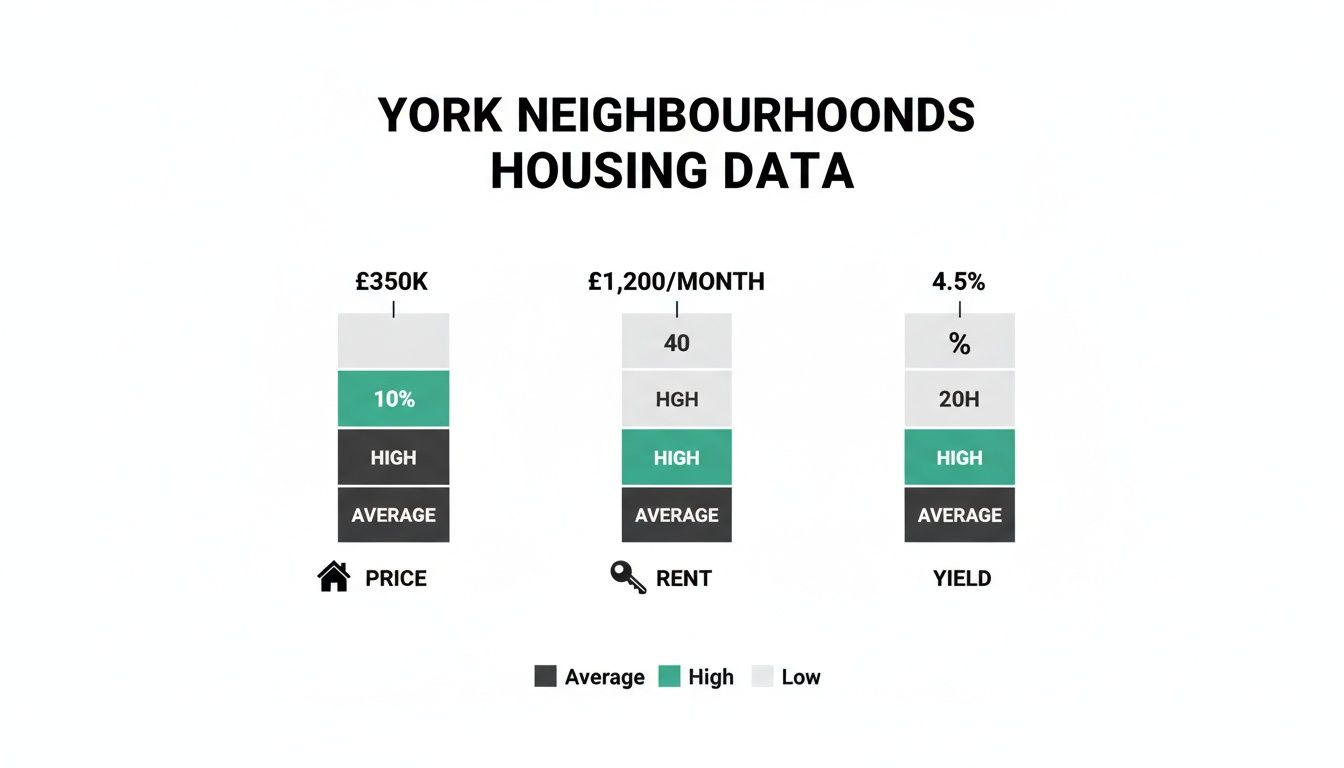
As the data shows, while average prices are certainly high, there's clear potential for strong rental income and healthy yields, especially if you target the upper end of the rental market.
How These Drivers Shape Housing Demand
These economic forces don't just exist on paper; they directly translate into real-world demand for specific types of property. For example, the constant stream of students creates a deep and incredibly reliable tenant pool for landlords, particularly those running HMOs in areas like Heslington or Tang Hall. This is the bedrock that supports the higher yields often seen in those neighbourhoods.
At the same time, the city's fantastic rail links attract high-earning professionals and their families. They are either looking for premium rental properties or aiming to buy in desirable suburbs like Fulford and South Bank, which in turn pushes up both rental and sales values for family homes. This commuter demand adds another layer of stability to the top end of the market.
In York, the economic drivers create a virtuous cycle. A strong jobs market pulls people in, and those people need housing. This demand supports property prices, which encourages more investment and development in the city, further reinforcing its economic strength.
The Long-Term Investment Perspective
For any serious property investor, understanding these drivers is really about managing risk. A market that's propped up by temporary factors is a gamble. But a market like York's, supported by enduring pillars like education, tourism, and transport, offers a much safer bet for achieving long-term capital growth and reliable rental income.
The stability these factors provide means that York's housing prices are far less susceptible to the dramatic boom-and-bust cycles that plague more speculative markets. This makes it an almost ideal location for building a resilient, long-term property portfolio. When you analyse a deal here, you're not just buying bricks and mortar; you're investing in a city with a proven and sustainable economic model.
So, What's Next for the York Housing Market in 2026?
After digging into past trends and the current state of play in York's neighbourhoods, the key question for any investor is: where are housing prices york headed? No one has a crystal ball, but by analysing economic signs, local development plans, and the wider UK property scene, we can build a solid forecast for 2026 and beyond.
The outlook for York's property market is one of cautious optimism. National factors, like Bank of England interest rate decisions, will always be influential. With inflation now largely under control, a period of greater stability on the rates front is expected. This alone should inject confidence and predictability back into the market for anyone needing a mortgage.
However, it's local factors that truly dictate York's path. The city's core economic engines—the universities, the relentless tourism trade, and its prime transport links—are enduring strengths. This creates a high floor under property demand, giving York a buffer against the sharp downturns that can hit less diverse local economies. We're not forecasting a massive boom, but rather a period of steady, sustainable growth.
Key Opportunities on the Horizon
For investors with a sharp eye, the next couple of years will throw up some specific chances to get ahead. Keeping a close watch on development and regeneration projects is where you can unlock some serious value.
- The York Central Development: This is the big one. The huge transformation of the land behind the railway station is set to create thousands of new homes and jobs. As this mammoth project takes shape, it's almost guaranteed to lift property values in the surrounding areas, like Holgate and The Groves.
- Infrastructure Upgrades: Any planned improvements to local transport or public spaces will only add to York's appeal, especially for professionals and young families. The neighbourhoods that benefit directly from these upgrades will likely see their capital growth speed up.
- Continued Demand for HMOs: Even with Article 4 rules in place, the demand for good quality student rooms is off the charts. For investors, this means existing, licensed HMOs are becoming increasingly precious assets that can deliver strong, reliable rental income.
Potential Risks to Keep on Your Radar
A proper forecast has to acknowledge the potential headwinds, too. Being aware of these risks lets you stress-test your plans and build a more resilient portfolio.
The biggest unknown is always a sudden shift in UK government policy. Any tweaks to how landlords are taxed—like changes to Capital Gains Tax or further tinkering with mortgage interest relief—could squeeze investor profits. Similarly, while it seems unlikely right now, a sharp spike in interest rates would hit borrowing costs hard and could put a damper on buyer demand.
The greatest asset for an investor is foresight. By understanding both the opportunities and the risks, you can position your portfolio to thrive in changing market conditions. It's about preparing, not predicting.
Another thing to watch is the cost of building and refurbishing properties. If material and labour costs stay stubbornly high, it can seriously eat into the profits of strategies like flipping or BRRRR. When you're sizing up a project, it's absolutely crucial to build in a healthy contingency fund. Getting a handle on the full scope of costs is vital, and you can learn more about key metrics like the Gross Development Value in our guide.
Ultimately, forecasting the housing prices york market is about balancing these competing forces. The city's powerful economic fundamentals provide a solid launchpad for growth, but smart investors will stay alert to national economic shifts and local rule changes. This is exactly what tools like DealSheet AI are for. They let you model different scenarios—what if interest rates jump? What if my refurb costs are 20% higher?—to see how a potential deal stacks up under pressure. That kind of proactive analysis is the key to navigating the future with confidence.
How To Analyse a York Property Deal in Seconds
Knowing the market trends for housing prices in York is one thing. Turning that knowledge into a profitable investment is where the real work begins. Let's be honest, firing up a spreadsheet to manually calculate Stamp Duty Land Tax (SDLT), project cash flow, and stress-test for interest rate changes can take hours.
This is where you can shift from theory to action in seconds.
Instead of wrestling with complex formulas and hunting for the latest tax rules, you can use tools to do the heavy lifting. This gives you an instant, data-driven verdict on a property's potential, which is a massive advantage in a competitive market like York.
From Property Portal to Profit Analysis
Imagine this: you're browsing Rightmove and spot a promising three-bedroom terraced house in Acomb. It's listed for £295,000, and the agent suggests a potential rent of £1,350 per month. Is it a good deal?
Here's how quickly you can find out:
- Find Your Property: Locate the listing on a major UK portal like Rightmove, Zoopla, or OnTheMarket.
- Copy the Link: Just copy the URL of the property listing from your browser.
- Paste into DealSheet AI: Open the DealSheet AI app and paste the link into the analysis tool. The AI instantly pulls all the key data—price, location, number of bedrooms, and even the agent's description.
Within moments, the app gets to work. It applies the correct UK tax rules and investment formulas based on your strategy, whether that's a standard Buy-to-Let or something more complex. It automatically calculates your likely mortgage costs, estimates running expenses, and factors in tricky tax implications like Section 24 for individual landlords.

The dashboard immediately shows you the metrics that matter most: Gross Yield, monthly cash flow, and the all-important Return on Investment (ROI).
Making Data-Backed Decisions Instantly
What used to be a long evening of number-crunching is now done in about 12 seconds. The app doesn't just give you a headline yield; it provides a full financial breakdown, highlighting the potential profits and the risks.
The real edge here is speed combined with accuracy. The app doesn't just spit out raw numbers. Its AI analyses the deal's context, flagging potential issues like a property being overpriced for its postcode or having a low energy efficiency rating that could mean big future costs.
This allows you to quickly vet multiple properties and focus your energy only on the ones that genuinely stack up financially. It transforms your approach from speculative guesswork to a systematic, data-led strategy.
If you want to get under the bonnet of these calculations, our guide to using a UK property investment calculator gives a comprehensive overview of the essential metrics. By using tools like this, you move from simply watching the housing prices in York to actively and efficiently finding the best investment opportunities hidden within the market.
Your Questions Answered: Investing in York
To round things out, let's tackle the questions that come up time and again from investors looking at the York market. These are the practical, on-the-ground queries we hear most often.
Is York a Good Place for a UK Buy-To-Let Investment?
Yes, absolutely. York remains a rock-solid choice for buy-to-let investors who prioritise stability and consistent tenant demand. You've got two universities, a resilient local economy, and a world-class tourism industry all feeding a constant need for quality rental property.
The catch? Entry prices are higher than in many other northern cities. This just means your deal analysis has to be spot on. Success here isn't about finding a "cheap" property; it's about meticulously underwriting every deal to make sure the numbers deliver the cash flow your strategy requires.
Which Areas in York Offer the Best Potential for Capital Growth?
For steady, long-term capital growth, you look for the same fundamentals that attract owner-occupiers: great schools, easy transport links, and a strong sense of community. In York, this points squarely at premium postcodes like Fulford, Bishopthorpe, and South Bank. These areas are always in high demand.
But if you're looking for that sweet spot between growth potential and a more accessible price tag, the smart money is on areas in the middle of regeneration. Keep a close eye on parts of Acomb and especially the neighbourhoods surrounding the huge York Central development. That's where the next wave of growth could really take off.
How Does the Student Population Affect Housing Prices in York?
The student market is a massive driver, plain and simple. It has a huge influence on the rental sector and, by extension, the housing prices York sees in key areas. With two universities fuelling non-stop demand, rental income is incredibly buoyant in student-heavy spots like Heslington, Badger Hill, and Tang Hall.
Naturally, this strong rental demand makes these postcodes a magnet for investors, which helps to underpin property values. The critical thing to remember, however, is the Article 4 direction in place across parts of the city. This restricts the creation of new Houses in Multiple Occupation (HMOs), so you absolutely must do your homework on licensing before buying.
What Are the Biggest Risks When Investing in York Property?
The big-picture risks are the same ones facing investors across the UK: interest rate hikes squeezing mortgage affordability and unexpected regulatory changes from the government. You can't control those, but you can plan for them.
The risk specific to York is that the higher entry prices can leave your cash flow looking a bit thin if you're not careful. This makes accurate, conservative deal analysis non-negotiable. The single biggest mistake you can make is overpaying for a property without a crystal-clear, evidence-backed understanding of its true rental potential and all the associated running costs.
Ready to stop guessing and start analysing? DealSheet AI removes the complexity, allowing you to vet York property deals in seconds and make decisions with total confidence. Download DealSheet AI from the App Store and start building your portfolio the smart way.