
The Best Property Investing Course UK: A 2026 Guide to Finding One That Delivers Real Value
The Best Property Investing Course UK: A 2026 Guide to Finding One That Delivers Real Value
Choosing the right UK property investing course is a critical first step, but with a market saturated with options, it's tough to distinguish genuine education from a slick sales pitch. The best course provides a practical, actionable roadmap for the 2026 UK market, focusing on deal analysis, current strategies, and legal frameworks. Before spending a penny, the most effective action you can take is to start analysing live deals with a professional tool like the DealSheet AI app. This builds practical skill and gives you the context to choose a course that truly accelerates your journey.
Finding the Right UK Property Investing Course
Getting into property in 2026 means facing a market with its own unique set of rules and opportunities. A solid property investing course should be your roadmap, helping you sidestep the kind of expensive mistakes that can set you back years and drain your confidence.
The aim isn't just to soak up theory; it's to build the conviction to take decisive, well-calculated action.
But let's be honest, the education space is crowded. You'll find everything from free YouTube videos to intense, multi-thousand-pound mentorships. This guide is designed to help you slice through that noise and find a course that delivers a real, tangible return on your investment.
A Structured Approach to Your Search
To make a smart choice, you need a clear process. It's easy to get swept up by a charismatic speaker or slick marketing, but the best decisions come from a methodical look at what's actually on offer. A structured approach ensures you match what you need to learn with the right provider.
The flowchart below breaks this down into a simple but powerful three-stage method.
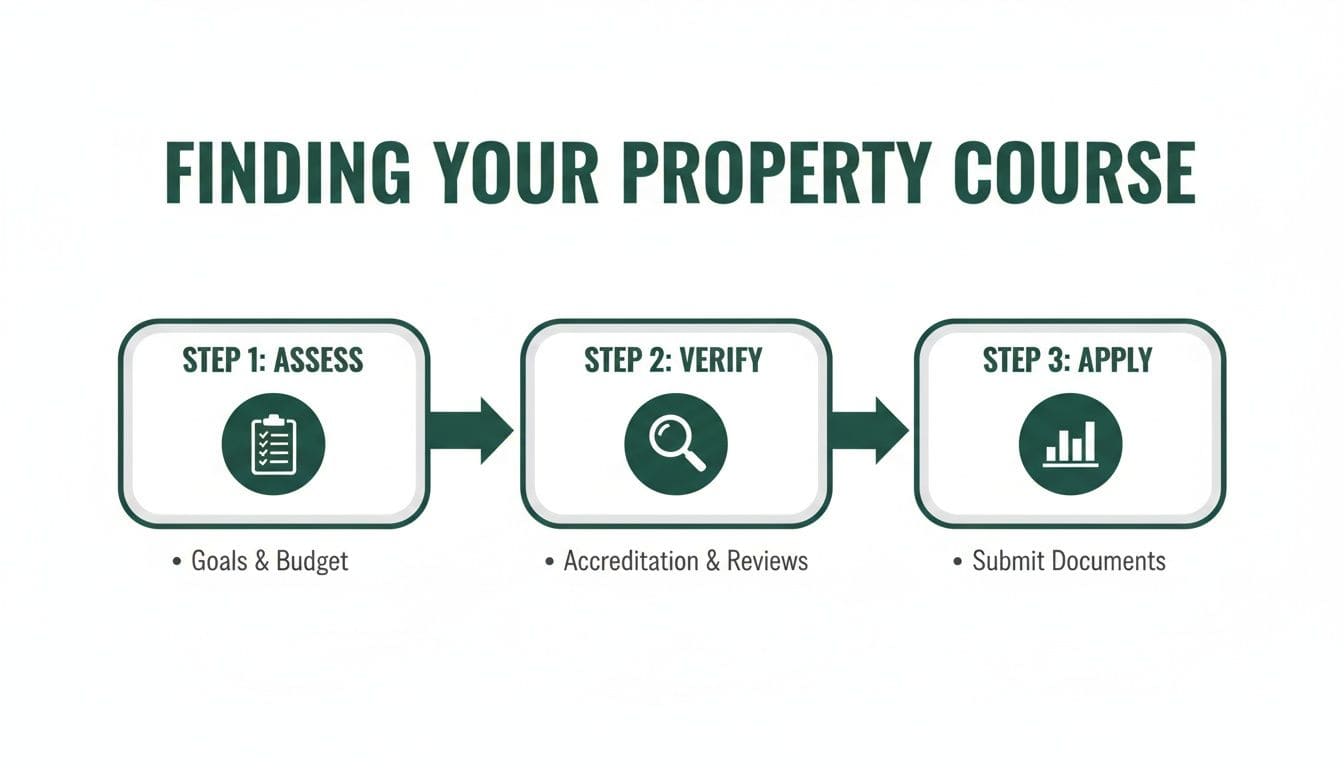
This process really hammers home the sequence that works: first, assess the curriculum for substance. Then, verify the credibility of the people teaching it. And finally, focus on how you'll actually apply what you learn. Each step is a filter, making sure you don't just enrol in a course, but the right course to accelerate your journey.
A common mistake is to pay for a course and then do nothing with the information. The true value is realised only when you apply the concepts to real-world deals, testing strategies and analysing numbers to build your confidence and your portfolio.
If you're just starting out, getting the fundamentals down first is crucial. You can get a head start with our guide on investing in property for beginners, which lays a solid foundation before you commit to spending any money. It'll help you ask smarter questions and properly gauge whether a course is a good fit for your goals.
What a Great Course Curriculum Must Include
A top-tier property investing course in the UK should feel like a detailed roadmap, not a high-level pep talk. Forget the motivational fluff; the best curriculums get straight into the practical, numbers-driven skills you'll actually need to build a portfolio in 2026.
Without that granular detail, you're just learning theory. A truly great course breaks down complex strategies into manageable, step-by-step processes you can apply to real-world opportunities you see on Rightmove tomorrow.

Core UK Investment Strategies Explained
The foundation of any worthwhile course is its deep dive into specific, proven investment strategies. Look for dedicated sections that don't just define these strategies but show you how to execute them from start to finish.
A solid curriculum will have modules on:
- Buy-to-Let (BTL): This needs to cover everything from identifying the right tenant demographic to understanding your legal obligations as a landlord under current UK law.
- House in Multiple Occupation (HMO): Look for specific training on Article 4 directions, local council HMO licensing requirements, and the unique financing hurdles that come with multi-let properties.
- Buy, Refurbish, Refinance, Rent (BRRRR): This module is pointless without detailed guidance on accurately costing refurbs, working with valuers, and the mechanics of refinancing to pull your initial investment back out.
For each strategy, the course must teach you the specific acquisition criteria, financing options, and legal duties involved. A generic overview is nowhere near enough to prepare you for the realities of each path.
The Non-Negotiable Skill: Deal Analysis
All the strategic knowledge in the world is useless if you can't accurately assess whether a deal is actually a deal. The single most important part of any property investing course is teaching you how to run the numbers with precision. This is where many courses fall flat, offering vague advice instead of hard formulas.
Your chosen course must teach you to calculate and interpret key UK metrics, not just generic global ones. This includes:
- Return on Investment (ROI): How to calculate it properly for different strategies, factoring in all costs.
- Gross and Net Yield: Understanding the crucial difference and why net yield is the only number that truly matters for your cash flow.
- Cash Flow: Projecting monthly and annual cash flow after accounting for mortgage payments, voids, maintenance, and management fees.
The ability to confidently analyse a deal is what separates successful investors from hopeful amateurs. Your course should equip you to dissect any potential investment, factoring in UK-specific costs like Stamp Duty Land Tax (SDLT), capital gains tax implications, and the impact of Section 24 mortgage interest relief restrictions.
To get a clearer picture of these crucial calculations, you might find it useful to check out our guide on how to calculate property yields in the UK. It'll give you a head start on what any good course should be teaching you in-depth.
From Sourcing to Completion: Practical Skills
Finally, a curriculum is incomplete without modules on the practical, day-to-day actions of an investor. Learning what to do is one thing; learning how to do it is what gets deals over the line.
A comprehensive course will give you actionable lessons on:
- Property Sourcing: Teaching you both on-market techniques (like setting up killer Rightmove alerts) and off-market strategies (such as direct-to-vendor marketing or building real relationships with agents).
- Negotiation Tactics: Providing actual frameworks and scripts for negotiating with estate agents and vendors to secure a better price or more favourable terms.
- Navigating the UK Legal Process: A step-by-step guide to the conveyancing process, explaining the roles of solicitors, mortgage brokers, and surveyors, and showing you how to keep a deal moving forward.
Without this practical foundation, even the best theoretical knowledge can leave you feeling stuck and unable to take that first step. A great curriculum builds not just knowledge, but the confidence to actually use it.
Vetting Your Instructors and Verifying Credibility
A slick curriculum is only half the story. The person delivering it is arguably more important, and their real-world experience is what you're paying for.
You need a credible instructor who is an active UK property investor right now, managing their own portfolio in the current market—not just a career speaker recycling anecdotes from a decade ago. Their value comes from fresh, on-the-ground experience, dealing with today's planning, financing, and tenant challenges.
Authenticity is everything. Look for an instructor who is open about their journey, including both the wins and the inevitable mistakes. Be very wary of trainers whose main marketing tool is a flashy lifestyle. Rented supercars and holiday villas don't teach you how to analyse a damp report or negotiate with an estate agent.
Substance must always come before style.

Looking Beyond the Sales Pitch
It's surprisingly easy to do your own due diligence on potential instructors. A few simple checks can reveal a lot about their actual experience and whether they are genuinely active in the property world. Don't just take their word for it—verify.
Start with these straightforward steps:
- Check Companies House: A quick search can confirm if they are directors of companies that hold property. This is tangible evidence of their business activities beyond just selling courses.
- Scan LinkedIn: Review their professional history. Does it show consistent, long-term involvement in the UK property sector, or did they only recently pivot to becoming a "guru"?
- Analyse Their Case Studies: Look for recent projects with real numbers. A credible expert will openly share purchase prices, refurbishment costs, final valuations, and rental income. They should also be willing to discuss what went wrong and the lessons learned.
This process helps you filter out polished marketers from genuine practitioners. A real investor's track record is built on completed projects, not just a well-managed social media presence.
Seeking Unbiased Social Proof
Testimonials on a course provider's website are carefully curated marketing assets. You should take them with a huge pinch of salt. To get a more balanced view, you need to find independent, third-party reviews.
Platforms like Trustpilot or Google Reviews can offer a more authentic perspective from past students. Look for recurring themes in the feedback, both positive and negative. Do reviewers consistently praise the practical, actionable content, or do they complain about a lack of depth and constant upselling?
A great tutor's primary mission is education, not sales. Their goal should be to empower you with the skills to succeed independently, not to lock you into an expensive mentorship sales funnel. If a "free" introductory event feels more like a high-pressure sales pitch, it's a massive red flag.
Verifying Industry Recognition
Another strong signal of credibility is recognition from established UK property organisations. While not a guarantee of quality, affiliations with respected bodies suggest a level of professionalism and adherence to industry standards.
Look for mentions of involvement with groups such as:
- The National Residential Landlords Association (NRLA)
- The Property Ombudsman
- Accredited property-related qualifications
This kind of external validation adds a layer of trust that self-proclaimed expertise simply cannot match. It shows they are engaged with the wider industry, not just operating in their own bubble.
This is especially important if you want to understand the nuances of being a professional landlord or property sourcer. If you want to dive deeper into what pros in the field need to deliver, our guide on UK property deal sourcing offers some valuable context.
Ultimately, the best instructors are those who focus on building your competence. They teach you frameworks, share their tools, and encourage critical thinking. A quality property investing course is one that makes you a better investor, not just another paying customer.
Understanding the UK Market Context for 2026
Any property course worth its salt has to be rooted in the reality of today's UK market. What worked five years ago might be a liability now, and learning theory in a vacuum is a surefire way to make expensive mistakes.
Put simply, a generic investment strategy doesn't work. You can't just apply a formula and expect it to deliver results everywhere, all the time. The best courses teach you how to read the landscape—regional quirks, national economic pressures, and what tenants actually want—and turn that insight into smart decisions for 2026.
Interpreting Key UK Economic Indicators
A good course won't just tell you that house prices are high. It will teach you why they're high and what that means for different investment strategies. This is the difference between making reactive, emotional choices and smart, forward-looking ones.
An actionable insight for 2026 is understanding the interplay between inflation, interest rates, and rental demand. For example, while the Bank of England's base rate may have stabilised, the impact of previous hikes continues to affect mortgage affordability. A quality course will teach you how to stress-test your deals against potential rate changes, ensuring your investments remain profitable even in a fluctuating economic climate.
Look for courses that incorporate up-to-date analysis of data from sources like the Office for National Statistics (ONS) and major mortgage lenders. For instance, understanding that rental prices in major UK cities have increased by an average of 8-10% year-on-year provides crucial context for your cash flow projections.
Understanding why prices hit record highs while affordability remains a key national concern is the kind of insight that separates successful investors from the rest. It helps you pivot your strategy towards what works now, not what worked in the past.
Adapting Strategies to Current Market Conditions
The UK property market isn't one single entity. A strategy that crushes it in Manchester could be a total flop in Bristol. What was profitable in 2022 might bleed cash in 2026. This is why a relevant property investing course absolutely must show you how today's conditions shape which strategies are most resilient.
With affordability for standard buy-to-lets so stretched, for example, other approaches have come to the forefront:
- HMOs (Houses in Multiple Occupation): These can generate much higher yields by renting out individual rooms, a model that thrives when young professionals and students can't afford a whole flat.
- Serviced Accommodation: This strategy taps into the short-term let market. It can be incredibly lucrative in tourist areas or places with lots of contractors, completely bypassing the long-term rental affordability squeeze.
- BRRRR (Buy, Refurbish, Refinance, Rent): This is all about "forcing" appreciation through renovation, creating your own value instead of just waiting for the market to grow organically.
A course that doesn't provide this kind of strategic context is basically selling you an out-of-date map. The curriculum has to link these strategies directly to the current economic climate, spelling out the pros and cons against a backdrop of rising interest rates, shifting rental demand, and regional development. If you're looking for pointers on where these strategies might work best, our article on the best areas for buy-to-let in the UK is a great place to start your research.
Ultimately, your education should make you agile. The goal isn't to learn one "perfect" strategy. It's to build a whole toolbox of them and develop the analytical skill to know which tool to use for which job, in any given market.
Putting Your Learning into Practice
The whole point of a property investing course is to get you from theory to profitable action. It's about building the confidence and competence to actually do deals.
But here's the uncomfortable truth: the biggest hurdle for most new investors is the jump from the classroom to the messy reality of a live deal. This is where people get stuck, completely paralysed by the fear of making a costly mistake.
Closing this gap between theory and reality is where modern tools are no longer a nice-to-have, but an absolute necessity. Once a course teaches you the principles behind calculating Return on Investment (ROI) or how a BRRRR deal should stack up, the next step is to practise. Relentlessly. You need to run the numbers on dozens of properties to build a genuine instinct for what a good deal actually looks like.
Bridging Theory and Real-World Application
In the old days, applying your newfound knowledge meant wrestling with complicated, error-prone spreadsheets. You'd spend hours manually typing in data from a Rightmove listing, trying to remember every single potential cost, from Stamp Duty Land Tax (SDLT) to void periods. It's a slow, clunky process that kills momentum right when you need it most.
A much smarter approach is to use technology built for this exact job. For example, instead of fighting with formulas, you can grab a property listing URL and drop it straight into an app like DealSheet AI. Within seconds, you have a complete financial analysis based on the specific strategy you want to model, whether that's a vanilla Buy-to-Let or a more complex HMO conversion.
This instant application of your learning is a game-changer for a few key reasons:
- It builds muscle memory. You can analyse ten potential deals in the time it would take to build one spreadsheet. This repetition rapidly hones your ability to spot opportunities and red flags.
- It lets you experiment. What happens if you get a £10k discount? What if your refurb budget is 20% higher? What if mortgage rates jump by 1%? You can instantly see how changing any variable affects your cash flow and ROI, which is crucial for developing sharp negotiation strategies.
- It grounds your knowledge in reality. Theory is clean; real deals are not. Applying what you've learned to live listings forces you to confront the actual numbers and costs in your target area.
From Learning Concepts to Executing Deals
A great course won't just teach you the 'why' behind the numbers; it will actively push you to use efficient tools to verify them. The instructor's job is to give you the strategic framework—the understanding of risk, financing, and legal obligations. Your job is to take that framework and analyse properties quickly and accurately.
Think about this real-world scenario. Your course has just covered the BRRRR (Buy, Refurbish, Refinance, Rent) strategy. You now understand the theory of creating value and recycling your capital. The very next day, you spot a tired-looking two-bed terrace on Zoopla that looks perfect.
Instead of getting bogged down in calculations, you can use a tool to:
- Instantly model the deal: Plug in the asking price and your estimated refurb costs.
- Project the post-works valuation: Test different Gross Development Value (GDV) figures to see what's realistic.
- Analyse the refinance: See exactly how much of your initial capital you can pull back out based on a 75% loan-to-value mortgage.
- Check the final numbers: Confirm the property will still cash flow positively as a rental once you've refinanced.
This process moves you from being a passive student to an active investor. It's the practical, hands-on application that cements the lessons from your property investing course and gives you the confidence to actually make an offer.
This is how you truly build momentum and start the journey of growing your assets. To see how these individual deals fit into a wider strategy, check out our guide on how to build a property portfolio in the UK. The key is to start with a solid foundation of knowledge and then immediately put it to work with tools that speed up your decision-making.
Red Flags and Common Pitfalls to Avoid
Navigating the world of property education means learning to spot the warning signs that separate a genuinely valuable property investing course from a very expensive mistake. Getting good at identifying these red flags early will protect your time, your money, and your motivation to build a proper portfolio here in the UK.
The most obvious red flag? Any promise of getting rich quickly. Property investment is a business built on diligence, patience, and calculated risk—it's not a lottery ticket. If a course is promising overnight wealth or "guaranteed" success, you should walk away. It's fundamentally misleading.

High-Pressure Tactics and a Lack of Transparency
One of the most common pitfalls happens at those free "taster" events, whether they're online or in a hotel conference room. You need to be deeply sceptical of high-pressure sales tactics designed to create a sense of urgency. Massive, "one-time-only" discounts that expire the second the webinar ends are a classic manipulation technique, not a sign you're getting a good deal.
Another huge red flag is a total lack of transparency. If the provider is cagey about their curriculum, the actual, verifiable experience of their instructors, or the total costs involved (including the inevitable upsells), your alarm bells should be ringing. Any educator worth their salt will be proud to share these details.
Keep an eye out for these specific warning signs:
- Vague Instructor Credentials: They talk a big game about being "successful" but offer zero verifiable proof of their current UK portfolio or any recent projects.
- A Fluffy Curriculum: The course outline is packed with buzzwords like "mindset" and "secrets" but is suspiciously light on concrete modules covering deal analysis, financing, or UK tax law.
- Hidden Costs: The initial course fee is just the hook. Once you're in, there's constant pressure to upgrade to eye-wateringly expensive "elite" mentorship programmes.
A course that focuses more on mindset coaching than on practical, actionable skills is a major red flag. A positive attitude is great, but it won't teach you how to analyse a deal, navigate the complexities of Section 24, or calculate your actual Return on Investment.
Overhyped Strategies and Misleading Claims
Finally, be incredibly wary of courses built around "no money down" or other "creative financing" strategies, especially when they're sold as simple, risk-free solutions for beginners. While these techniques do exist, they are highly complex, carry significant risks, and are almost never suitable for someone just starting out.
These strategies often demand a deep understanding of property law, razor-sharp negotiation skills, and a ready-made network of specialist brokers and solicitors. Pitching them as an easy entry point to the market is just irresponsible.
A quality property investing course will ground you in the fundamentals first. They'll teach you how to save a deposit, how to secure a mortgage, and how to analyse deals with your own capital before you even think about touching advanced, high-risk manoeuvres. The goal should be to build a sustainable, long-term portfolio, not to chase risky shortcuts that can easily lead to financial disaster.
Got Questions About Property Investing Courses?
Even after you've done your homework, it's completely normal to have a few final questions rattling around before you commit your time and money. Here are some of the most common ones I hear from investors, answered plainly to help you make a confident final call.
How Much Should I Expect to Pay for a UK Course?
You'll see a massive range, from free YouTube videos to intensive mentorships costing thousands. For a solid, comprehensive property investing course in the UK, you're typically looking at something in the £500 to £2,500 bracket.
It's easy to get fixated on the price tag, but the real question is about value. The whole point of a course is to get a clear return on your investment, which you'll see in the profitable deals it gives you the skills and confidence to complete.
Are Online Courses as Good as In-Person Ones?
Honestly, both have their place. Online courses offer brilliant flexibility, letting you fit learning around your job and family life, and they're often more affordable. On the other hand, nothing beats an in-person event for networking and direct, face-to-face time with instructors.
The "best" option really comes down to how you learn. A well-structured online programme with live Q&A sessions, practical assignments, and an active community forum can be just as powerful as its in-person cousin.
A classic mistake is thinking a higher price automatically means better quality. Judge a course on how relevant its curriculum is to today's UK market, the instructor's real-world track record, and the practical skills it teaches—not just the cost.
Do I Really Need a Course to Get Started?
Look, it's not strictly mandatory. But enrolling in a good property investing course massively shortens your learning curve. More importantly, it helps you sidestep the kind of expensive beginner mistakes that can set you back thousands before you've even got going.
The alternative is learning by trial and error, which is often a far more expensive education than any formal training. A structured course gives you a proven framework for tricky areas like UK tax, financing, and accurate deal analysis, giving you the confidence to act decisively when a good opportunity comes along.
Ready to turn what you've learned into action? Download the DealSheet AI app and start analysing real UK property deals in seconds. It's the perfect way to practise your new skills. Get started with a free trial on the App Store.