
A Guide to a Watertight Rent to Rent Contract UK in 2026
A Guide to a Watertight Rent to Rent Contract UK in 2026
A watertight rent to rent contract UK is the legal bedrock of a successful property cash flow business, allowing you to generate income without needing a mortgage. This agreement is a commercial lease between you (the operator) and a property owner, giving you the right to rent out their property to tenants and profit from the difference. This guide outlines the critical components of a secure contract, from due diligence to legal compliance for 2026. The key is to structure a deal where your rental income significantly exceeds the guaranteed rent you pay the landlord. Before signing, savvy investors use tools like the DealSheet AI app to model profit, voids, and costs with real data. Download DealSheet AI from the App Store and start your free trial today.
This guide will walk you through the essential components of a secure rent to rent contract UK, from doing your homework upfront to staying legally compliant.
Understanding the Rent to Rent Model
A rent to rent agreement, often marketed to landlords as a 'guaranteed rent' deal, essentially positions you as a professional tenant or property manager. You sign a commercial lease with the property owner, guaranteeing them a fixed monthly rental income for a set period, usually three to five years.
In exchange, you gain the right to manage and sublet the property. The difference between the rent you collect and the rent you pay the owner is your profit. Simple in theory, but the devil is in the details.
This model is a fantastic way to create high-cashflow assets, like turning a standard single-let property into a House in Multiple Occupation (HMO) or serviced accommodation units. The landlord gets what they want: hands-off, consistent income without the daily grind of tenant management, chasing rent, or dealing with minor maintenance. You, the operator, get to build a property business with far less capital than a traditional purchase.
The Core Principle: Profit from the Spread
The entire business lives or dies on the "spread"—that margin between your rental income and all your expenses.
Let's say you agree to pay a landlord a guaranteed £1,200 per month for a three-bedroom house. After a light cosmetic upgrade, you might rent out each room for £600, bringing in a total income of £1,800.
After paying the landlord their £1,200 and covering your operational costs (utilities, council tax, maintenance), what's left over is your net profit. Success here is all about maximising occupancy and keeping a tight grip on costs. If you're new to this world, it's worth getting your head around the fundamentals first; you can find helpful tips in our guide on investing in property for beginners.
A successful rent to rent strategy isn't just about finding a property. It's about securing a watertight contract that gives you the control and permissions needed to operate legally and profitably. It transforms you from a simple tenant into a business operator.
It's crucial to understand that the legal document underpinning this whole arrangement is not a standard Assured Shorthold Tenancy (AST). It has to be a bespoke commercial lease or a management agreement. This document must explicitly grant you the right to sublet the property and clearly define its permitted use, such as an HMO.
Without that crucial subletting clause, your entire operation would be unlawful. You'd be exposed to severe legal and financial fallout. Getting this contract right is, without a doubt, the single most critical step in your rent to rent journey.
Here's a quick rundown of what a solid agreement should cover.
Key Components of a UK Rent to Rent Agreement
This table provides a high-level overview of the essential parts of a rent to rent contract and why each one matters.
| Component | Purpose | Critical Consideration |
|---|---|---|
| Parties & Property | Clearly identifies the landlord, the operator (you), and the specific property. | Ensure names and addresses are 100% correct as they appear on the Land Registry title. |
| Term (Duration) | Defines the length of the agreement, typically 3-5 years. | Is the term long enough for you to recoup your setup costs and turn a reliable profit? |
| Guaranteed Rent | Specifies the fixed monthly rent you will pay the landlord. | This amount must be realistic and sustainable, even with potential voids. |
| Permitted Use | States exactly how the property can be used (e.g., as an HMO or serviced accommodation). | This clause is non-negotiable. Without it, your business model is legally invalid. |
| Right to Sublet | Explicitly gives you permission to rent out the property to other tenants. | This is the most crucial clause. Ambiguity here is a deal-breaker. |
| Repairs & Maintenance | Outlines who is responsible for what – typically you handle minor day-to-day repairs. | Clearly define the financial threshold for "minor" vs "major" repairs to avoid disputes. |
| Compliance | Confirms who is responsible for legal duties (e.g., gas safety, EICR, licensing). | As the operator, you will likely take on most of these responsibilities. Be clear on this. |
| Break Clause | Allows either party to terminate the contract early under specific conditions. | A landlord's break clause is a significant risk. Understand the triggers and notice periods. |
Getting these components right from the outset protects both you and the landlord. It turns a verbal understanding into a professional, legally binding business arrangement, which is exactly what you need to build a sustainable portfolio.
Essential Due Diligence Before You Sign
Jumping into a rent to rent contract UK without doing your homework is a classic rookie mistake, and it's a surefire way to lose money. Before you even think about putting pen to paper, a deep-dive due diligence process is absolutely non-negotiable. This isn't just about ticking off a list; it's about making sure your entire business is built on solid, legal ground.
First things first: you have to confirm you're actually dealing with the legal owner of the property. For a small fee, you can get an official copy of the title register from HM Land Registry. This is the ultimate proof of ownership and, just as importantly, it will show you if there's a mortgage on the property.
Verifying Permissions and Consents
Now, finding a mortgage registered against the property doesn't have to be a deal-breaker, but it does add a massive, unskippable step to your checklist. If there's a mortgage, you must see written proof that the lender has given their 'consent to let'.
Don't just take the landlord's word for it. If you do, you're risking everything. Lenders can recall the mortgage if they discover an unauthorised commercial subletting arrangement. This forces the owner to sell up, and just like that, your business collapses overnight.
The landlord's insurance policy is equally critical. A standard buy-to-let policy almost never covers a commercial rent-to-rent deal, especially if you're planning to run it as an HMO or serviced accommodation. You need to see the actual insurance documents to make sure the policy explicitly allows the kind of subletting you'll be doing. If it doesn't, the property is uninsured, leaving both you and the owner dangerously exposed.
Never, ever take a landlord's word that they have the right permissions. Always insist on seeing the physical documents—the lender's letter of consent and the full insurance policy schedule. This one simple step is what separates the pros from the amateurs who get burned.
Navigating Local Council Regulations
Once you've cleared things with the owner, your next stop is the local council's website. You need to investigate the local rules, which can make or break your entire business model.
Many areas across the UK now have Article 4 directions in place. These are specific planning rules that restrict or remove permitted development rights, often to control the creation of new Houses in Multiple Occupation (HMOs). If your target property is in an Article 4 area, you might not be able to get the HMO licence you need.
On top of that, more and more councils are bringing in selective licensing schemes. This means all private rented properties in a certain area need a licence, even if they aren't HMOs. It's another layer of compliance and cost you have to build into your numbers from day one. You can find out about both Article 4 and selective licensing by searching on the local council's website.
If you really want to get your deal analysis right, our guide on how to evaluate HMOs and serviced accommodation dives much deeper into the numbers.
This flowchart really brings home the core financial decision you have to make during your due diligence before you commit to anything.
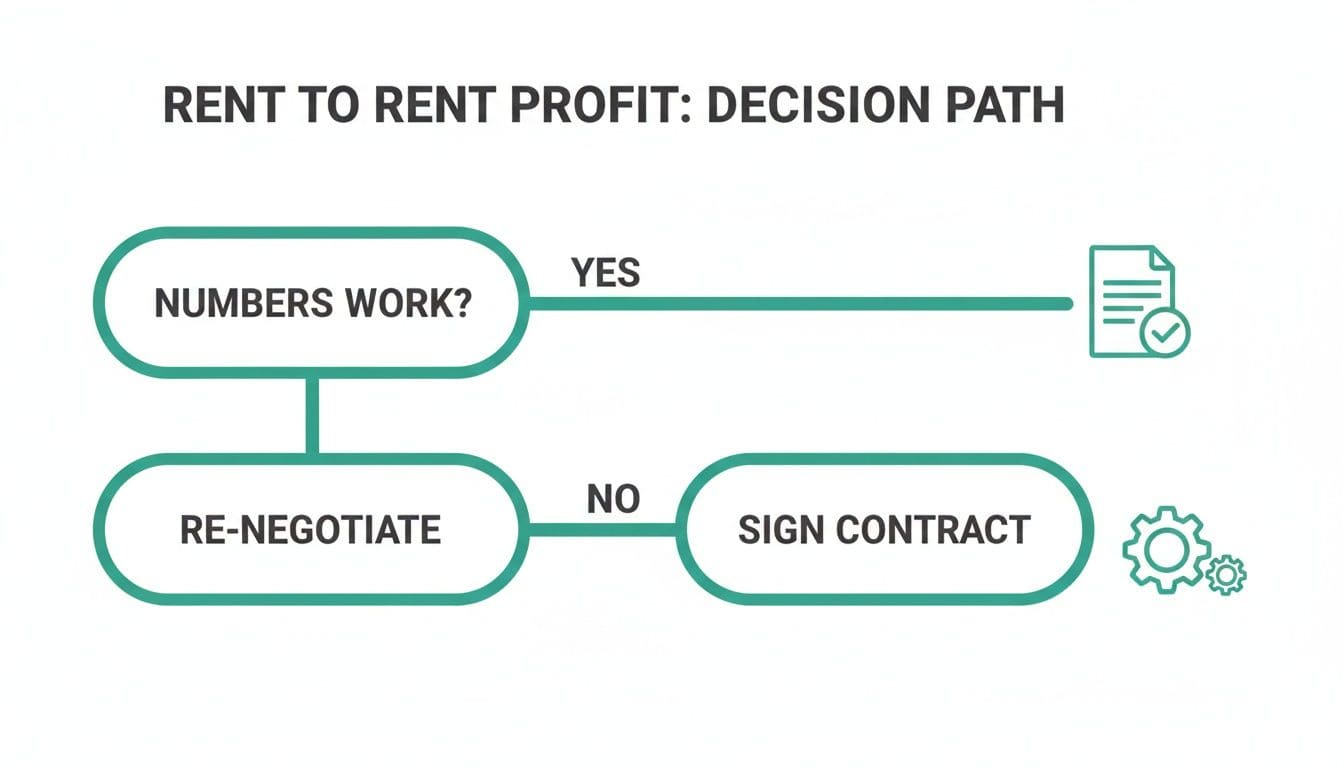
The message is simple: if the numbers don't stack up after you've factored in all the real-world costs and regulations, you have two choices. You either renegotiate the terms, or you walk away.
Crafting the Core Clauses of Your Contract
This is where your rent-to-rent deal is truly made or broken. The quality and clarity of your contract clauses will determine the success and security of your entire operation. A robust rent-to-rent contract UK protects you, reassures the landlord, and provides a clear framework to fall back on when things get messy. Let's break down the absolutely non-negotiable clauses you have to get right.

Defining the Term of the Agreement
The 'Term' clause simply states how long your agreement with the property owner will last. This is a critical factor for your profitability. A short term, like 12 months, is almost never viable for a rent-to-rent operator. You need enough time to recoup your initial outlay on furniture, any light refurbishments, and marketing.
For this reason, a term of three to five years is pretty much the industry standard. This longer period gives you the runway to establish consistent cash flow, build a buffer for void periods, and ultimately see a healthy return. A five-year term provides the most security and profit potential, while a three-year term is often a realistic starting point when negotiating with a slightly hesitant landlord.
The All-Important Permitted Use Clause
This clause is the legal heart of your rent-to-rent business. It has to explicitly state exactly how you are allowed to use the property. Vague language is your absolute enemy here; the clause needs to be crystal clear.
If your strategy is a House in Multiple Occupation (HMO), the contract must specifically grant you permission to operate it as one.
Example Wording:
"The Tenant [Your Company Name] is permitted to use the Property for the purpose of subletting individual rooms on separate tenancy agreements, operating the Property as a House in Multiple Occupation (HMO) in compliance with all relevant local and national regulations."
For a serviced accommodation model, the wording would be different, focusing on granting rights for short-term lets. Without this explicit permission, you would be in immediate breach of contract, and the landlord could terminate the agreement on the spot. If you are structuring a deal around a complex property, it might be worth reviewing our article on structuring complex deals for more advanced insights.
Repairs and Maintenance Responsibilities
Arguments over repairs are one of the most common friction points in the rental sector, so your contract must eliminate any and all ambiguity. A well-drafted clause clearly separates your responsibilities from the landlord's.
As the operator, you will typically be responsible for:
- Day-to-day minor repairs: This covers the small stuff, like changing light bulbs, unblocking sinks, and managing cosmetic fixes reported by your tenants.
- Tenant-caused damage: You are on the hook for repairing any damage caused by the tenants you place in the property.
The property owner, on the other hand, nearly always retains responsibility for the big-ticket items:
- Structural integrity: Think roof, foundations, external walls, and windows.
- Major systems: The boiler, central heating, and electrical wiring are squarely the owner's problem.
A great contract will often set a financial threshold. For example, it might state that the operator is responsible for all repairs up to £100, with anything costing more falling to the landlord. This simple addition prevents countless future arguments.
Subletting Rights and HMO Compliance
While the 'Permitted Use' clause defines the business model, a separate 'Right to Sublet' clause provides the explicit legal authority to actually do it. This clause confirms the property owner authorises you to create tenancies with your own sub-tenants. It is the legal mechanism that allows your business to exist.
This is also where HMO licensing comes into play. If the property needs an HMO licence to be operated legally, the contract must state who is responsible for getting and maintaining it. In almost every single case, this responsibility will fall to you, the operator.
The government's guidance on HMOs is a crucial resource for understanding what you're signing up for.

This official page outlines the basic criteria for what constitutes an HMO. This is your starting point for figuring out if a licence is needed from your local council. Understanding these rules isn't optional; it's a fundamental part of your compliance duties.
Negotiating Fair Break Clauses
A break clause allows either you or the landlord to terminate the agreement early, provided certain conditions are met and notice is given. While this offers flexibility, it also introduces risk—especially for you as the operator.
A landlord-activated break clause can be incredibly dangerous. Imagine investing thousands setting up a property, only for the owner to terminate the contract after 12 months, leaving you completely out of pocket. You should always try to negotiate against a landlord break clause. If you can't, at the very least, ensure it cannot be activated within the first 24 to 36 months of the term.
Your own break clause, however, is a valuable safety net. It could allow you to exit the deal if local regulations change unexpectedly and make the business model unprofitable. A typical operator's break clause might be exercisable after 12 or 18 months, with a notice period of three to six months.
Staying Compliant: Your Legal Duties in a Rent-to-Rent Business
Getting compliance wrong will sink your rent-to-rent business faster than anything. You can have the most watertight rent to rent contract UK in the world, but it's worthless if you're not meeting your legal obligations as the property operator.
This is your no-nonsense guide to staying on the right side of the law in 2026. The penalties for getting this wrong are severe – we're talking unlimited fines and even criminal prosecution.
Your responsibilities kick in the second you take control of the property. For most rent-to-rent operators, especially those running an HMO model, that starts with one crucial thing: licensing.
Getting to Grips with HMO Licensing
A House in Multiple Occupation (HMO) is simply a property rented out by at least three people who aren't from one 'household' (like a family) but share a kitchen or bathroom. The rules can get a bit fiddly and often vary between councils in England, Scotland, Wales, and Northern Ireland, but the core principles are the same everywhere.
Mandatory Licensing is the big one. It applies across England to any HMO with five or more tenants who make up more than one household.
But here's where people get caught out. Many local councils have brought in Additional Licensing schemes. These can drag properties with as few as three tenants into the licensing net. You absolutely must check the specific rules for the local council where your property is. No excuses.
Getting an HMO licence isn't just about filling in a form. The council will be looking closely at two things: are you a 'fit and proper person' to be a landlord, and does the property meet their standards? They'll be checking:
- Room sizes: There are legally mandated minimum sizes for bedrooms.
- Amenities: You need enough cookers, bathrooms, and bins for the number of people living there.
- Fire safety: This is a massive focus. Think mains-powered smoke alarms, proper fire doors, and clear escape routes.
Operating without a required licence is a criminal offence. The fines aren't just a slap on the wrist; they are genuinely business-ending.
The Safety Regs You Absolutely Cannot Ignore
Beyond licensing, every single rented property in the UK is covered by strict safety laws. As the rent-to-rent operator, you step into the landlord's shoes and take on their legal duty to keep your tenants safe. These are non-negotiable.
Here are your key responsibilities:
- Gas Safety (CP12): Every year, a Gas Safe registered engineer must check all gas appliances and flues. You have to give a copy of that certificate to your tenants within 28 days of the check.
- Electrical Safety (EICR): You need a qualified electrician to carry out an Electrical Installation Condition Report at least every five years. This report confirms the property's wiring and electrical systems are safe, and a copy must go to your tenants.
- Fire Safety: At a minimum, this means fitting smoke alarms on every floor and carbon monoxide alarms in any room with something like a wood-burning stove. For HMOs, the requirements are way stricter, often demanding heat detectors in kitchens and fire extinguishers.
The most successful rent-to-rent operators I know treat compliance like a core business function, not a box-ticking exercise. They schedule these checks into their calendars a year in advance and keep meticulous records. It protects their tenants, their business, and their reputation.
The market dynamics we're seeing in 2026 really highlight why this operational control is so vital. UK rent-to-rent statistics show gross yields are averaging around 5%, but the net profit on subletting contracts is getting squeezed by rising costs. This is exactly the kind of scenario where DealSheet AI users can stress-test their HMO or auction strategies, especially with rent hikes forecast at 2-4%. Early 2026 data puts the average rent-to-price ratio at 0.42% per month, and properties are letting in just 17 days, showing demand is still strong. For more on this, you can explore the latest 2026 UK rent predictions.
Protecting Tenant Deposits: It's Not Your Money
Finally, you have a cast-iron legal duty to protect your sub-tenants' deposits. It's their money, not yours.
Any deposit you take for an Assured Shorthold Tenancy (AST) in England and Wales has to be placed in one of the three government-approved tenancy deposit schemes:
- Tenancy Deposit Scheme
- Deposit Protection Service
- MyDeposits
You have to do this within 30 days of receiving the cash, and you must also give the tenant the legally required paperwork, known as 'Prescribed Information'.
Fail to do this, and the consequences are painful. You lose your right to use a Section 21 notice to evict a tenant, and they can sue you for compensation of up to three times the deposit amount. It's an expensive and easily avoidable mistake.
For a deeper dive into other property-related financial obligations, you might find our guide on what Stamp Duty Land Tax is useful.
How to Model Profit and Mitigate Financial Risks
Profit in a rent-to-rent deal is all about the margins, and believe me, they can be far thinner than you might think at first glance. To make a rent-to-rent contract UK work, you have to move beyond simple sums and forecast your true, long-term profitability with ruthless accuracy.

Budgeting Beyond the Basics
Your financial model has to account for every single potential cost. It's easy to get excited about the spread between your guaranteed rent to the landlord and the potential income from tenants, but the real costs are lurking in between.
You need to budget meticulously for these non-negotiables:
- Void Periods: An empty room generates zero income but still costs you money. Even in a hot market, you should budget for at least one month's void per room, per year. Anything less is just wishful thinking.
- Utility Bills: Don't just guess. Ask the landlord for previous bills for gas, electricity, and water to get a feel for the property's real usage patterns.
- Council Tax: If you're setting up an HMO, the council tax liability falls on you. This needs to be factored in as a fixed monthly cost.
- Maintenance & Repairs: A solid rule of thumb is to set aside 5-10% of your gross rental income for ongoing maintenance. This covers everything from minor fixes to replacing worn-out furniture down the line.
- Compliance Fees: Budget for the annual gas safety checks, the five-yearly electrical reports (EICRs), and the cost of any required HMO or selective licences. These are not optional extras.
The UK rental market in early 2026 is seeing operational costs squeeze margins like never before. While the average advertised rent outside London climbed just 2.2% year-on-year in Q4 2025, the costs are escalating much faster. You're looking at HMO licensing fees averaging £800-£1,500 per property, mandatory fire door upgrades costing £300-£500 a pop, and potential council tax rebanding that can add another £200-£500 a year. Utilities have jumped 15-20% since 2024, while void periods—now averaging 17 days—chip away at your cash flow. You can explore more insights on 2026 UK rental market trends to see the full picture.
Leveraging the Landlord's Position
Understanding the landlord's financial situation can give you a massive negotiating advantage. Since 2020, the government's Section 24 tax changes have been fully phased in. In short, this means private landlords can no longer deduct their mortgage interest costs from their rental income before calculating their tax bill.
This has pushed many higher-rate taxpayer landlords into a loss-making position. Your offer of a fixed, guaranteed rent—which is a fully tax-deductible expense for their business—can be incredibly attractive. It gives them predictable income and massively simplifies their tax affairs, often making them much more open to your proposal.
Practical Risk Mitigation Strategies
A robust financial model is only half the battle; you also need a concrete plan to mitigate the risks you identify. This is where smart negotiation and sensible financial planning come into play.
Here are a few practical strategies I've seen work time and again to de-risk a deal:
- Negotiate a Rent-Free Period: Always ask the landlord for a one or two-month rent-free period at the start of your contract. This gives you crucial breathing room to carry out any light refurbishment, furnish the property, and get your first tenants in before you have to start paying out.
- Build a Contingency Fund: Never, ever start a rent-to-rent business without a cash buffer. Aim to have at least three to six months' worth of the guaranteed rent and operating costs set aside in a separate account. This fund will be your saviour when you face an unexpected major repair (like a boiler failure) or extended void periods.
- Stress-Test Your Deal: Before you sign anything, run your numbers through some worst-case scenarios. What happens to your profit if two rooms are empty for three months? What if energy bills jump by another 20%? Seeing how your cash flow holds up under pressure is absolutely vital. For those looking to refine their financial models, our article on using a rent-to-value calculator provides some extra metrics that can really help.
The real test of a good rent-to-rent deal isn't how much it makes when everything goes right; it's whether it can survive when things go wrong. A detailed, stress-tested financial forecast is your best insurance policy against failure.
Common Questions About Rent to Rent Contracts
When you're getting into rent to rent, a few questions pop up time and time again. Even with a solid grasp of the basics, the legal side of things can throw some curveballs. Let's tackle some of the most common sticking points investors have with the rent to rent contract UK model, so you can move forward with confidence.
Is a Rent to Rent Contract the Same as a Management Agreement?
No, and confusing the two is a fundamental mistake. They are completely different legal beasts.
A management agreement makes you an agent. You're working for the landlord, taking a fee (usually a percentage of the rent) to handle the tenants. Crucially, the tenancy agreements are between the landlord and the tenants. You're just the middleman.
In a rent to rent deal, you become the landlord's tenant. You sign a commercial lease with the owner, and then you create separate tenancy agreements with your own sub-tenants, making you their direct landlord. You get the control and the profit, but you also take on all the risk.
What Happens if a Sub-Tenant Damages the Property?
In short, it's your problem. Your agreement with the property owner makes you responsible for returning the property in its original state, minus fair wear and tear. If one of your tenants knocks a hole in the wall, the owner will be coming after you for the cost of the repair, not the tenant.
This is exactly why a rock-solid tenant vetting process and taking a proper security deposit are non-negotiable. You can use the tenant's deposit to cover the damage, but if the cost of repairs is more than the deposit, that shortfall comes straight out of your pocket.
Can I Use a Standard AST for a Rent to Rent Agreement?
Absolutely not. Do not do this. It's a critical legal error that could kill your business before it even starts.
An Assured Shorthold Tenancy (AST) is designed for a person living in a property as their main home. It gives them residential rights; it does not give them the right to run a business from the property or to sublet it to other people.
You must have a bespoke commercial lease or a purpose-built rent to rent agreement. This contract needs explicit clauses that grant you the right to sublet and clearly define the 'permitted use' of the property (e.g., as a House in Multiple Occupation). Using an AST would put you in immediate breach of contract and open you up to serious legal action from the owner.
How Does the Upcoming Renters' Rights Act Affect My Business in 2026?
The Renters (Reform) Bill, which will significantly change tenancy law in the UK, is a major factor for any property business operating in 2026 and beyond.
The biggest change is the end of fixed-term tenancies. All new tenancies will become rolling periodic contracts from day one, and 'no-fault' Section 21 evictions are being scrapped. Landlords will have to provide a valid reason from a prescribed list to regain possession.
For rent to rent operators, this means it will become much harder—and potentially take much longer—to evict a problematic tenant. This increases your risk of long void periods and expensive legal fights, which can decimate your profits. If you're running HMO or serviced accommodation models that rely on efficient tenant turnover, this is something you need to plan for carefully.
Any deal you analyse that will run into 2026 must have this increased risk baked into your numbers. Your tenant selection process will need to be more rigorous than ever before.
Ready to analyse your next rent to rent deal with speed and accuracy? The DealSheet AI app helps UK property investors evaluate opportunities in seconds. Stop wasting time with spreadsheets and start making data-driven decisions with confidence. Download DealSheet AI from the App Store and start your free trial today.