
Mastering GDV in Property: A UK Investor's Guide for 2026
Mastering GDV in Property: A UK Investor's Guide for 2026
Gross Development Value, or GDV in property, is the estimated final sales value of a completed development project. In simple terms, it's the total revenue you expect to generate once all building or refurbishment work is finished and the property is sold. Understanding GDV is the cornerstone of any successful property development in the UK, as it determines a project's potential profit and is the key metric used by lenders to approve finance. For actionable insights and rapid deal analysis, modern investors use tools like the DealSheet AI app to calculate GDV and analyse deals with speed and precision.
It's the north star for your entire deal. From figuring out what you can afford to pay for a piece of land to convincing a lender to back you, every major financial decision hinges on this one forecast. For anyone flipping houses, building new homes, or converting commercial property in the UK, getting your head around GDV isn't just a good idea—it's non-negotiable.
What GDV Means for Your Property Deals

At its heart, Gross Development Value is a well-informed prediction. It answers the simple but critical question: "What will this be worth when I'm finished?" This isn't just a hopeful guess; it's an evidence-based estimate of the property's future market value, and it forms the foundation of your project's entire financial plan.
This forecast is vital for a couple of key reasons. For you as the developer, it sets the absolute ceiling on your potential revenue. By taking the GDV and subtracting all your costs—the purchase, construction, professional fees, and finance—you arrive at your potential profit. This simple bit of maths is what tells you whether a deal is even worth picking up.
The Role of GDV in Decision Making
Lenders and investors will scrutinise your GDV calculation more than almost anything else. A well-researched, credible GDV shows them you've done your homework and you properly understand the local UK market. It gives them the confidence to put their money into your project because the loan they offer will almost always be a percentage of this final value.
A robust GDV isn't just a number; it's a story about a project's potential. It tells lenders you've identified a clear path from an under-utilised asset to a profitable sale, backed by solid market evidence.
To help you get a clear picture of what goes into a solid GDV calculation, here's a quick summary of the key components.
GDV at a Glance: Key Components
| Component | Description | Why It Matters for Investors |
|---|---|---|
| Local Market Comparables | Recently sold prices for similar, finished properties in the immediate area. | This is your reality check. It grounds your forecast in what real buyers are actually paying right now. |
| Property Specifications | The quality of your finishes, fixtures, and overall design compared to competitors. | A higher-spec finish can justify a premium price, but it also increases costs. This component balances ambition with market reality. |
| Market Trends | The anticipated direction of local property prices over your project's timeline. | A project finishing in 2026 faces different market conditions than one today. Factoring in trends shows you're thinking ahead. |
Building a credible GDV means digging into these areas to create a forecast that stands up to scrutiny. A strong grasp of GDV in property allows you to work backwards, confidently figuring out the maximum price you can afford to pay for a site while still hitting your profit targets.
If you're new to the world of property investing and want to get a better handle on the fundamentals, our guide on investing in property for beginners is a great place to start.
Calculating GDV with Real UK Examples
Right, let's move from theory to practice. Nailing your Gross Development Value (GDV) is where the rubber meets the road, and your forecast is only as strong as the evidence you can find to back it up.
Let's walk through two very different, real-world UK scenarios to see how you build a GDV that's robust enough to take to a lender.
This is the basic flow: you take a raw asset (the property), run it through a rigorous analysis, and the result is your potential profit. GDV is the number that bridges the gap between the two.
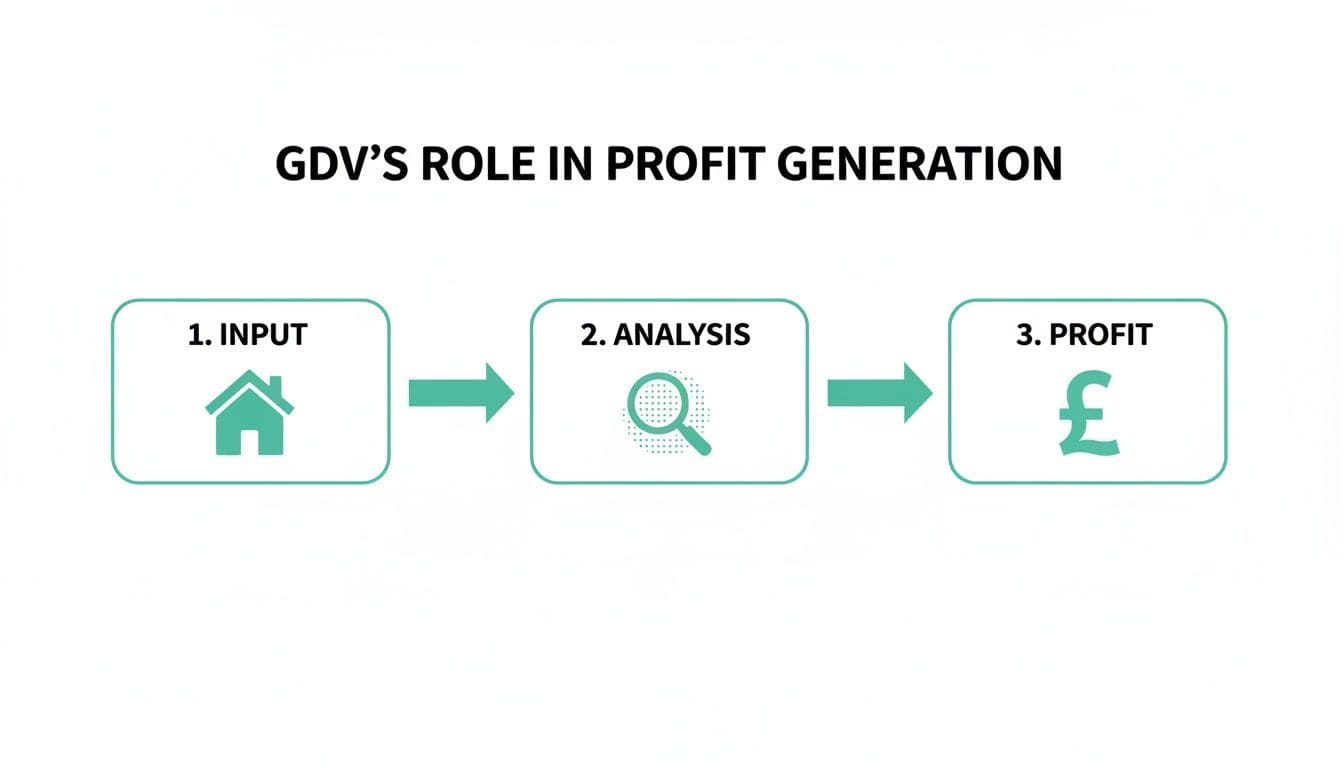
Without a solid number here, the whole deal falls apart.
Example 1: The Bristol Flip
Imagine you've found a tired, three-bedroom semi-detached house in a decent Bristol suburb. The plan is a classic flip: new kitchen, new bathroom, fresh decor, and a garden tidy-up to boost kerb appeal. Your job is to calculate a realistic GDV to make sure there's a worthwhile profit after all your costs.
Your best friend here is comparable evidence, or 'comps'.
- Step 1: Get onto Rightmove and Zoopla. You're looking for at least three similar three-bed semis that have actually sold within the last six months, and ideally within a half-mile radius.
- Step 2: Be ruthless with your filtering. Only look at properties refurbished to the standard you're aiming for. Ignore the wrecks, and ignore the ones with massive extensions that your project won't have.
- Step 3: Analyse the sold prices. Let's say you find three perfect comps that sold for £345,000, £350,000, and £355,000. A sensible, evidence-backed GDV for your project would be around £350,000. Claiming a higher figure without hard evidence is one of the most common mistakes developers make.
A well-researched GDV isn't just an average of nearby sales. It's an interpretation. You're adjusting for slight differences in condition, the quality of the finish, and whether your property is on the nicer side of the street compared to your comps.
Example 2: The Liverpool BRRRR Project
Now for a different strategy. Let's say you're doing a 'Buy, Refurbish, Rent, Refinance, Repeat' (BRRRR) on a terraced house in Liverpool. Here, the GDV has two jobs: it sets the capital value for your refinance mortgage, and it proves the property's rental potential.
For a BRRRR, your calculation needs two layers:
- Sales GDV: You do exactly what we did in Bristol. Find sold prices for recently refurbished terraced houses nearby to establish the capital value. Let's say your research points to £180,000.
- Rental GDV: This is just as important. You need to prove the property can generate a solid income. Look for current rental listings for similar quality homes on the same streets. If you see that smart, refurbished terraces are consistently letting for £900 per month, that figure directly supports your capital valuation.
When the lender sends their surveyor, they'll be checking both of these figures. They'll only agree with your £180,000 valuation if they also believe the £900 monthly rent is achievable. Why? Because the rent underpins the entire investment's viability.
This dance between the sales and rental values is what makes or breaks a BRRRR deal. It also shows how versatile the GDV concept is. And of course, to get your refurbishment numbers right in the first place, you'll need a good handle on the current building costs per square metre to make sure your budget is grounded in reality.
How GDV Unlocks Property Development Finance
For any UK property developer, the GDV calculation isn't just a number for your internal spreadsheets. It's the single most important figure you'll present to a lender. It tells them everything they need to know about your project's potential and, ultimately, whether they'll open their wallets.
Think of it this way: your GDV is the key that unlocks the funding you need to get spades in the ground.
Lenders use your Gross Development Value to work out how much they're willing to lend. This is done through a critical metric called Loan to GDV (LTGDV).

This ratio, always shown as a percentage, represents the maximum loan they'll offer against the project's estimated final value.
Understanding Loan to GDV
You can think of LTGDV as a lender's safety buffer. By lending a percentage of the final value, they ensure there's enough equity in the deal to cover their loan, even if costs overrun or the market takes a slight dip.
For instance, a specialist development finance lender might offer up to 70% LTGDV. If your meticulously researched GDV is £1,000,000, the absolute maximum loan you could secure is £700,000. This single loan has to cover everything—site purchase, construction, and all the professional fees along the way.
The credibility of your GDV calculation directly impacts the loan offer. A well-evidenced GDV builds lender confidence, potentially leading to better terms. A weak, optimistic GDV will be quickly challenged by their surveyor, often stopping a deal in its tracks.
A strong application is always supported by robust, real-world comparable evidence. To get a better handle on funding, check out our guide on the different property development finance options available in the UK.
GDV in a Volatile Market
Getting your GDV right becomes even more critical when the market is choppy. UK property has seen some dramatic swings. By Q4 2024, the market was in a cautious recovery, with house prices rising 3.6% year-on-year. But this followed a major downturn in 2023, where mortgage approvals plummeted by 31.7% as the Bank of England held rates firm at 5.25%.
These kinds of shifts directly impact your end values, and lenders need to see that you've factored this uncertainty into your projections. You can get more context on these trends by reading this in-depth analysis of UK house price history.
This is where a compelling case is essential. When you present a project, you're not just justifying the end value; you're showing the lender your scheme is resilient enough to withstand market shifts during the build. A high-quality, well-researched GDV analysis proves you understand the risks you're asking them to share.
Using GDV to Forecast Profit and Analyse Deals
Securing a loan is one thing, but the real power of GDV in property lies in how you use it to analyse your own deal. It's the number you work backwards from to make sure a project is actually worth your time, risk, and capital.
Experienced developers don't just find a site and hope the numbers work. They start with the end in mind, using the GDV to anchor every single decision, starting with the most important one: how much to pay for the land or property in the first place.
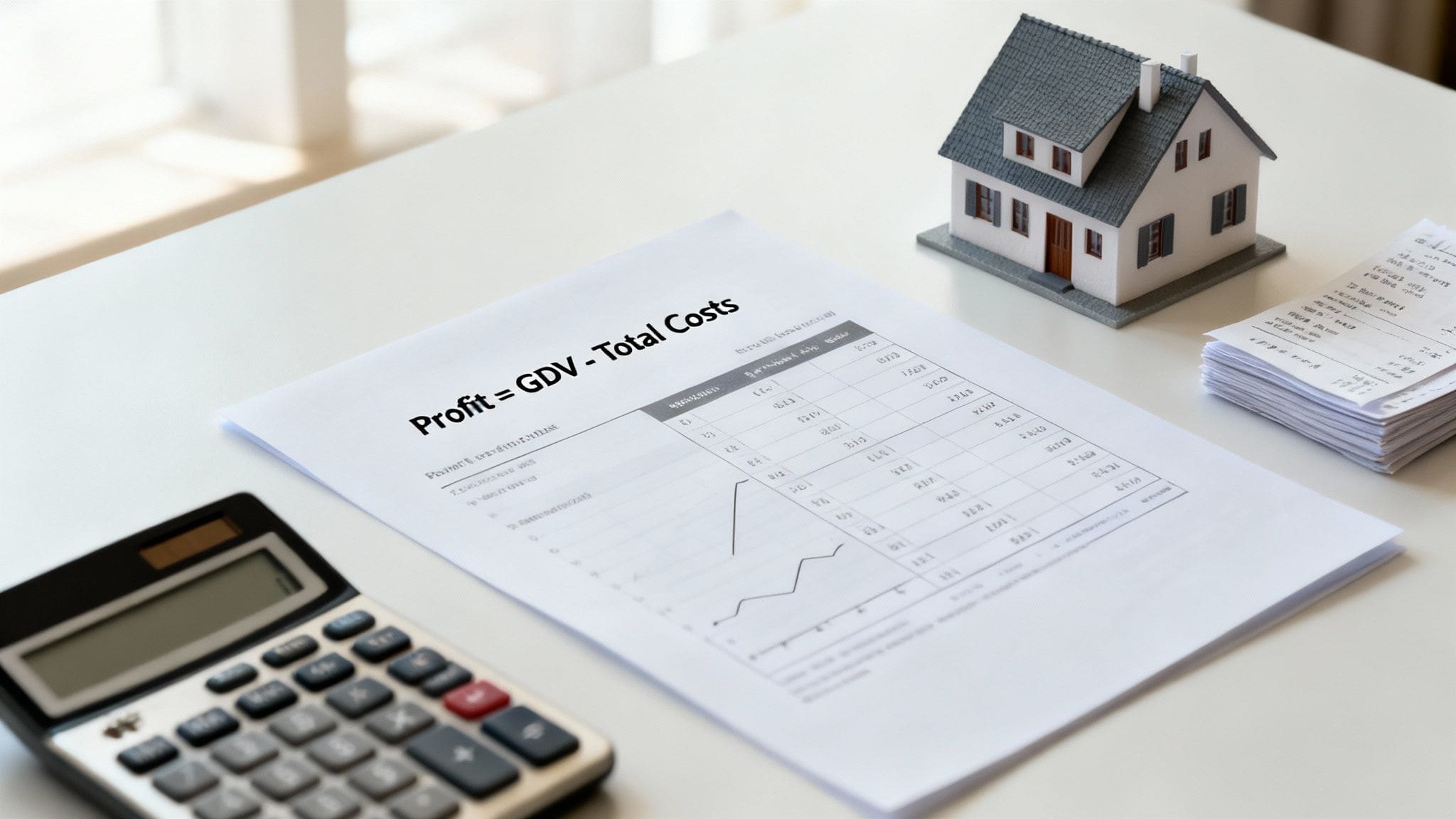
The entire process boils down to one beautifully simple piece of logic that should be at the heart of every appraisal you do.
Profit = GDV - Total Costs
This isn't just a formula; it's the bridge connecting your final sales price (GDV) to every pound you'll spend on the purchase, construction, professional fees, finance, and eventual sale. Getting this right is what separates strategic developers from hopeful speculators.
The 20 Percent Profit Rule
In the UK development world, there's a well-established rule of thumb: your target profit should be at least 20% of the GDV. This isn't just an arbitrary target; it's a critical benchmark that keeps both you and your lender happy.
For you, a 20% profit margin is the reward for taking on all the risk, time, and stress a development project entails. For the lender, it's a vital safety net. They need to see that if the market softens or costs creep up, there's enough fat in the deal to absorb the hit without putting their loan at risk. A deal showing a wafer-thin 5% or 10% margin is often seen as too risky to touch.
You can get a better feel for how these returns are measured with a good UK-focused property ROI calculator, which helps put all the numbers in context.
Working Backwards to Find Your Maximum Offer Price
This is where understanding GDV in property becomes your secret weapon. Instead of falling for a property and trying to make the numbers fit, you can use the profit formula to calculate the absolute maximum you can afford to offer.
Let's walk through a real-world example.
- Estimated GDV: After solid research, you're confident the finished development will sell for £500,000.
- Target Profit (20% of GDV): £500,000 x 0.20 = £100,000. This is your non-negotiable profit target.
- Estimated Total Costs (excluding purchase): You've budgeted £150,000 for the build, fees, and finance.
Now, you simply rearrange the profit formula to solve for the missing piece: the purchase price.
Maximum Purchase Price = GDV - Total Costs - Target Profit Maximum Purchase Price = £500,000 - £150,000 - £100,000 = £250,000
The answer is crystal clear. To hit your target profit, the most you can pay for this site is £250,000. Every pound you bid over that number comes directly out of your own pocket, increasing your risk and making the entire venture less worthwhile.
By analysing deals this way, you walk into negotiations armed with a clear, data-driven walk-away price.
Avoiding Common GDV Mistakes and Pitfalls
Getting your GDV wrong can torpedo a project before it even starts. An optimistic guess turns a promising deal into a financial headache, and it's your main defence against overpaying for a site or under-profiting on the exit.
A robust forecast is so much more than just averaging out a few local sales. It's a carefully adjusted figure that accounts for the hidden costs and market realities that catch out inexperienced developers.
The most common trap is simply forgetting to deduct the costs of actually selling the thing. Your real top-line revenue isn't the sale price; it's what's left in the bank after you've paid everyone who helped you sell it. A GDV that looks strong on paper can quickly crumble once you factor in these inevitable deductions.
Factoring in the Costs Everyone Forgets
To build a financial model that's actually resilient, you have to be honest about the costs that will eat into your final sales figures.
- Estate Agent Fees: In the UK, you're typically looking at 1% to 2.5% of the sale price, plus VAT. On a £400,000 flat, that's a hit of up to £12,000 straight off the top.
- Legal Fees: You'll need a solicitor to handle the conveyancing when you sell. It's a non-negotiable cost that needs to be in your budget from day one.
- Buyer Incentives: In a sticky market, you might have to sweeten the deal to get a buyer over the line. This could mean contributing to their Stamp Duty or covering their legal fees. It's smart to consider this a potential cost.
Ignoring these can leave your profit forecast thousands of pounds out of whack. A professional developer plans for these costs from the beginning, rather than treating them as a nasty surprise at the end.
Stress-Testing Your GDV Against Reality
Beyond the raw costs, your GDV has to stand up to the pressures of time and buyer sentiment. A valuation you calculate at the start of a 12-month build might be pure fantasy by the time you're ready to sell, especially if the market takes a turn.
A great GDV isn't just optimistic; it's defensible. It's a figure you can confidently present to a lender's surveyor because it has been stress-tested against potential market shifts, costs, and timing delays.
Take the "new-build premium," for example. It's a real risk. A freshly refurbished or newly constructed property often fetches a higher price, but that premium can vanish almost overnight. The first owner absorbs that initial shine, meaning its resale value a year later could easily be lower. Your GDV needs to reflect what a real-world buyer will pay when your project is finished, not some temporary, inflated figure.
Wider economic pressures also play a huge role. We've seen how affordability challenges have directly impacted what buyers can pay, putting a hard ceiling on end values for investors across the UK. When buyers can't borrow as much, they simply can't pay as much. It's essential to understand the full picture of trends in the UK property market to ground your forecasts in reality.
Streamlining Your Deal Analysis with Technology
In the fast-moving UK property market, speed and accuracy are everything. If you're still spending hours manually pulling comparable sales data and wrestling with complex spreadsheets for every potential deal, you're already behind. This old-school approach isn't just slow; it's riddled with costly human errors that can sink your profit forecasts before you've even made an offer.
A smarter way to work has emerged, built for modern investors who value their time. Instead of juggling multiple websites and data sources, you can now automate the most time-consuming parts of your deal analysis. This is exactly where tools like DealSheet AI become essential for calculating an accurate GDV in property without the manual grind.
From Manual Labour to Instant Insight
Think about it. You find a promising listing online. The traditional process kicks in, demanding hours of work before you can even decide if it's worth a second look. The new approach is fundamentally different.
By leaning on technology, you shift your focus from data entry to data analysis. The goal is to spend less time building the appraisal and more time interrogating the results to make smarter, faster investment decisions.
With a tool like DealSheet AI, you can just upload a property listing from a website or an agent's PDF. The platform gets to work, automatically extracting the key details and running the numbers for you. It generates a comprehensive analysis that includes:
- A data-backed GDV estimate
- Projected refurbishment and purchase costs
- Crucial return metrics like ROI and yield
This lets you move from slow, complex appraisal building to making fast, data-driven decisions with confidence. For investors looking to build a more efficient workflow, understanding how to create a single source of truth for your property data is a game-changer, eliminating scattered information and streamlining your entire process.
Got Questions About GDV? We've Got Answers
To wrap things up, let's tackle a few of the common questions that pop up when developers and investors are getting to grips with GDV.
How Is GDV Different from Market Value?
This is the most common point of confusion, but it's actually quite simple.
Market Value (MV) is what a property is worth right now, in its current state. Think of it as the 'as-is' price. A standard residential mortgage is based on this number.
Gross Development Value (GDV), on the other hand, is a forecast. It's what that same property will be worth in the future, once your planned development or refurbishment is finished. Development finance is almost entirely based on GDV because the lender is funding the creation of that future, more valuable asset.
Who Actually Decides the "Official" GDV?
While you'll always calculate your own GDV to analyse a deal, the 'official' number for any finance application comes from an independent RICS-qualified surveyor. Crucially, they are instructed by the lender, not by you.
Their job is to give an impartial, evidence-based valuation based on your plans, your costings, and solid local market data. A lender will then use the surveyor's GDV figure to work out the final loan they're prepared to offer.
It's a classic case of 'trust but verify'. Lenders need an independent, expert opinion to back up your numbers and protect their own investment. That's why the surveyor's valuation is the one that ultimately counts.
Can You Increase a Project's GDV?
Yes, but any increase needs to be backed up by hard evidence, not just optimism.
You can definitely lift a project's potential GDV by improving the property's specification (think high-end kitchens and bathrooms), adding more usable square footage, or cleverly reconfiguring the layout to squeeze in an extra bedroom.
However, just telling a lender it'll be worth more won't fly. To get them on board with a higher value, you must show them strong comparable evidence—proof that similar, higher-spec properties in the immediate area have recently sold for that premium price.
Ready to stop guessing and start making data-driven decisions? The DealSheet AI app takes the complexity out of calculating GDV and analysing deals. Download it from the App Store and start your free trial today.